Jul 11, 2025
Baskets for observing residue incorporation by earthworms in winter cereals
- Lola Leveau1,
- Thomas Dagbert1,
- Jean Desimpel2,
- Joachim Dumont de Chassart2,
- Aline Fockedey2,
- Fiona Marto2,
- Joy Van Den Broeck2
- 1PEPA lab: Plant Ecology, ecoPhysiology and sustainable Agriculture, Earth & Life Institute, UCLouvain, Louvain-la-Neuve, Belgium;
- 2UCLouvain, Louvain-la-Neuve, Belgium
- Lola Leveau: PhD student;
- Thomas Dagbert: Laboratory technician
- Jean Desimpel: Bioengineer master student
- Joachim Dumont de Chassart: Bioengineer master student
- Aline Fockedey: Bioengineer master student
- Joy Van Den Broeck: Bioengineer master student
- Ecosystem Services indicators



Protocol Citation: Lola Leveau, Thomas Dagbert, Jean Desimpel, Joachim Dumont de Chassart, Aline Fockedey, Fiona Marto, Joy Van Den Broeck 2025. Baskets for observing residue incorporation by earthworms in winter cereals. protocols.io https://dx.doi.org/10.17504/protocols.io.4r3l215xqg1y/v1
License: This is an open access protocol distributed under the terms of the Creative Commons Attribution License, which permits unrestricted use, distribution, and reproduction in any medium, provided the original author and source are credited
Protocol status: Working
We use this protocol and it's working
Created: July 11, 2025
Last Modified: July 11, 2025
Protocol Integer ID: 222319
Keywords: surface residues by earthworm, residue incorporation by earthworm, earthworm basket, surface activity of earthworm, applicable within belgian winter wheat field, earthworm, belgian winter wheat field, agricultural environment, ordinary biodiversity in agricultural environment, straw on the soil, soil, winter cereal, basket, surface residue, surface of the basket, broader observatory initiative
Abstract
The original 'Earthworm Basket' protocol was developed by the French Observatoire Participatif des Vers de Terre (OPVT), as part of a broader observatory initiative on ordinary biodiversity in agricultural environments (OPVT, 2020). The protocol is designed to assess the surface activity of earthworms by placing a basket filled with chopped straw on the soil and monitoring three primary indicators: the presence of casts on the surface of the basket, the presence of middens on the surface of the basket, and the changes in straw cover over time, which serves as an indirect measure of the incorporation of surface residues by earthworms. The current protocol was adapted from the original OPVT protocol by members of the PEPA laboratory (Earth & Life Institute, UCLouvain, Belgium) to make it applicable within Belgian winter wheat fields.
Guidelines
The original OPVT protocol was adapted in 2020 and 2021 by members of the PEPA laboratory (Earth & Life Institute, UCLouvain, Belgium) to make it applicable within Belgian winter wheat fields. Details regarding the modifications made to the original protocol are provided in italics in the following section.
Materials
For each crop field, or experimental zone, prepare:
- 3 standard baskets, accessible to earthworms;
- 1 control basket, fitted with an internal tulle layer to prevent earthworm access;
- 4 x 50 g of dried organic wheat straw (dried at 60°C), chopped into pieces no longer than 5 cm;
- 12 market gardening staples; 4 stakes or sticks with labels indicating the field and basket identifiers;
- 1 liter of tap water in a plastic bottle perforated with small holes in the cap;
- 1 camera or mobile phone for taking photographs.
For one field, the material costs approximately 25€ in Belgium, with costs decreasing if the experiment is repeated, as the baskets are reusable.
Standard baskets consist of a base and a lid that overlap when closed, like a shoe box. Both components measure 50*40*10 cm and are constructed from green plastic-coated wire mesh with 10-12 mm square openings.
Control baskets include an additional inner layer of green tulle fabric (2 mm mesh size) to prevent earthworms from entering the basket. They allow distinguishing straw movements due to the wind or rain from those due to earthworm activity, and to measure potential straw degradation due to meso- and microorganisms.
Standard earthworm basket. The basket is composed of two pieces and opens as a shoe box.
The straw is added once the basket is installed on the field, not before.
Before start
The complete original protocol, labelled “Paniers à vers de terre”, was initially available on the OPVT website but has since been removed (OPVT, 2015).
Details regarding the modifications made to the original protocol by the PEPA team are provided in italics in the following sections.
Experimental Season
In-field observations last for a four-month period, from the beginning of March to the end of June.
This period is chosen instead of the original six-month window proposed by the OPVT (October to March) to suit the agronomic context of Belgian winter cereal crops. In Belgium, winter cereals are sown over a wide range of dates, from early October to early December. This variability would either
- lead to substantial differences in observation start dates between fields if baskets are installed immediately after sowing in each field, or
- create substantial differences in the time elapsed since the last soil mechanical disturbance – i.e. seedbed preparation – if baskets are installed simultaneously across all fields, after the final sowing operations.
By beginning observations in March, baskets can be installed on the same day in all fields, and the time since last mechanical disturbance is less different between crops as some time has already passed since sowing.
Field Installation
In each crop field, the experimental area consists of a one-hectare square plot. The control basket is placed at the center of the plot, while the three standard baskets are placed at the corners of an equilateral triangle centered on the control basket, each located 30 meters from it.
Experimental plot for a one-hectare square area in a crop field, with three normal baskets
(1, 2 and 3) and one control basket (c).
All baskets are installed outside of tractor wheel tracks to prevent damage, as the experiment extends over several months during which tractors may enter the field for fertilizer or pesticide applications. If mechanical weeding operations are planned during the experimental period, mark each basket with a one-meter-high flag so that the farmer can easily identify their locations and adjust machinery to avoid the baskets.
For each basket, the same day, at the beginning of March:
Remove all plants within a area of 50 x 30 cm, aligning the long side of the rectangle parallel to the crop rows. If necessary, level the soil by lightly scraping it with the bottom of the basket or a garden tool to creat a horizontal surface.
Place the base of the basket on the leveled soil. Secure it to the ground using three market gardening staples, ensuring close and even contact between the bottom of the basket and the soil surface.
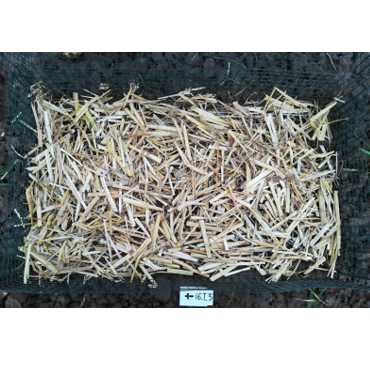
Fill the basket base with 50 g of straw, distributing it evenly to form a uniform layer.
Filling of the basket with 50 g of dried and chopped straw
Sprinkle the straw with 25 cl of water. This simulates a light rainfall and helps keep the straw in place, reducing displacement by wind.
Take an initial photograph of the straw layer, with the objective positioned horizontally above the basket.
Close the basket with its lid.
Insert the labeled stake through the wire mesh at the upper left corner of the basket and push it into the ground. This placement stabilizes the lid and helps prevent disturbance by hares or other animals.
Photograph of a normal basket without its lid, at the beginning of the experiment.The labeled stake is on the bottom of the photograph. Photograph credit: Aline Fockedey, 2020.
Field Measurements and Final Indicators
Two options are proposed for field measurements:
Bi-monthly visits: Conduct visits every two weeks to monitor the temporal dynamics of earthworm surface activity, as well as the cumulative outcome by the end of the experiment. This approach follows the original OPVT protocol.
Two visits: Conduct only two field visits — one to install the experiment and one at the end of the observation period - to measure the cumulative surface activity of earthworms over the entire experiment. We added this option as it allows for the collection of data on earthworm activity across a large number of crop fields in a time- and cost-efficient manner.
First option: temporal dynamics and final result of earthworm surface activity
Twice per month, i.e. every 15 days, open the lid of each basket and:
- Take a photograph of the straw layer.
- Estimate the percentage of straw remaining on the surface, in increments of 10%. NB The original OPVT protocol classified straw cover into only five categories: >40%, 39-25%, 24-15%, 14-1%, and 0% as the protocol was mainly designed for general public sensibilization and not for research and results analysis. Here, a system with 10 classes (100-91%, 90-81%,…,10-0%) is proposed to provide more precise data and facilitate statistical analysis.
- Record the presence of new middens and casts, as well as the disappearance of previously observed middens and casts.
Example of basket during an experiment, with middens and casts. earthworm middens are recognizable by their cone-shaped “campfire” appearance, and the straws that enter an earthworm burrow in the middle of the straw pile. Source: OPVT, 2015
At the end of the experiment (end of June), for each basket:
- Take a final photograph of the straw layer.
- Collect the remaining straw into a plastic bag.
- Remove the basket, stake, and staples.
- Rinse the straw with tap water to remove soil aggregates and dust.
- Dry the straw at 60°C for three days.
- Weigh the dried straw.
NB: Steps 2 to 6 were added to the OPVT protocol to obtain a direct measure of straw incorporation by weight. This result is a continuous variable, which is advantageous for statistical analyses. Moreover, weighing requires minimal expertise, unlike the identification of earthworm middens and casts. Finally, compared to straw surface estimates, straw mass is also less prone to bias, as the same surface coverage may correspond to different quantities of straw depending on the thickness of the layer formed by wind redistribution or faunal activity.
This version of the experiment provides the following result variables, obtained from the standard baskets:
- Number of casts appearing at each time point, and number of casts formed over the entire experiment.
- Number of middens appearing at each time point, and number of middens formed over the entire experiment.
- Percentage of straw surface remaining at each time point, and at the end of the experiment.
- Total dry weight of straw remaining at the end of the experiment.
The last two variables can also be expressed as the surface area and mass of straw incorporated (i.e. disappeared from the surface) during the experiment, calculated by subtracting the final values from the initial values: 100% for surface and 50 g for dry weight.
Second option: final result of earthworm surface activity only
At the end of the experiment, for each basket:
- Take a final photograph of the straw layer.
- Collect the remaining straw into a plastic bag.
- Remove the basket, stake, and staples.
- Rinse the straw with tap water to remove soil aggregates and dust.
- Dry the straw at 60°C for three days.
- Weigh the dried straw.
NB: Steps 2 to 6 were added to the OPVT protocol to obtain a direct measure of straw incorporation by weight. This result is a continuous variable, which is advantageous for statistical analyses. Moreover, weighing requires minimal expertise, unlike the identification of earthworm middens and casts. Finally, compared to straw surface estimates, straw mass is also less prone to bias, as the same surface coverage may correspond to different quantities of straw depending on the thickness of the layer formed by wind redistribution or faunal activity.
This version of the experiment provides the following result variables, obtained from the standard baskets:
- Total percentage of straw surface remaining at the end of the experiment.
- Total dry weight of straw remaining at the end of the experiment.
The last two variables can also be expressed as the surface area and mass of straw incorporated (i.e. disappeared from the surface) during the experiment, calculated by subtracting the final values from the initial values: 100% for surface and 50 g for dry weight.
Protocol references
OPVT: Observatoire Participatif des Vers de Terre. The OPVT is managed by the observatory of the University of Rennes (OSUR CNRS), in collaboration with the Museum National d'Histoire Naturelle (CERSP, UMR 7204). Rennes, France.
OPVT. (2015).
Paniers à Vers de Terre - Comment observer facilement les activités de surface des lombriciens? - Guide de terrain. Université de Rennes 1/CNRS - OSUR - UMR Ecobio. https://ecobiosoil.univ-rennes1.fr/page/protocole-participatif-paniers-a-vers-de-terre [broken link, original location of the protocol]
OPVT. (2020).
Accueil - EcoBioSoil. https://ecobiosoil.univ-rennes1.fr/OPVT_accueil.php
PEPA lab: Plant Ecology, ecoPhysiology and sustainable Agriculture. This laboratory is part of the Earth & Life Institute, from the university UCLouvain, Louvain-la-Neuve, Belgium. https://pepa-lab.github.io/
Master's theses of Aline Fockedey, Joachim Dumont de Chassart and Joy Vanden Broeck [FR]: available on the Dial platform https://dial.uclouvain.be/memoire/ucl/fr/home or request through Lola Leveau.
Acknowledgements
We would like to thank the OPVT for the original protocol and their help at the beginning of our experiments when we had questions, and the 20 Belgian farmers that provided access to 60 crop fields to test this protocol between 2020 and 2023.