Apr 07, 2026
Version 3
Bacterial Nucleic Acid Extraction Protocol Adapted for a Resource-Limited Setting V.3
- Bonie Datul1
- 1National Institute of Molecular Biology and Biotechnology (BIOTECH), University of the Philippines Los Baños



Protocol Citation: Bonie Datul 2026. Bacterial Nucleic Acid Extraction Protocol Adapted for a Resource-Limited Setting. protocols.io https://dx.doi.org/10.17504/protocols.io.14egnr5rml5d/v3Version created by Bonie B. Datul
License: This is an open access protocol distributed under the terms of the Creative Commons Attribution License, which permits unrestricted use, distribution, and reproduction in any medium, provided the original author and source are credited
Protocol status: Working
We use this protocol and it's working
Created: April 07, 2026
Last Modified: April 07, 2026
Protocol Integer ID: 314572
Keywords: bacteria, DNA extraction, low-cost, low-tech , bacterial dna extraction protocol, bacterial nucleic acid extraction protocol adapted, available bacterial dna extraction kit, limited laboratory, tech laboratory, thesis experiments without external funding, bacterial total nucleic acid extraction protocol, dna extraction, dna, laboratory
Abstract
Commercially available bacterial DNA extraction kits, while readily available in the market, are still quite relatively costly; especially for student-researchers who are conducting thesis experiments without external funding. This bacterial total nucleic acid extraction protocol is based on common solution-based methods and adapted for a resource-limited laboratory, minimizing the need for specialized equipment.
Guidelines
This protocol provides a workflow for isolating high-quality total nucleic acids from bacteria using standard benchtop equipment and widely available reagents. It is specifically optimized for laboratories where advanced automated extraction systems or specialized commercial kits are unavailable, prioritizing solution-based lysis and ambient-temperature steps without compromising yield.
Materials
Consumables:
- 1.5 mL microcentrifuge tubes, fresh and sterile
- Pipette tips (blue, yello, and white), sterile
Reagents:
- Ethanol, absolute (≥99%)
- Ethanol, 70%
- Lysis Buffer (To prepare: In 3.0 mL sterile distilled water, mix in 5.0 mL 10X TE Buffer and 2.0 mL 5% SDS.)
- Lysozyme, 50mg/mL
- NaCl, 5.0 M
- Nutrient Broth
- Proteinase K, 20mg/mL
- Resuspension Buffer (To prepare: In 7.0 mL sterile distilled water, add 1.0 mL 100 mM Tris-HCl and 2.0 mL 50 mg/mL lysozyme. Vortex to mix.)
- SDS (sodium dodecyl sulfate), 5%
- TE Buffer, 1X working solution
- Tris-HCl, 10 mM
- Tris-EDTA (TE) Buffer, 10X stock solution
Safety warnings
CAUTION: While this method is adapted for basic laboratories, precise incubation temperatures are still critical for enzymatic lysis (e.g., Lysozyme or Proteinase K steps). If a calibrated water bath is unavailable, monitor temperature manually with a thermometer to avoid denaturing the DNA or inactivating the enzymes prematurely.
NOTE: In the absence of refrigerated high-speed centrifugation, the removal of supernatant must be performed with extreme care. Residual ethanol from wash steps is a common inhibitor for downstream PCR; ensure a complete air-drying step (5–10 minutes) before final elution.
Before start
Since this protocol utilizes non-kit reagents, ensure all buffers are prepared with deionized or triple-distilled water. The absence of commercial stabilizers means reagents are more susceptible to microbial growth; always filter-sterilize or autoclave solutions before use to prevent DNA degradation by exogenous DNases.
Bacterial Culture
3m
Inoculate a loopful of bacteria in 5 mL of Nutrient Broth. Incubate Overnight at Room temperature with shaking.
Transfer 1.5 mL of the overnight bacterial culture into a sterile fresh 1.5-mL microcentrifuge tube.
Harvest the cells by centrifuge at 12.000 rpm for 00:03:00 . Carefully pour off or pipette out the supernatant, leaving the cell pellet.
3m
Optional, if low cell yield. Onto the same tube, repeat steps 2 and 3.
Cell Lysis
1h 50m
Resuspend the bacterial cell pellet with 150 µL Resuspension Buffer. Pipette up and down vigorously to disperse the cells. Incubate at 37 °C for 00:15:00 .
15m
Add 150 µL freshly prepared lysis buffer. Vortex vigorously to mix well. Incubate at 37 °C for 00:30:00 .
30m
Optional RNase Treatment. Add 5.0 µL RNase A (10 mg/mL ) to the suspension. Vortex to mix well. Incubate at 37 °C for 00:15:00 .
15m
Add 10 µL Proteinase K (20 mg/mL ) to the suspension. Vortex to mix well. Incubate at 65 °C for 00:20:00 , vortex gently every 5 minutes.
Note
Lysate should be clear at the end of incubation. Otherwise, extend the incubation time to 30 minutes or until the lysate clarifies.
20m
Protein Precipitation (Salting Out)
13m
Cool the lysate to room temperature. Then add 35.0 µL of 5.0 Molarity (M) NaCl solution (approximately 0.5 Molarity (M) final salt concentration).
Mix thoroughly by inverting the tube 10-20 times. Or vortex gently for 5
seconds, to avoid shearing of DNA.
Incubate On ice for 00:10:00 . (Critical in the precipitation of proteins and cell debris).
10m
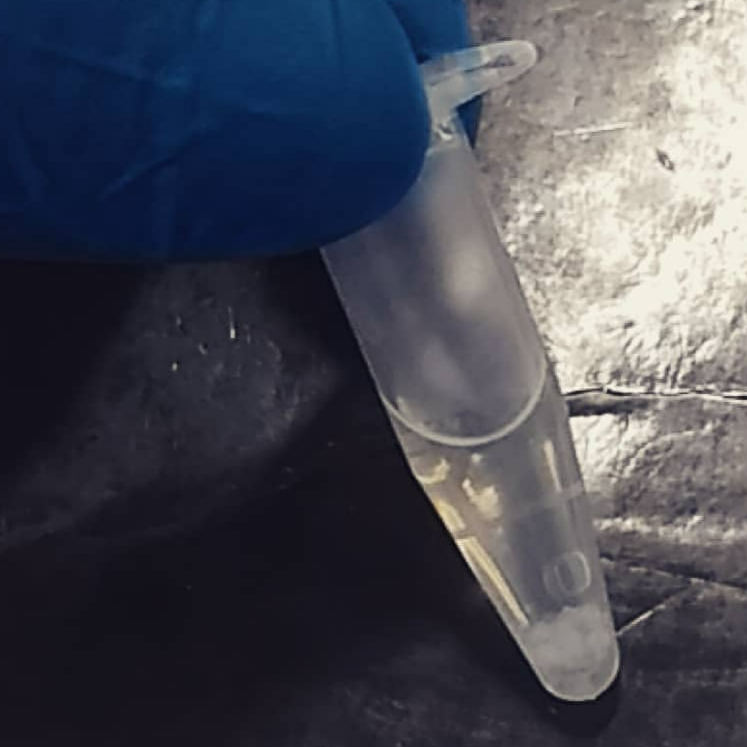
Centrifuge at 14.000 rpm for 00:03:00 . A white pellet (protein and cell debris) should be visible at the bottom.
Expected result
A white pellet (protein and cell debris) should be visible at the bottom of the tube. If not, place the tube on ice for 5-10 minutes. After which, the pellets should be observable.
3m
DNA Precipitation
3m
Carefully transfer 250 µL of the supernatant (which contains the DNA) to a new, clean 1.5-mL tube. Be careful not to transfer any of the white protein pellet!
Incubate On ice for 00:30:00 , or even longer (e.g. Overnight at -20 °C ) for better yield. Cold temperature enhances DNA precipitation.
Add 500 µL ice-cold absolute ethanol. Mix gently by inverting the tube slowly until DNA strings become visible (often looks like fine white threads). This may take several inversions. (If DNA concentration is low, the DNA strings may not be visible).
Note
Pause Point: You can stop at this point, store your samples at –20°C, and complete the procedure later.
Mix again gently by inverting the tube a few times. Centrifuge at 14000 rpm for 00:03:00 .
Expected result
A visible white DNA pellet should form at the bottom or side of the tube.
3m
DNA Washing
8m
Add 500 µL cold 70% ethanol to the tube. Mix gently by inverting the tube a few times to wash the DNA. Centrifuge at 14.000 rpm for 00:03:00 (at 4 °C , if available).
Note
Tip: Orient tubes in an equal fashion to facilitate subsequent removal of supernatant without disturbing resultant DNA pellet.
Carefully pour off or pipette out the supernatant, being careful not to disturb/lose the DNA pellet.
Note
The DNA pellet at this stage is very loose and difficult to see.
Repeat Steps 16 and 17.
After the final wash, carefully remove as much of the remaining ethanol as possible. You can use a fine-tipped pipette to aspirate small droplets.
Note
If you can't remove all the ethanol, that is ok. It is better to leave some ethanol than risk sucking up your DNA!
DNA Drying
45m
Air-dry the DNA pellet at room temperature in a laminar flow hood with the motor on for 00:10:00 -00:20:00 or in a dry bath/heat block at 37 °C for 00:05:00 -00:10:00 , until all visible ethanol has evaporated. The pellet might become translucent.
Note
Do not over-dry, as this can make the DNA difficult to resuspend.
45m
DNA Rehydration/Elution
10m 10s
Preheat 1x TE buffer (8.0 ) at 65 °C for 00:10:00 . This helps the DNA dissolve faster.
10m
Add 50-100 µL of the preheated TE buffer to the DNA pellet.
Gently tap the tube or flick it to resuspend the DNA. Avoid vigorous vortexing, which can shear long DNA molecules.
The DNA should dissolve, forming a clear solution. Centrifuge at 5000 rpm for 00:00:10 to pool the elution at the bottom of the tube.
10s
Store the DNA at 4 °C for short-term use or at -20 °C for long-term storage.
Protocol references
1. Zumbo P. 2013. Ethanol Precipitation. Laboratory of Christopher E. Mason, Ph.D., Department of Physiology and Biophysics. Weill Cornell Medical College.
2. Doyle JJ and Doyle JL. 1987. A rapid DNA isolation procedure for small quantities of fresh leaf tissue. Phytochemistry Bulletin 19:11-15.
3. Promega. DNA Purification. https://worldwide.promega.com/resources/guides/nucleic-acid-analysis/dna-purification/
4. Oswald N. 2025. 5 ways to Damage DNA. https://bitesizebio.com/7445/5-ways-to-damage-dna/
5. Oswald N. 2025. DNA Precipitation Protocol: Ethanol vs Isopropanol. https://bitesizebio.com/2839/dna-precipitation-ethanol-vs-isopropanol/
6. Elmesmery M. 2025. 7 Different DNA Extraction Methods. https://praxiabio.com/en/blog/2022/08/24/7-different-dna-extraction-methods/
7. Gand M, Bloemen B, Vanneste K, Roosens NH, De Keersmaecker SCJ. 2023. Comparison of 6 DNA extraction methods for isolation of high yield of high molecular weight DNA suitable for shotgun metagenomics Nanopore sequencing to detect bacteria. BMC Genomics 24(1):438. doi: 10.1186/s12864-023-09357-5. PMID: 37537509; PMCID: PMC1040187. https://bmcgenomics.biomedcentral.com/articles/PMC1040187/
8. GIT - Bacterial DNA Extraction. https://www.vivantechnologies.com/index.php?option=com_content6view=article6id=875:gf-1-bacterial-dna-extraction-kit6catid=89:gf-1-nucleic-acid-extraction-kits6Itemid=44
9. Price JL, Kuyzk MA, Hardie DB, Yang J, Smith DS, Jackson AM, Parker CE, Borchers CH. 2010. A quantitative study of the effects of chaotropic agents, surfactants, and solvents on the digestion efficiency of human plasma proteins by trypsin. J Proteome Res. 9(10):5422-37. doi: 10.1021/pr100650u. PMID: 20722421; PMCID: PMC2964461. https://pubs.acs.org/doi/abs/10.1021/pr100650u
10. Smith B, Edgar MA, Clarke SC. 2003. Comparison of commercial DNA extraction kits for extraction of bacterial genomic DNA from whole-blood samples. J Clin Microbiol. 41(6):2440-3. doi: 10.1128/JCM.41.6.2440-2443.2003. PMID: 12791861; PMCID: PMC1565197.
11. Proteinase K: Introduction 6 Applications. https://www.sigmaaldrich.com/PH/en/technical-documents/technical-article/genomics/dna-and-rna-purification/introduction-to-proteinase-k-and-its-applications
12. Detergents for Cell Lysis and Protein Extraction. https://www.thermofisher.com/us/en/home/life-science/protein-biology/protein-biology-learning-center/protein-biology-resource-library/pierce-protein-methods/detergents-cell-lysis-protein-extraction.html
13. Campanella J and Mellerick D. 2024. DNA Isolation. https://www.ebsco.com/research-starters/health-and-medicine/dna-isolation
14. Nkuna R, Ijom G, Matambo TS. 2022. Applying EDTA in Chelating Excess Metal Ions to Improve Downstream DNA Recovery from Mine Tailings for Long-Read Amplicon Sequencing of Acidophilic Fungal Communities. J Fungi (Basel) 8(5):419. doi: 10.3390/jof8050419. PMID: 35628675; PMCID: PMC9143545. https://www.mdpi.com/articles/PMC9143545/
15. Proteinase K. https://www.takarabio.com/products/cloning/nucleic-acid-extraction/proteinase-k#select-Proteinase%20K%20can%20be%20used%20to%20che%20%20perm%20in%20food
16. RNase A solution. https://worldwide.promega.com/products/biochemicals-and-labware/biochemical-buffers-and-reagents/rnase-a-solution/?catNum=A7973
17. Kennedy S. 2024. A Complete Guide to How Nucleic Acid Extraction Kits Work. https://bitesizebio.com/13516/how-dna-extraction-kits-work/
18. Invitrogen™ PureLink™ Genomic DNA Mini Kit. https://www.fishersci.ca/shop/products/invitrogen-purelink-genomic-dna-mini-kit-3/182800
19. DNA Purification. https://worldwide.promega.com/resources/guides/nucleic-acid-analysis/dna-purification/
20. Sodium Dodecyl Sulfate. https://worldwide.promega.com/products/biochemicals-and-labware/biochemical-buffers-and-reagents/sodium-dodecyl-sulfate--molecular-biology-grade--sds-/?catNum=H5113