Apr 30, 2025
Automated high throughput Qiagen MagAttract High Molecular Weight DNA extraction from mosquitoes
- 1Wellcome Sanger Institute



Protocol Citation: Fiona Teltscher, Mara Lawniczak 2025. Automated high throughput Qiagen MagAttract High Molecular Weight DNA extraction from mosquitoes. protocols.io https://dx.doi.org/10.17504/protocols.io.ewov1o1n7lr2/v1
License: This is an open access protocol distributed under the terms of the Creative Commons Attribution License, which permits unrestricted use, distribution, and reproduction in any medium, provided the original author and source are credited
Protocol status: Working
We use this protocol and it's working
Created: March 10, 2023
Last Modified: April 30, 2025
Protocol Integer ID: 78445
Keywords: magattract, high molecular weight DNA, hmw DNA extraction, kingfisher, high-throughput, dna from insect, extracted hmw dna, dna yield, sheared dna, single anopheles mosquito, chromiumtmgenome reagent kits user guide, quantity of dna, ng of dna, hmw dna, more dna, mb genome, protocol for the extraction, dna, qiagen magattract kit, mosquito, high molecular weight, extraction, preserved specimen, small specimen size
Funders Acknowledgements:
Wellcome
Grant ID: 220540/Z/20/A
Bill and Melinda Gates Foundation
Grant ID: INV-009760
Abstract
This is an automated protocol for the extraction of high molecular weight (HMW) DNA from insects. It uses the Qiagen MagAttract kit and factors in modifications described in the ChromiumTMGenome Reagent Kits User Guide pages 6-8 (https://support.10xgenomics.com/genome-exome/library-prep/doc/user-guide-chromium-genome-reagent-kit-v2-chemistry). Due to small specimen size, we need to maximize DNA yield. so we also do a double elution to release more DNA.
DNA resulting from this protocol can be further sheared and cleaned for successful PacBio HiFi sequencing. In our experience, a single Anopheles mosquito preserved using best practices (snap frozen from living) weighing 2-3 mg yields about 600-800 ng of DNA using this protocol. Following shearing using g-tubes (Covaris) or the MegaRuptor and SPRI based clean up, we typically retain about 200 ng of sheared DNA, which is just about sufficient to reach 25x coverage PacBio HiFi of a 250 Mb genome. The quality and quantity of DNA is best when starting with a snap frozen from living specimen. However, we have also successfully extracted HMW DNA using this protocol from 100% ethanol and DESS (DMSO salt solution) preserved specimens held at room temperature for as long as a week, as long as the specimen was gently squished to ensure rapid penetration of the preservative.
This protocol has been used successfully on a wide range of arthropod species as part of the Tree of Life Programme at the Wellcome Sanger Institute. Please use the commenting function to share whether this protocol worked or not for your species. If you make modifications to improve this protocol so it works better for your species, please use the forking function in protocols.io to share these adjustments.
Materials
 MagAttract_HMW_Lawniczak_KingFisher_protocolsio.kfx2.9KB
 MagAttract HMW DNA kitQiagenCatalog #67563
KingFisher™ Plastics for 96 deep-well formatThermo Fisher ScientificCatalog #95040450B
Equipment
KingFisher™ Plastics for 96 deep-well format
NAME
KingFisher 96 Deep-well Plate, Barcoded
TYPE
Thermo Scientific™
BRAND
95040450B
SKU
LINK
Equipment
KingFisher™ Plastics for 96 deep-well format
NAME
KingFisher 96 tip comb for deep-well magnets
TYPE
Thermo Scientific™
BRAND
97002534
SKU
LINK
Equipment
KingFisher Apex Benchtop Sample Prep
NAME
Nucleic Acid Purification System
TYPE
Thermo Scientific™
BRAND
5400930
SKU
LINK
Equipment
DNA LoBind® Tubes
NAME
microcentrifuge tubes
TYPE
Eppendorf
BRAND
0030108051
SKU
LINK
Equipment
Pestle for 1.5 mL Microtube, 100/pk
NAME
pellet pestle
TYPE
Cole-Parmer Essentials
BRAND
WZ-44468-19
SKU
LINK
Equipment
Multipette® E3
NAME
multi-dispenser pipette
TYPE
Eppendorf
BRAND
4987000371
SKU
LINK
Equipment
Combitips® advanced
NAME
multi-dispenser pipette tips
TYPE
Eppendorf
BRAND
various sizes
SKU
LINK
Equipment
micropestles
NAME
micropestly
TYPE
Eppendorf
BRAND
EP0030120973
SKU
LINK
Protocol materials
MagAttract HMW DNA kitQiagenCatalog #67563
gDNA 165kb Analysis Kit 275 SamplesAgilent TechnologiesCatalog #FP-1002-0275
Qubit® dsDNA HS Assay KitThermo Fisher ScientificCatalog #Q32854
Quant-iT™ PicoGreen™ dsDNA Assay KitInvitrogen - Thermo FisherCatalog #P11496
Buffer ALQiagenCatalog #67563
1X PBS (Phosphate-buffered saline )
Proteinase KQiagenCatalog #67563
RNase AQiagenCatalog #67563
KingFisher™ Plastics for 96 deep-well formatThermo Fisher ScientificCatalog #95040450B
Nuclease-Free WaterQiagenCatalog #129114
Buffer PEQiagenCatalog #19065
MagAttract Suspension GQiagenCatalog #67563
Buffer MBCatalog #67563
Buffer AEQiagenCatalog #19077
Buffer MW1Catalog #67563
Tape PadsQiagenCatalog #19570
Safety warnings
Buffers AL, MB and MW 1 contain guanidine hydrochloride/guanidine thiocyanate, which can form highly reactive compounds when combined with bleach. DO NOT add bleach or acidic solutions directly to the sample preparation waste. Waste needs to be collected in a suitable vessel and disposed of in accordance local regulations.
Before start
All kit components, buffers and RNase A stock solution can be stored at room temperature (15–25°C) for up to 1 year. The box should be labelled with received date. Mix Buffer AL thoroughly by shaking before use. Buffers MW1 and PE are supplied as a concentrate. Before using for the first time, be sure to add the appropriate amount of ethanol (96–100%) as indicated on the bottle. Many components of the kit are also available from Qiagen separately.
Sample preparation
2h 1m
Prepare an open insulated box of dry ice to store sample tubes on whilst working through steps 2-4
Make mastermix of reagents for lysis.
Note
Make sure to choose the right size of tube for preparing the mastermix.
Calculate the mastermix volumes for the number of samples plus 1 for spare pipetting volume. Volumes per sample are: 200 µL 1X PBS (Phosphate-buffered saline ) ; 20 µL Proteinase KQiagenCatalog #67563 (Mix by inverting the tube 5 times); 4 µL RNase AQiagenCatalog #67563 and 150 µL Buffer ALQiagenCatalog #67563 (mix by inversion)
For each sample, add 374 µL of the mastermix from step 2 into a new 1.5 ml DNA LoBind tube.
Carefully remove the Sample from the sample tube using clean forceps. If the Sample has been stored in a preservation liquid, lightly make contact on a clean piece of tissue to remove surface liquid from the sample. Submerge the sample into the mastermix in tubes (see step 3) with clean forceps. Insert a sterile pestle in the tube and smash, smear, squash, twist, grind the tissue against the wall of the tube for 00:01:00 . There should be no recognisable body parts visible following pestle smashing, only flakes. Place the sample in a tube rack on the bench. Clean forceps with 70-100% ethanol.
Mosquito in tissue lysis buffer.
Tissue disruption with an autoclavable pestle.
Mosquito debris after tissue disruption.
1m
Repeat step 4 for the remaining samples
Briefly spin all samples in a minicentrifuge or similar to collect solution at bottom before next step
Incubate the sample at 25 °C (or room temperature if no heat block is available) for 02:00:00
2h
Preparation of plates for the Kingfisher Apex
2h 50m
Unpack 9 Kingfisher Deepwell 96 well plates
Note
Different plates are available - barcoded and not barcoded, "sterile" (individually wrapped) and standard (wrapped as a set of 5).
Note
While the samples are incubating for two hours, the plates for the Kingfisher Apex can be prepared. We either cover them with clean wipes or proceed to load them onto the Kingfisher to avoid contamination.
Prepare wash buffers included in the MagAttract HMW DNA kitQiagenCatalog #67563 by adding Ethanol to them.
Prepare and fill the plates with Buffer AEQiagenCatalog #19077 , Nuclease-Free WaterQiagenCatalog #129114 , Buffer PEQiagenCatalog #19065 , Buffer MW1Catalog #67563 , MagAttract Suspension GQiagenCatalog #67563 andBuffer MBCatalog #67563 as suggested below:
| A | B | C | D | E | |
| Plate type | Catalog number | Label | Content | Volume | |
| KingFisher 96 deep-well plate and 96 tip comb for deep-well magnets | 95040450 and 97002534 | Magattract tip plate, date and initials | Plate with tip comb | N/A | |
| KingFisher 96 deep-well plate | 95040450 | Elution 2, date and initials | Buffer AE | 200µl | |
| KingFisher 96 deep-well plate | 95040450 | Elution 1, date and initials | Buffer AE | 200µl | |
| KingFisher 96 deep-well plate | 95040450 | NFW Wash, date and initials | Nuclease-free water | 500µl | |
| KingFisher 96 deep-well plate | 95040450 | PE Wash 2, date, initials | Buffer PE | 700µl | |
| KingFisher 96 deep-well plate | 95040450 | PE Wash 1, date, initials | Buffer PE | 700µl | |
| KingFisher 96 deep-well plate | 95040450 | MW1 Wash 2, date, initials | Buffer MW1 | 700µl | |
| KingFisher 96 deep-well plate | 95040450 | MW1 Wash 1, date, initials | Buffer MW1 | 700µl | |
| KingFisher 96 deep-well plate | 95040450 | Sample Plate, date, initials | Suspension G magnetic beads and Buffer MB | 15µl (Suspension G) and 280µl (Buffer MB) |
Note
Kingfisher 96 deep-well plates are available barcoded (B suffix to the catalog number) and not barcoded and packed as a pack of 5 (95040450) and individually wrapped (95040460), either of them will work. The barcode reader inside the machine will time out after about 10 seconds at which point the machine will prompt the user to either try again or move to the next plate.
Note
The type of tip comb depends on what magnet head your instrument has. This protocol will work with either the 96 deep-well head or the 96 combi head, but has only been extensively tested with the deep-well head.
Only fill the wells that you intend to use, but the same well will have to be used for each plate. E.g. you start with a new plate and have 4 samples which you intend to run in wells A1, A2, A3 and A4, so you fill those wells in every plate.
Note
A repeater pipette or multichannel pipette can be helpful when a large number of samples is processed.
Plates should be labelled on the opposite side to the letters to make loading them correctly easier. Marking which wells have been used makes reusing them easier and ensures that wells are not accidentally used again.
Download the programme onto a computer and transfer it to your KingFisher Apex:  MagAttract_HMW_Lawniczak_KingFisher_protocolsio.kfx
MagAttract_HMW_Lawniczak_KingFisher_protocolsio.kfx Equipment
KingFisher Apex System
NAME
Automated DNA purification system
TYPE
ThermoFisher Scientific
BRAND
5400930
SKU
LINK
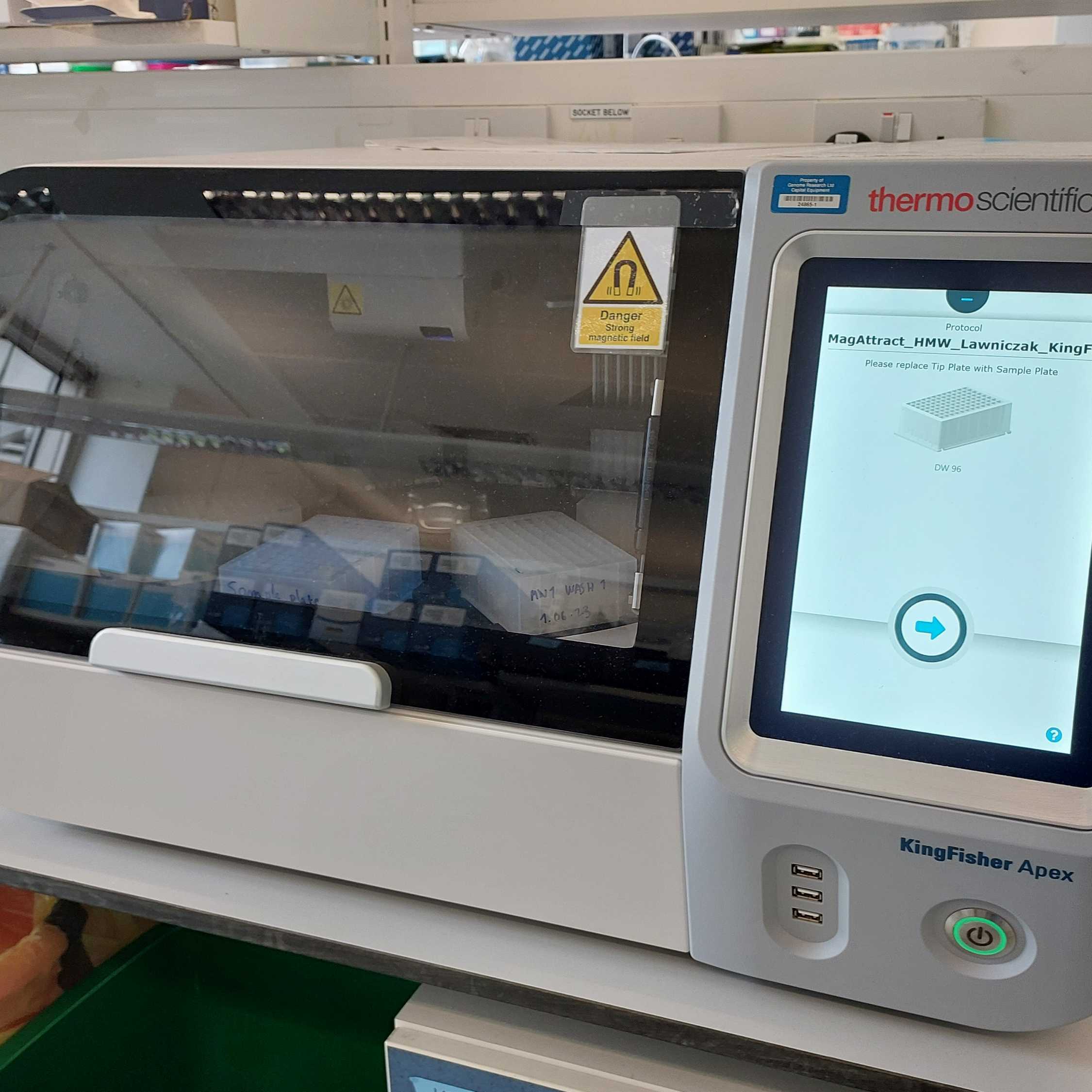
Start your KingFisher Apex and select the correct protocol to run.
Note
We recommend 1 hour of UV light either before or after every run to avoid contamination between runs.
Note
When starting and choosing the programme make sure you have the correct magnet head attached. In this protocol we are using the 96 deep well head and the corresponding tip comb
The software allows you to input batch/lot information for each reagent. This is optional but highly recommended.
Load all but the sample plate onto the instrument.
Once the 02:00:00 incubation time for the sample has elapsed add the sample to the sample plate using wide-orifice pipette tips. Make sure to keep a record which sample was added in which well.
2h
Load the sample plate including the sample onto the instrument and start the programme. It takes about 00:50:00 .
50m
Post-extraction
Once the KingFisher Apex is finished the plates can be removed as prompted. Elution 1 and 2 for each sample can be combined into the same tube (making sure to use wide-orifice tips).
Note
Be careful to combine elution 1 and 2 of the same sample and to not mix up elution 1 and 2 of different samples at this step.
Used plates that still have unused wells can be reused in future runs. Either carefully tip out the waste without contaminating unused wells or keep buffers in.
Note
If you keep the buffer in the wells make sure to reuse the plates soon after as some of the buffers can crystallise and cause the tip comb to not fit into the well anymore, leading to an error message and a potentially failed run.
Mark which wells were used and cover plates with a film, such as Tape PadsQiagenCatalog #19570 . When reusing plates that still have used buffers from previous runs in some wells make sure you only run the same programme with the same volume to avoid spillage in the machine.
Store the extracted gDNA sample at 4 °C . Assess the quantity of DNA extracted using the Qubit® dsDNA HS Assay KitThermo Fisher ScientificCatalog #Q32854 or Quant-iT™ PicoGreen™ dsDNA Assay KitInvitrogen - Thermo FisherCatalog #P11496 and assess the quality of the DNA using the Femto PulsegDNA 165kb Analysis Kit 275 SamplesAgilent TechnologiesCatalog #FP-1002-0275
Protocol references
ChromiumTMGenome Reagent Kits User Guide pages 6-8 (https://support.10xgenomics.com/genome-exome/library-prep/doc/user-guide-chromium-genome-reagent-kit-v2-chemistry).
Qiagen MagAttract Manual
Edel Sheerin, Filipa Sampaio, graeme oatley, Maja Todorovic, Michelle Strickland, Raquel Juliana Vionette do Amaral, Caroline Howard 2023. Sanger Tree of Life HMW DNA Extraction: Automated MagAttract v.1. protocols.iohttps://dx.doi.org/10.17504/protocols.io.x54v9p2z1g3e/v1