Apr 01, 2026
Automated aDNA extraction from human teeth
- Allysson Farias1,
- Sebastião Lacerda Lima Filho1,
- Marcos Tadeu Ellery Frota1,
- José Sousa Júnior1,
- Odnan Lima1,
- Beatriz Freire Guimaraes1,
- Thamires Silva Cavalcante1,
- Letícia Evangelista Tomé da Silva1,
- Maria Elisabete Amaral de Moraes1,
- Juvandi Santos2,
- Manoel Odorico Moraes Filho1
- 1Universidade Federal do Ceará;
- 2Universidade Estadual da Paraíba



External link: https://www.instagram.com/labbat.npdm.ufc/
Protocol Citation: Allysson Farias, Sebastião Lacerda Lima Filho, Marcos Tadeu Ellery Frota, José Sousa Júnior, Odnan Lima, Beatriz Freire Guimaraes, Thamires Silva Cavalcante, Letícia Evangelista Tomé da Silva, Maria Elisabete Amaral de Moraes, Juvandi Santos, Manoel Odorico Moraes Filho 2026. Automated aDNA extraction from human teeth. protocols.io https://dx.doi.org/10.17504/protocols.io.ewov1korogr2/v1
License: This is an open access protocol distributed under the terms of the Creative Commons Attribution License, which permits unrestricted use, distribution, and reproduction in any medium, provided the original author and source are credited
Protocol status: Working
We use this protocol and it's working
Created: January 11, 2026
Last Modified: April 01, 2026
Protocol Integer ID: 238421
Keywords: Ancient DNA, extraction, molecular technique, automation, extracta 32, adna extraction from human teeth ancient dna, human teeth ancient dna, dna extraction, adna extraction, automated adna extraction, degraded ancient dna, dental sample, exogenous dna contamination, archaeological bone, bone sample, respective extraction kit, fine bone powder for downstream processing, extraction plate, specifications of the respective extraction kit, generating fine bone powder, dna yield, resulting dna, chemical decontamination of laboratory surface, dental drill, irradiation of sample, automated extraction protocol, genetic material, dental drill under aseptic condition, concentration nature of the genetic material
Funders Acknowledgements:
Funcap (Pesquisador Visitante)
Grant ID: PVS-0215-00120.01.00/23
FINEP - Pesquisa, Desenvolvimento e Inovação no Diagnóstico, Tratamento e Reabilitação de Pessoas com Doenças Raras (DR)
Grant ID: 1662/22
Abstract
Ancient DNA (aDNA) extraction requires strict contamination control and optimized workflows due to the highly fragmented and low-concentration nature of the genetic material. This protocol describes a standardized procedure for automated aDNA extraction from archaeological dental and bone samples. All pre-extraction steps were conducted under controlled conditions, including chemical decontamination of laboratory surfaces and materials, ultraviolet (UV) irradiation of samples, consumables, and work areas, and the use of protective barriers to minimize exogenous DNA contamination. Archaeological bone and dental samples were mechanically pulverized using a dental drill under aseptic conditions, generating fine bone powder for downstream processing. DNA extraction was performed using a bead-based automated system (Extracta 32), with samples processed on extraction plates according to the specifications of the respective extraction kits. Following incubation, automated extraction protocols were executed, and the resulting DNA was recovered into sterile microcentrifuge tubes. DNA yield and purity were subsequently assessed by UV spectrophotometry using the NanoDrop‱ system. This workflow enables reproducible recovery and quality assessment of highly degraded ancient DNA while reducing manual handling and contamination risk.
Image Attribution
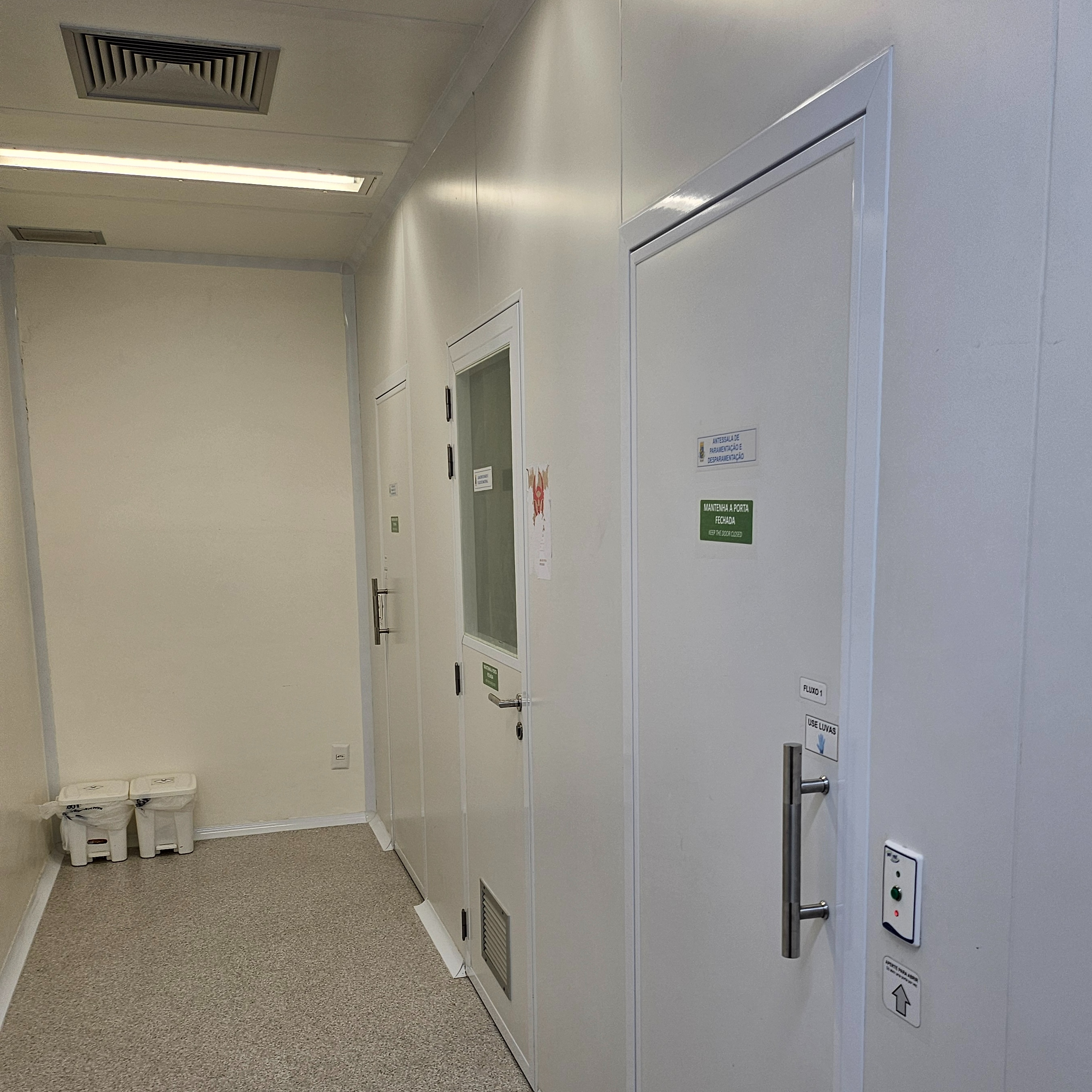
Biosecurity Level 2 (BSL-2) from the NPDM (Drug Research and Development Center in portuguese) in UFC (Federal University of Ceará).
Materials
Reagents
| REAGENT | SUPPLIER | |
| Sodium hypochlorite (10%) | - | |
| Hydrogen peroxide (1:1 dilution in ultrapure water) | Exodo Científica | |
| Ethanol 70% | Exodo Científica | |
| Proteinase K (PK) | Loccus® | |
| Lysis buffer LS3 | Loccus® | |
| Elution buffer | Loccus® | |
| CR reagent (MCFD kit) | Loccus® | |
| Ultrapure water | - | |
| MPTA-MDx DNA Extraction Kit | Loccus® | |
| MCFD DNA Extraction Kit | Loccus® |
Equipments
| EQUIPMENT | SUPPLIER | |
| Portable UV-C lamp | BIOSEPT® | |
| Fixed UV-C germicidal lamp | G-light® | |
| Micro grinder | Dremel® | |
| Laminar flow cabinet | Trox Technik® | |
| Extracta® 32 automated nucleic acid extractor | Loccus® | |
| NanoDrop™ spectrophotometer | Thermo Fisher | |
| −20 °C freezer | - | |
| Adjustable micropipettes P10, P100, and P1000 | - | |
| Titanium drill bit, 2.4 mm diameter | Dremel® | |
| Aluminum foil, UV-C sterilized | - |
Personal protective equipment (PPE)
| PPE | |
| Impermeable chemical-resistant protective coveralls with hood | |
| N95 / PFF2 respirators | |
| Nitrile disposable gloves | |
| Disposable shoe covers | |
| Disposable hair caps | |
| Wide-vision protective safety goggles (over-glasses type) |
Safety warnings
All procedures should be executed in an ancient DNA clean room facility.
Ethics statement
Research involving archaeological heritage in this study was conducted in accordance with national and international ethical guidelines. Prior authorization for the handling, transport, and destructive analysis of archaeological samples was granted by the Brazilian National Institute of Historic and Artistic Heritage (IPHAN), Paraíba State, allowing the transfer of materials from the Laboratory of Archaeology and Paleontology (LABAP), State University of Paraíba (UEPB), to the Translational Bioarchaeology Laboratory (LABBAT), NPDM, Federal University of Ceará (UFC). Appropriate facilities for sample storage and preservation were ensured. The IPHAN authorization permit number is 01408.000358/2023-17.
Before start
All procedures involving ancient DNA must be performed following strict contamination control practices. Ensure that the laboratory environment, laminar flow hood, equipment, consumables, and samples are properly decontaminated prior to use. Ultraviolet (UV) irradiation must be applied as specified in the protocol. Personnel must wear appropriate personal protective equipment throughout all procedures. Automated extraction programs and equipment settings should be verified before initiating the protocol.
Cleaning and decontamination of the clean room and laminar flow hood
1d 0h 30m
Donning PPE
- Ensure personal items are removed. Tie long hair. Perform hand hygiene with soap and water or 70% alcohol solution. Allow hands to dry completely.
- While seated or supported, place disposable shoe covers over footwear. Ensure full coverage of soles and heel. Confirm elastic is secure and no exposed shoe material remains.
- Place disposable cap over hair. Ensure complete coverage of scalp and ears. Adjust elastic band for firm but comfortable fit.
- Position the 3M Aura 9320 respirator over nose and mouth. Place lower strap behind the neck and upper strap at the crown of the head. Mold the nose clip firmly to the nasal bridge Perform a seal check: inhale sharply and confirm inward collapse; exhale and check for air leakage around edges.
- Place wide-vision goggles over eyes. Adjust arms or strap for stable positioning. Ensure compatibility with respirator and no interference with seal.
- Put on nitrile gloves last. Extend gloves over the wrist to overlap with lab coat sleeves if applicable. Inspect for tears or defects. Put another pair of gloves and change it between sample management.
Preparation of the clean room and work area (NPDM/UFC - BSL 2 facility)
- Clean the room using bleach solution (e.g. sodium hypochlorite) or oxidizing agents (e.g. hydrogen peroxide).
- Perform asepsis of all materials and work surfaces using 70 % volume ethanol and gauze before and after use.
- Separate the aluminum foil sheets that will be used to cover the laminar flow hood.
1d
Preparation and decontamination of samples
- Place each tooth under mobile UV light in labeled containers containing the sample identification information.
- Clean the tooth surface using gauze and bleach solution, without removing dental calculus.
- Irradiate the teeth with UV light for 00:15:00 each side.
Note
Avoid re-entering the room during UV irradiation to prevent recontamination.
15m
Decontamination of consumables, reagents, and hood surface
- Expose all tubes, pipette tips, and reagents to UV light for 00:15:00
- Place two sheets of aluminum foil on the work surface and irradiate both sides with UV light for 00:15:00 each side.
15m
Pulverization of Archaeological Bone Sample
4h 45m
Decontamination of the dental drill head
- Clean all dental drills and dental drill head with bleach and UV for 00:15:00 .
- Detach the dental drill head and immerse it in bleach solution inside a beaker after use.
- Each dental drill head must be cleaned separately for each new sample to be pulverized.
Note
Do not reuse bleach between samples.
15m
Decontamination of the biological safety cabinet
- Clean the biological safety cabinet with70 % volume ethanol.
- Turn on the UV light and irradiate the cabinet for 00:15:00 .
15m
Preparation of the Work Surface and Utensils
- Turn off the UV light of the biological safety cabinet.
- Cover the work surface with one sheet of aluminum foil and clean it with 70 % volume ethanol.
- Clean all utensils to be used with high-quality paper moistened with 70 % volume ethanol.
- Place the cleaned utensils on the aluminum foil inside the cabinet.
- Turn the UV light back on and irradiate the surface and utensils for 00:15:00 , until completely dry.
- Repeat these steps for each sample to be pulverized.
15m
Bone pulverization and sample collection
- Ensure that the UV light of the biological safety cabinet is turned off.
- Place the archaeological tooth on the aluminum foil inside the biological safety cabinet.
- Attach the drill head to the dental drill.
- Drill the archaeological tooth to generate approximately 100–150 mg of a white powder.
- Transfer the white powder to a low-retention microtube.
- Label the microtube with the sample identification information.
Note
Avoid overheating the bone during drilling to prevent DNA degradation. Use low rotation per minute (RPM).
3h
Sample weighing and storage
- Remove the microtube containing the bone powder from the biological safety cabinet.
- Using a small spatula previously cleaned with 70 % volume ethanol (Step 3), transfer the bone powder to a second low-retention microtube.
- Weigh the powder teeth to obtain 10 mg of bone powder using a precision balance with a glass enclosure.
- Ensure that the second microtube is previously labeled.
- Store the first microtube containing the remaining powder teeth at room temperature.
1h
Automated DNA Extraction Using Extracta 32
2d 4h 50m
Preparation of Bone Powder Samples
- Add 500 µL of DB3 buffer500 µL to each microtube containing 10 mg of powder teeth .
- Ensure that all tubes are properly identified.
20m
Preparation of Extraction Plates
- Open the plastic packaging containing the extraction plates supplied with the extraction kits.
- A total of two extraction plates must be opened and used.
20m
Sample Loading – MPTA-MDx kit (First Extraction Plate)
- Using the extraction plate from the MPTA-MDx kit, add 300 µL of each sample into a single well of the extraction plate.
- Load samples into up to 8 wells, corresponding to 8 samples, filling one full column of the plate.
- Add 20 µL of Proteinase K to each well used.
Note
Pipette tips must be changed between each sample.
20m
Sample Loading – MCFD kit (Second Extraction Plate)
- Using the extraction plate from the MCFD kit, add 300 µL of each sample into the wells of columns 1 and 2 of the extraction plate.
- Load samples into a total of 16 wells, corresponding to 8 samples.
- Add 20 µL of Proteinase K to each well used.
- Add 6 µL of CR reagent to each well used.
20m
Incubation
- Incubate both extraction plates at room temperature for Overnight 48h
2d
Automated extraction
- After incubation, place the extraction plates into the Extracta 32 automated extractor (Loccus).
- Run the automated extraction protocol corresponding to eachpowder teeth kit:
- MPTAP016MDx for the MPTA-MDx kit;
- MCFDP016 for the MCFD kit.
3h
7. Recovery of extracted DNA
- Upon completion of the automated program, remove the extraction plates from the Extracta 32.
- Transfer the extracted DNA from each well into new, sterile, properly labeled microcentrifuge tubes.
30m
DNA quantification and purity assessment by UV spectrophotometry using the NanoDrop™
1h
1. Sample Preparation
- On the day following DNA extraction, remove the extracted DNA samples from the freezer.
- Allow the samples to thaw at room temperature for 00:15:00
- Perform all procedures wearing appropriate personal protective equipment (lab coat, cap, and nitrile gloves).
15m
2. NanoDrop‱ Calibration
- Turn on the NanoDrop‱ spectrophotometer.
- Add 1 µL of ultrapure water to the pedestal.
- Run the Blank measurement.
- Clean the arm tip and pedestal using a high-absorbency wipe.
Note
Clean the NanoDrop‱ pedestal between each measurement.
15m
DNA Quantification
- Pipette 1 µL of the first DNA sample onto the NanoDrop‱ pedestal.
- Click Measure to obtain DNA concentration and absorbance ratio values.
- Clean the pedestal after each measurement.
- Repeat this procedure for all 16 samples.
- Repeat the entire quantification process three times for each sample.
30m
Protocol references
1. Poinar, Hendrik N., and A. Cooper. "Ancient DNA: do it right or not at all." Science 5482.1139 (2000): 416.
2. Gondek, Agata T., Sanne Boessenkool, and Bastiaan Star. "A stainless-steel mortar, pestle and sleeve design for the efficient fragmentation of ancient bone." BioTechniques 64.6 (2018): 266-269.
3. Pinhasi, Ron, et al. "Isolating the human cochlea to generate bone powder for ancient DNA analysis." Nature protocols 14.4 (2019): 1194-1205.
4. Extracta 32 protocols (MPTAP016MDx and MCFDP016).