Jul 12, 2023
Assessment of oxidative phosphorylation and glycolysis in NK cells (Seahorse assays)
- 1University of Minnesota



External link: https://doi.org/10.1126/sciadv.adn1849
Protocol Citation: Philippa Kennedy 2023. Assessment of oxidative phosphorylation and glycolysis in NK cells (Seahorse assays). protocols.io https://dx.doi.org/10.17504/protocols.io.yxmvmxqq5l3p/v1
Manuscript citation:
Kennedy PR, Arvindam US, Phung SK, Ettestad B, Feng X, Li Y, Kile QM, Hinderlie P, Khaw M, Huang R, Kaufman M, Puchalska P, Russell A, Butler J, Abbott L, McClure P, Luo X, Lu QT, Blazar BR, Crawford PA, Lim J, Miller JS, Felices M Metabolic programs drive function of therapeutic NK cells in hypoxic tumor environments. Science Advances 10(44). doi: 10.1126/sciadv.adn1849
License: This is an open access protocol distributed under the terms of the Creative Commons Attribution License, which permits unrestricted use, distribution, and reproduction in any medium, provided the original author and source are credited
Protocol status: Working
We use this protocol and it's working
Created: April 23, 2020
Last Modified: July 12, 2023
Protocol Integer ID: 36060
Keywords: Seahorse, agilent, NK cells, natural killer, glycolysis, ATP, metabolism, assessment of oxidative phosphorylation, glycolytic rate assay, rate of oxidative phosphorylation, precise measure of glycolysi, rate of glycolysi, extracellular acidification rate, oxidative phosphorylation, glycolysis in nk cell, atp rate, glycolysi, oxygen consumption rate, presence of glucose, consumption of oxygen, glucose, seahorse assay, acidification of the extracellular space, mito stress test kit, combined assay, nk cell, maximal capacity of these cell
Disclaimer
These protocols are based upon the manufacturer's instructions and protocols provided by Ameeta Kelekar's lab (University of Minnesota).
Abstract
The rate of glycolysis (as measured by acidification of the extracellular space) and the rate of oxidative phosphorylation (as calculated from the consumption of oxygen) are measured in cells before and after the addition of drugs that test the resting and maximal capacity of these cells to respond.
Agilent offers a Mito Stress test kit (cat. 103015-100) to analyze both extracellular acidification rate (ECAR) and oxygen consumption rate (OCR) in a combined assay that is the most commonly used in the literature. This assay is conducted in the presence of glucose. The glycolytic rate assay (cat. 103344-100) and ATP rate assays (cat. 103592-100) determine basal ECAR in the media that initially does not contain glucose and thus gives a more precise measure of glycolysis.
Materials
MATERIALS
Seahorse XFp FluxPakAgilent TechnologiesCatalog #103022-100
Sodium PyruvateMerck MilliporeSigma (Sigma-Aldrich)Catalog #P5280
Seahorse XF Assay MediumAgilent TechnologiesCatalog #103575-100
Poly-L-LysineMerck MilliporeSigma (Sigma-Aldrich)Catalog #P4707-50ML
Seahorse XF 1.0 M glucose solutionAgilent TechnologiesCatalog #103577-100
Seahorse XF Glycolytic Rate Assay KitAgilent TechnologiesCatalog #103344-100
Seahorse XF Real-Time ATP Rate Assay KitAgilent TechnologiesCatalog #103592-100
Seahorse XF Cell Mito Stress Test KitAgilent TechnologiesCatalog #103015-100
Poly-L-lysine solution (Cat. No. P4707-50mL, MilliporeSigma)
Day 0
Day before assay: Hydrate seahorse sensor cartridge
Add 200 μL of sterile water to each well of the Seahorse utility plate.
Add Seahorse Calibrant to a 50 mL conical tube. Place both the cartridge and aliquoted calibrant at 37°C in a non-CO2 incubator overnight.
Day 1
Day of assay:
Replace water in utility plate with 200 μL Seahorse calibrant per well and place back into the non-CO2 incubator
Make sure that the Seahorse XF Assay medium (Agilent Technologies) is at pH 7.4
Wash NK cells twice, once with PBS and once with Seahorse XF Assay medium (Agilent Technologies)
NK cells are resuspended in Seahorse XF Assay Medium and added to a 96 well or 24 well flat bottom plate that has been coated with 0.01% poly-L-Lysine solution (Millipore Sigma) according to the manufacturer's instructions.
Option 1: 500,000 cells/well are added to a 96 well plate.
Option 2: 1 million cells/well are added to a 24 well plate.
Spin down cells to adhere to the plate. Spin plate at 40 g (500 RPM) for 4 minutes. Rotate plate 180° and then spin cells at 80 g (700 RPM) for 4 minutes without brake.
Check for even plating under microscope.
Put cell plate in the non-CO2 incubator while preparing drugs.
Prepare drugs and add 25 μL into ports for a 96 well seahorse assay or 75 μL into ports for a 24 well seahorse assay
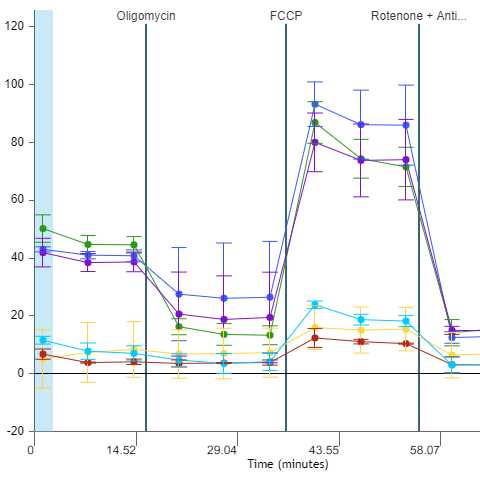
The extracellular acidification rate (ECAR) and the oxygen consumption rate (OCR) are measured (pmoles/min) in real time in an XFe96 analyzer after injection of drugs in the specified order.
e.g.
- Mito Stress Test kit (10 mM glucose, 1 μM oligomycin then 1 μM FCCP plus 1mM sodium pyruvate then 0.5 μM rotenone/antimycin A; Cat. No. 103015-100)
- Glycolytic rate assay kit (0.5μM rotenone/antimycin A then 50mM 2-DG; Cat. No. 103344-100)
- ATP Rate Assay kit (1μM oligomycin then 0.5μM rotenone/antimycin A; Cat. No. 103592-100; all Agilent Technologies)
The spare respiratory capacity (SRC) is calculated from the change from basal oxygen consumption, after addition of glucose, to maximal oxygen consumption, after addition of FCCP.