May 04, 2026
Version 3
Assessing protein crystal tolerance of chemistry reagents for HT-crystallographic screening V.3

- Milo Cooper1,2,3,
- Anu V. Chandran1,2,3,
- Charlotte Chinn1,2,3,
- Mathew Golding1,2,3,
- Peter Marples1,2,3,
- Ali Ebrahim1,2,3,
- Tracy Keates1,2,3,
- Warren Thompson1,2,3,
- Jasmin Aschenbrenner1,2,3
- 1Diamond Light Source;
- 2Research Complex at Harwell;
- 3OpenBind Consortium
- OpenBind Consortium



Protocol Citation: Milo Cooper, Anu V. Chandran, Charlotte Chinn, Mathew Golding, Peter Marples, Ali Ebrahim, Tracy Keates, Warren Thompson, Jasmin Aschenbrenner 2026. Assessing protein crystal tolerance of chemistry reagents for HT-crystallographic screening. protocols.io https://dx.doi.org/10.17504/protocols.io.14egn516yg5d/v3Version created by Milo Cooper
License: This is an open access protocol distributed under the terms of the Creative Commons Attribution License, which permits unrestricted use, distribution, and reproduction in any medium, provided the original author and source are credited
Protocol status: Working
We use this protocol and it's working
Created: May 01, 2026
Last Modified: May 04, 2026
Protocol Integer ID: 316162
Keywords: Automated chemistry, crystallisation, Diamond Light Source, crystal, XChem, Openbind, fragment screening, FBDD, protein crystallography, protein crystal tolerance of chemistry reagent, assessing protein crystal tolerance, protein crystallisation facility at the research complex, protein crystallisation facility, crystallographic screening this protocol, crystallographic screening, protein crystal, throughput crystallographic screening of ligand, organic chemistry reagent, chemistry reagent, exposure to organic chemistry reagent, crystal attrition, reducing crystal attrition, xchem laboratory at diamond light source, crystal, reagent, xchem laboratory, ligand, solvent, screening,
Funders Acknowledgements:
UK Department of Science, Innovation and Technology
Grant ID: G2-SCH-2025-06-16537
Abstract
This protocol describes the testing of how protein crystals survive exposure to organic chemistry reagents and solvents, with the purpose of reducing crystal attrition prior to high-throughput crystallographic screening of ligands from crude reaction mixtures containing the reagents. A step-by-step description is included, describing how to complete this process using the XChem laboratory at Diamond Light Source and the Protein Crystallisation Facility at the Research Complex at Harwell. The data analysis cut-offs, rationale, and GitHub repo for the code utilised during analysis are included.
This version updates the old spreadsheet-based analysis with a Python program using pandas dataframes, XtalControl. (v.02 at time of writing)


Materials
Echo Acoustic Liquid Handler
Formulatrix Rock Imager
Beckman Coulter Echo-qualified 384-well polypropylene microplate https://www.mybeckman.uk/supplies/echo-qualified-supplies/acoustic-liquid-handler-microplates/001-14555 Codes: Product No:001-14555
SwissCI 3 lens crystallization plates https://swissci.com/product/3-lens-crystallisation-plate/ Codes:
Midi: UVXPO-3LENS 3W96T-PS 3W96T-UVP
Loops https://moleculardimensions.com/en/category/mounted-litholoops Codes: Catalog # MD7-131, Catalog # MD7-133, Catalog # MD7-135, Catalog # MD7-138
Safety warnings
Always wear appropriate PPE for this protocol, including during the handling of liquid nitrogen.
Refer to Material Safety Data Sheets for additional safety and handling information.
Plate preparation
Set up a SwissSci 3-drop crystallisation plate according to the specific crystallisation protocol and incubate in a Formulatrix imager.
Once crystals have grown to a suitable size for mounting, image the plates. Export a corresponding csv containing the targeted drops for wells containing crystals using the CHiMP dispensing file generator on ISPyB.
Prepare a plate containing the reagents and crude reactions to be tested by pipetting the reagents and reactions into a 384-well PP plate. If the controls plate has already been prepared, skip forwards to Step 4.
Note
- Refer to “control-plate-map.csv” for the plate map format.
- Prepare 100 µL 500 millimolar (mM) stock solutions of the reagents and catalysts in DMSO. Halve the concentration to 250 millimolar (mM) if there are solubility issues.
- Transfer 50 µL of the of the stock solutions prepared to a 384-PP Echo compatible control plate.
- If available, transfer 50 µL of representative crude reaction mixtures to the 384-PP control plate.
- For all solvents that will be used in potential reactions and the DMSO used for the dilutions, add 50 µL of 2% v/v reaction solvent in DMSO to the 384-PP plate.
Solvent Test
Determine the maximum % DMSO and the soak time that the crystals can tolerate. Transfer a dilution series of DMSO (e.g. 25%, 20%, 15%, 10%, 5% of drop volume).
Note
More details on the solvent test available below.
For soaking control context, representative steps are described within this protocol.
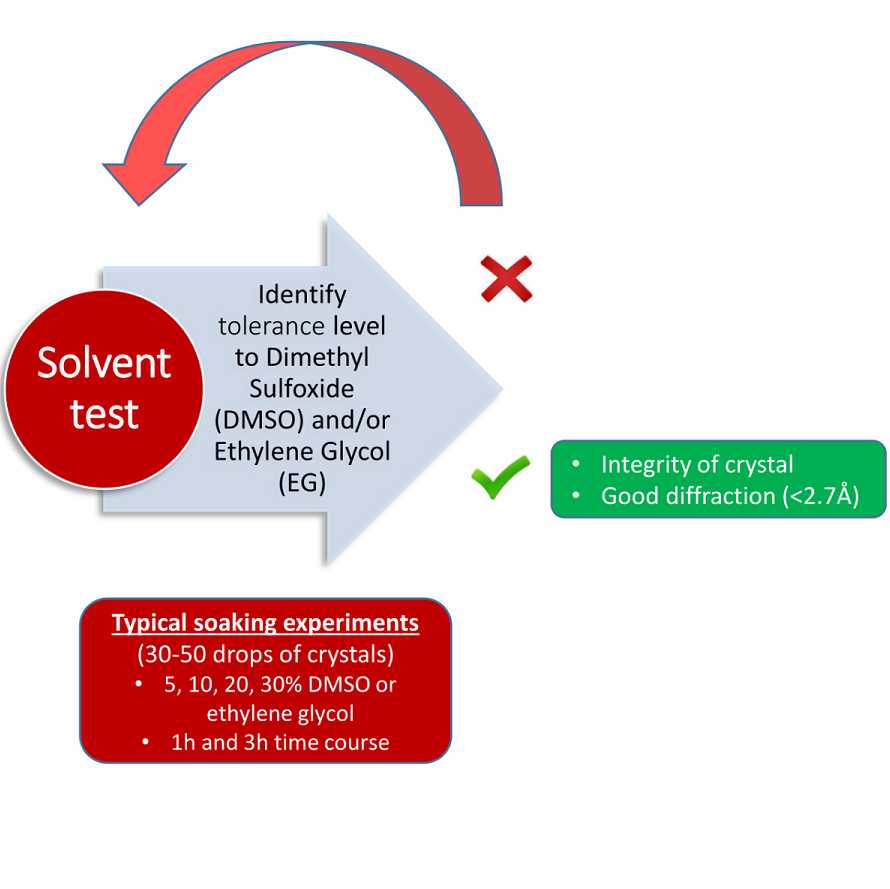
Mount the crystals at 1, 2, and 3 hours post-soaking, cryo-cool the crystals, and store in liquid nitrogen to prepare the crystals for diffraction experiment.
Collect diffraction data from the crystals. Use automated data processing and model building software to confirm adequate resolution (>2.5Å) and successful model building.
The standard suite used at Diamond Light Source for diffraction data processing is: xia2_dials, fast_dp, autoPROC, xia2_3dii, and autoPROC + STARANISO. DIMPLE was used for automated model building.
Initial Experiment
Soak, in triplicate, the control plate. Use the transfer % and soak time determined by the solvent test.
Note
Remember to include 3x DMSO as a negative control.
If available, include a known binder in the controls, i.e. a fragment that has already been confirmed as a hit and modelled successfully.
After the soaking time has been reached, use the Crystal Shifter to mount and cryo-cool the crystals, storing in liquid nitrogen until diffraction.
Safety information
Wear appropriate PPE when handling liquid nitrogen.
The quick note-taking UI of the Crystal Shifter can be used to note issues with the droplet or crystal that may not be captured by data collection, such as the tested reagent precipitating when added to the crystallisation buffer.
Collect and process the diffraction data from the soaked crystals.
Analysis
Load the ISPyB visit containing the data collection into XChem Explorer (XCE).
Run a DIMPLE automated model building job through XCE. When complete, export the XCE data as a csv file.
Load ISPyB sample data and exported XCE data into XtalControl, which will process and help visualise the results for each reagent soaked.
Assess the data, and tag reagents as “failed” in red, or “suspicious” in orange, according to the standards below. For all failure modes, determine if reagent is critical, or if more viable alternatives exist for the same reaction and role.
Check that the DMSO-only controls have survived and do not reach any failure modes.
Note
What we define as a “failure”:
Type of failure modes and cutoffs:
a. Can’t be mounted (2x - 3x for 3 repeats)
b. No diffraction (for any repeat)
c. Resolution poor (3.0+ Å average)
d. Model building failure (Any of: Failed DIMPLE run; Rfree > 0.40; Rcryst > 0.35, occurring 2x – 3x for 3 repeats)
Note
What we define as “suspicious” or a partial failure:
Partial failure modes and cutoffs:
a. Can’t be mounted (1x for 3 repeats)
b. N/A
c. Resolution poor (2.2 - 3.0 Å average)
d. Model building failure (Any of: Failed DIMPLE run; Rfree > 0.40; Rcryst > 0.35, occurring 1x for 3 repeats)
Follow-up experiments
Follow-up experiments are to be completed if a failure or partial failure mode is reached, and the reagents available (which have not reached a failure mode) do not meet the Chemistry requirements.
Complete follow-up soaks with a reduced transfer % by thirds or quarters in a stepped dilution e.g. if the starting transfer fraction is 20%, follow with 15%, 10%, 5%. Each step in the dilution should be in triplicate.
Remember to check the volume transferred is above the Echo liquid handler minimum volume (2.5 µL ). Include DMSO-only controls for each transfer %.
If the soaks continue to fail at the lowest transfer %, follow up using a time series with a 00:30:00 stepped reduction in time, again in triplicate.
After the soaking time has been reached, use the Crystal Shifter to mount and cryo-cool the crystals, storing in liquid nitrogen until diffraction.
Safety information
Wear appropriate PPE when handling liquid nitrogen.
Collect and process diffraction data from the soaked crystals.
Analyse the diffraction data produced from the follow-up soaks. XtalControl will separate soaks by transfer percentage as well as reagent used, so all data can be processed in a single batch.
Protocol references
Peter Marples, Daren Fearon, Blake Balcomb. XChem solvent test (2025) https://dx.doi.org/10.17504/protocols.io.5jyl82518l2w/v1
Douangamath, A., Powell, A., Fearon, D., Collins, P. M., Talon, R., Krojer, T., Skyner, R., Brandao-Neto, J., Dunnett, L., Dias, A., Aimon, A., Pearce, N. M., Wild, C., Gorrie-Stone, T., von Delft, F. Achieving Efficient Fragment Screening at XChem Facility at Diamond Light Source. J. Vis. Exp. (171), e62414, doi:10.3791/62414 (2021)
Baker, L.M., Aimon, A., Murray, J.B. et al. Rapid optimisation of fragments and hits to lead compounds from screening of crude reaction mixtures. Commun Chem 3, 122 (2020). https://doi.org/10.1038/s42004-020-00367-0
Acknowledgements
OpenBind received funding from the UK Department of Science, Innovation and Technology under grant number G2-SCH-2025-06-16537.