Aug 12, 2024
Assessing Geotactic and Phototactic Responses in Parhyale hawaiensis as Indicators of Environmental Pollutant Exposure
- 1Heriot-Watt University



Protocol Citation: Ibrahim Lawan 2024. Assessing Geotactic and Phototactic Responses in Parhyale hawaiensis as Indicators of Environmental Pollutant Exposure. protocols.io https://dx.doi.org/10.17504/protocols.io.x54v92zwml3e/v1
License: This is an open access protocol distributed under the terms of the Creative Commons Attribution License, which permits unrestricted use, distribution, and reproduction in any medium, provided the original author and source are credited
Protocol status: Working
We use this protocol and it's working
Created: August 12, 2024
Last Modified: August 12, 2024
Protocol Integer ID: 105146
Keywords: • Ecotoxicology • Amphipod • Geotaxis • Phototaxis • Behavioural Assay • Environmental Pollutants, phototactic responses in parhyale hawaiensi, marine amphipod parhyale hawaiensi, parhyale hawaiensi, ecotoxicological research, aquatic organism, accessible approach for ecotoxicological research, environmental pollutant exposure, indicators of environmental pollutant exposure, marine ecosystem, deeper understanding of pollutant effect, physiological effects of various contaminant, environmental pollutant, pollutant effect, environmental monitoring effort, phototactic response, organism, various contaminant, contaminant, ecosystem, effective behavioural assay, physiological effect
Disclaimer
The protocol provided here is intended for educational purposes only and should be conducted in appropriate laboratory settings. The developers of this protocol are not liable for any damages or consequences arising from its use. Users should ensure compliance with relevant safety regulations and ethical guidelines when conducting experiments involving live organisms.
Abstract
This protocol presents a series of cost-effective behavioural assays tailored to evaluate the sub-lethal impacts of environmental pollutants on the marine amphipod Parhyale hawaiensis. Our methods focus on geotactic (gravity-induced movement) and phototactic (light-induced movement) responses to provide critical insights into the neurotoxic and physiological effects of various contaminants on aquatic organisms. The assays described here provide a standardised, cost-effective, and accessible approach for ecotoxicological research, supporting a broad spectrum of studies and environmental monitoring efforts. Their implementation enhances reproducibility and contributes to a deeper understanding of pollutant effects on marine ecosystems.
Materials
• Adult Parhyale hawaiensis (6-8 months old)
• 25-ml or 50-ml glass measuring cylinders
• 50-ml plastic tubes
• Black tape
• Exposure medium (reconstituted seawater)
• Environmental pollutant of interest
• Stopwatch or timer
• Light source (e.g., LED lamp)
• Marker or grease pencil
• Data recording sheets
Introduction
Environmental pollutants, including organic contaminants, heavy metals, and pesticides, are pervasive in aquatic ecosystems and pose significant risks to marine organisms. Sub-lethal exposure to these pollutants can lead to alterations in behavioural patterns, serving as early indicators of neurotoxic effects. Parhyale hawaiensis has emerged as a valuable model organism in aquatic ecotoxicology due to its widespread distribution, ease of laboratory culture, and sensitivity to environmental stressors (Dos Santos et al., 2022). This organism typically uses geotactic responses to orient itself within its habitat. It relies on polarisation and light-intensity gradients for navigation and for searching for food or mates within its environment (Paris et al., 2022; Ramos et al., 2019). Behavioural endpoints offer a rapid and sensitive means of assessing the sub-lethal effects of pollutants, which may not be apparent through traditional toxicity tests (Ford et al., 2021; Soose et al., 2023). This protocol focuses on two key behavioural assays: geotaxis (movement in response to gravity) and phototaxis (movement in response to light), which can provide insights into the neurological and physiological impacts of environmental contaminants on P. hawaiensis. These behaviours are fundamental to the organism’s survival and can be altered by exposure to contaminants, making them excellent indicators of sub-lethal effects.
Objective
To establish sensitive and cost-effective assays for detecting sub-lethal impacts of environmental pollutants on marine invertebrates.
Test Organism Preparation
2.1. Obtain adult Parhyale hawaiensis from a reputable source or a maintained laboratory culture.
2.2. Select matured organisms (~ 5-7 mm in length, females) and (~ 8-10 mm in length, males) for testing.
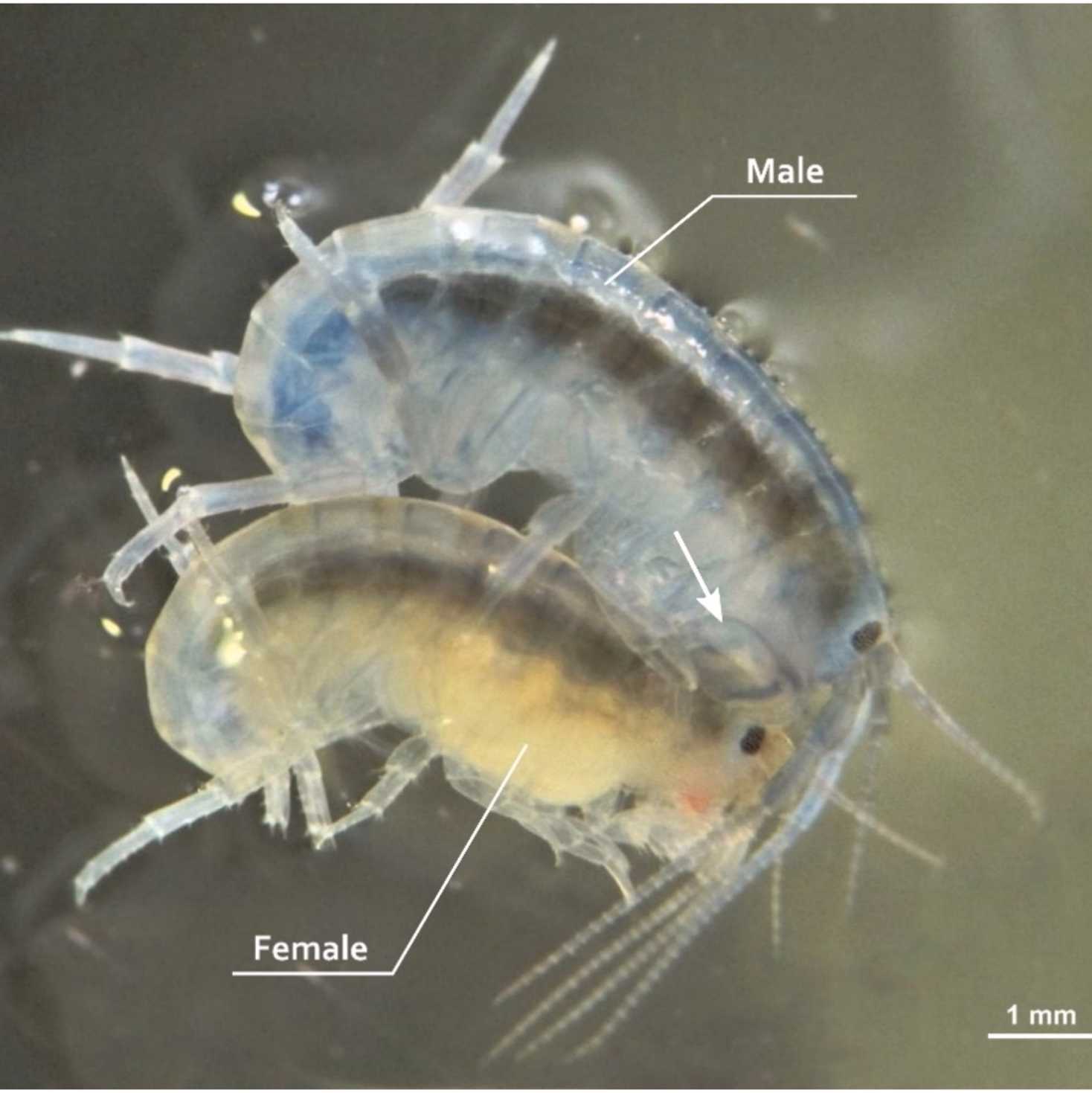
2.3 Sex the organisms under a stereomicroscope to ensure precise identification of males and females.
2.4. Acclimate the organisms to test conditions for at least 48 hours prior to exposure
How to differentiate male and female P. hawaiensis phenotypically
Exposure Setup
3.1. Prepare stock solutions of the environmental pollutant to be tested.
3.2. Create a dilution series of the pollutant in artificial seawater or filtered natural seawater.
3.3. Set up exposure chambers with appropriate volumes of the diluted pollutant solutions.
3.4. Include a control group exposed only to clean seawater.
3.5. Transfer individual P. hawaiensis to exposure chambers.
3.6. Maintain exposure conditions for the desired duration (e.g., three weeks), ensuring proper aeration and water quality.
Geotaxis Assay
4.1. Prepare 25-ml glass measuring cylinders for each test organism.
4.2. Fill cylinders to the 20 ml mark with the exposure medium.
Marked measuring cylinders ready for geotactic test
How to set up the measuring cylinders for geotactic assay
4.3. Mark a line at the 10 ml point on each cylinder.
4.4. Gently transfer one exposed P. hawaiensis (male or female) to each cylinder.
4.5. Allow a 2-minute acclimation period.
set up
4.6. Over a 6-minute observation period, record the number of times each organism crosses the 10 ml line.
4.7. Repeat the assay with the desired number of replicates (e.g., twelve) per treatment group.
| A | B | C | D | E | F | |
| Data Recording Sheets for Parhyale hawaiensis Behavioral Assays | ||||||
| Geotaxis Assay Data Recording Sheet | ||||||
| Date: 15/08/2022 Researcher: Ibrahim Lawan | ||||||
| Environmental Pollutant: Benzo[a]pyrene Concentration: 250 μg/L | ||||||
| Replicate | Number of line crossings in 6 minutes | |||||
| 1 | 7 | |||||
| 2 | 9 | |||||
| 3 | 6 | |||||
| 4 | 8 | |||||
| 5 | 10 | |||||
| 6 | 7 | |||||
| Mean number of line crossings: | 7.83 | |||||
| Notes: Organism in replicate 5 showed particularly high activity. Water temperature was maintained at 27°C ± 2°C throughout the experiment. No mortality was observed during the assay. | ||||||
Example of Data Recording Sheert for geotactic response
Phototaxis Assay
5.1. Prepare 50-ml plastic tubes as horizontal choice chambers.
5.2. Cover one-half of each tube with black tape to create a dark region.
NB: Ensure both ends of the tube are covered to avoid direct lighting.
Horizontal light or dark region choice chambers
Protoype
5.3. Drill a small hole in the top-middle part of each tube for organism introduction.
5.4. Fill tubes with exposure medium, ensuring no air bubbles are present.
5.5. Gently introduce one exposed P. hawaiensis (male or female) through the drilled hole, which serves as the starting location.
5.6. Allow a minimum of 2 minutes for acclimation.
5.7. Over a 6-minute observation period, record the organism’s position every 30 seconds.
• Score 1 if the organism is in the light side
• Score 0 if the organism is in the dark side
| A | B | C | D | E | F | G | H | I | J | K | L | M | N | |
| Phototaxis Assay Data Recording Sheet | ||||||||||||||
| Date: 16/08/2022 Researcher: Ibrahim Lawan | ||||||||||||||
| Environmental Pollutant: Benzo[a]pyrene (BaP) Concentration:250 μg/L | ||||||||||||||
| Instructions: Record 1 for light side, 0 for dark side at each 30-second interval. | ||||||||||||||
| Replicate | 30s | 60s | 90s | 120s | 150s | 180s | 210s | 240s | 270s | 300s | 330s | 360s | Total Score | |
| 1 | 1 | 1 | 1 | 0 | 0 | 1 | 1 | 1 | 0 | 0 | 1 | 1 | 8 | |
| 2 | 0 | 0 | 1 | 1 | 1 | 1 | 0 | 0 | 1 | 1 | 1 | 1 | 8 | |
| 3 | 1 | 1 | 1 | 1 | 1 | 0 | 0 | 1 | 1 | 1 | 1 | 1 | 10 | |
| 4 | 0 | 1 | 1 | 1 | 1 | 1 | 1 | 0 | 0 | 1 | 1 | 1 | 9 | |
| 5 | 1 | 1 | 0 | 0 | 1 | 1 | 1 | 1 | 1 | 0 | 0 | 1 | 8 | |
| 6 | 1 | 1 | 1 | 1 | 1 | 0 | 0 | 1 | 1 | 1 | 1 | 0 | 9 | |
| Mean total score: | 8.7 | |||||||||||||
| Notes: Light intensity was maintained equal throughout the experiment. Organism in replicate 3 appeared to be more photoactive than others. All organisms showed a general preference for the light side, suggesting a slight photophilic response. | ||||||||||||||
Example of Data Recording Sheert for phototactic response
5.8. Repeat the assay with the desired number of replicates (e.g., twelve) per treatment group.
Data Analysis
6.1. For geotaxis:
• Calculate the mean number of line crossings for each treatment group.
• Higher scores indicate stronger negative geotactic responses.
6.2. For phototaxis:
• Sum the scores for each organism over the 12 observations.
• A score of 12/12 indicates strong photopositive behaviour.
• A score of 0/12 indicates strong photonegative behaviour.
6.3. Based on your experimental set-up, treatments, research question, and nature of your data, perform appropriate statistical analyses (e.g., t-test, Mann-Whitney, ANOVA, Kruskal-Wallis, regression analysis, etc) to determine the significant effects of pollutant exposure on behavioural endpoints.
Quality Control
• Maintain consistent laboratory conditions (temperature, lighting, and handling) across all tests.
• Include appropriate controls (e.g., unexposed organisms, solvent controls if applicable).
• Regularly check the health and condition of the test organisms.
• Calibrate and maintain all equipment used in the assays.
Conclusion
This protocol provides a standardised and cost-effective approach for assessing the behavioural impacts of environmental pollutants on P. hawaiensis through geotaxis and phototaxis assays. These behavioural endpoints offer sensitive and ecologically relevant measures of sub-lethal toxicity, serving as valuable complements to traditional toxicity testing methods. Researchers can use this protocol and generate critical data on the effects of various contaminants on this key marine amphipod species. Thereby, contributing to our understanding of aquatic ecosystem health and the potential impacts of environmental pollution.
Protocol references
Dos Santos, A., Botelho, M. T., Vannuci-Silva, M., Artal, M. C., Vacchi, F. I., Magalhães, G. R., Gomes, V., Henry, T. B., & de Aragão Umbuzeiro, G. (2022). The amphipod Parhyale hawaiensis as a promising model in ecotoxicology. Chemosphere, 307, 135959. https://doi.org/10.1016/j.chemosphere.2022.135959
Ford, A. T., Agerstrand, M., Brooks, B. W., Allen, J., Bertram, M. G., Brodin, T., Dang, Z., Duquesne, S., Sahm, R., Hoffmann, F., Hollert, H., Jacob, S., Kluver, N., Lazorchak, J. M., Ledesma, M., Melvin, S. D., Mohr, S., Padilla, S., Pyle, G. G., Scholz, S., Saaristo, M., Smit, E., Steevens, J. A., van den Berg, S., Kloas, W., Wong, B. B. M., Ziegler, M., & Maack, G. (2021). The Role of Behavioral Ecotoxicology in Environmental Protection. Environ Sci Technol, 55(9), 5620-5628. https://doi.org/10.1021/acs.est.0c06493
Paris, M., Wolff, C., Patel, N. H., & Averof, M. (2022). Chapter Eight - The crustacean model Parhyale hawaiensis. In B. Goldstein & M. Srivastava (Eds.), Current Topics in Developmental Biology (Vol. 147, pp. 199-230). Academic Press. https://doi.org/10.1016/bs.ctdb.2022.02.001
Ramos, A. P., Gustafsson, O., Labert, N., Salecker, I., Nilsson, D. E., & Averof, M. (2019). Analysis of the genetically tractable crustacean Parhyale hawaiensis reveals the organisation of a sensory system for low-resolution vision. BMC Biol, 17(1), 67. https://doi.org/10.1186/s12915-019-0676-y
Soose, L. J., Hugl, K. S., Oehlmann, J., Schiwy, A., Hollert, H., & Jourdan, J. (2023). A novel approach for the assessment of invertebrate behavior and its use in behavioral ecotoxicology. Sci Total Environ, 897, 165418. https://doi.org/10.1016/j.scitotenv.2023.165418