May 04, 2023
Version 2
Artificial saliva V.2
- 1Leiden University
- BYOC



Protocol Citation: Bjørn Peare Bartholdy, a.g.henry 2023. Artificial saliva. protocols.io https://dx.doi.org/10.17504/protocols.io.3byl4k1jzvo5/v2Version created by Bjørn Peare Bartholdy
License: This is an open access protocol distributed under the terms of the Creative Commons Attribution License, which permits unrestricted use, distribution, and reproduction in any medium, provided the original author and source are credited
Protocol status: Working
We use this protocol and it's working
Created: December 10, 2021
Last Modified: May 04, 2023
Protocol Integer ID: 55830
Keywords: artificial saliva solution for oral biofilm growth, oral biofilm growth, artificial saliva solution, artificial saliva, oral biofilm, dental calculus
Funders Acknowledgements:
ERC European Union’s Horizon 2020
Grant ID: STG–677576
Abstract
Creating an artificial saliva solution for oral biofilm growth, specifically dental calculus.
This is a modified version of Sissons et al. 1991.
Guidelines
This protocol explains how to mix 1000 mL of artificial saliva.
Materials
Chemicals
Mucin from porcine stomach (Type III)
Trypticase peptone
Proteose peptone
Yeast Extract
KCl
NaCl
CaCl2
Na2HPO4
NaHCO3
Hemin
Menadione
Urea
L-Arginine
Equipment
1000 mL beaker
100 mL graduated cylinder
2 x 1000 mL bottle
Magnetic stirrer (with heating element)
Autoclave
pH measure
Protocol materials
Bacto Yeast ExtractBecton Dickinson (BD)
Mucin from porcine stomach (Type III)Merck MilliporeSigma (Sigma-Aldrich)Catalog #M1778
Oxoid™ Proteose PeptoneThermo FisherCatalog #LP0085B
Trypticase™ PeptoneThermo FisherCatalog #211921
CaCl2
Hemin
NaCl
NaHCO3
KCl
Sodium phosphate dibasicMerck MilliporeSigma (Sigma-Aldrich)Catalog #7558-79-4
NaOH
Menadione
Urea
L-ArginineCatalog #A5006
Before start
Mix the solution under a fumehood. It can smell pretty bad.
Also have the incubator under a fumehood, if possible. I had no such luxury...
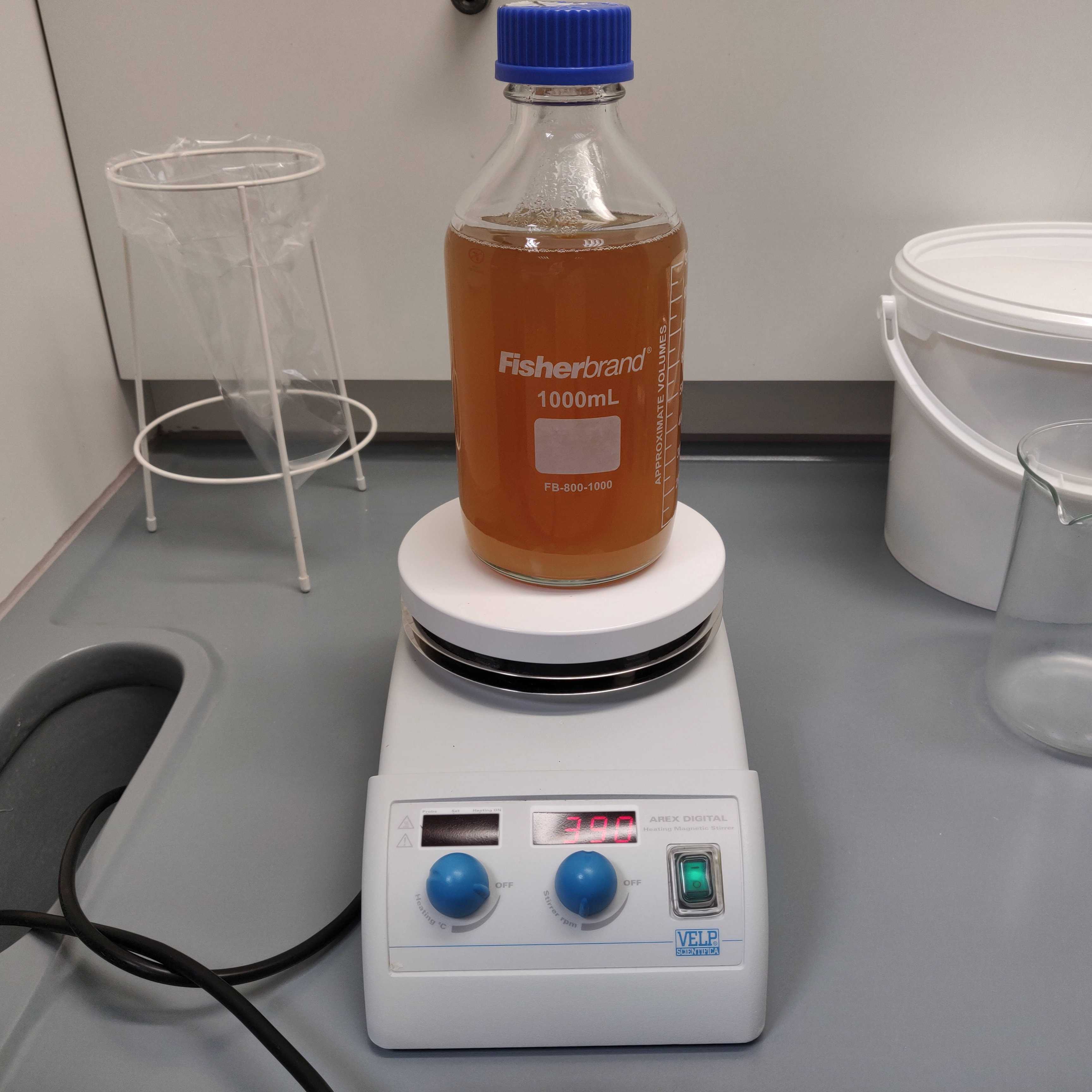
Add 300 mL distilled (or deionized) dH2O to a 1000 mL beaker, with stirring and heat 60 °C .
Add:
- 2.5 g Mucin from porcine stomach (Type III)Merck MilliporeSigma (Sigma-Aldrich)Catalog #M1778
- 5 g Trypticase™ PeptoneThermo FisherCatalog #211921
- 10 g Oxoid™ Proteose PeptoneThermo FisherCatalog #LP0085B
- 5 g Bacto Yeast ExtractBecton Dickinson (BD)
Let the reagents completely dissolve before continuing to the next step
Add:
- 2.5 g KCl
- 0.35 g NaCl
- 0.2 g CaCl2
- 0.74 g Sodium phosphate dibasicMerck MilliporeSigma (Sigma-Aldrich)Catalog #7558-79-4
- 0.54 g NaHCO3
- 2.5 mg Hemin
Add the remaining 700 mL distilled (or deionized) H2O
Adjust to 7 with NaOH and stirring
Transfer to two 1000 ml bottles, so around half of each bottle is filled.
Autoclave at 121 °C , 1 Bar for 00:15:00 minutes
Safety information
Do NOT screw bottle caps on tightly before autoclaving.
Loosely screw the caps on the bottles or cover the tops with foil.
15m
Once the solution has cooled, combine solutions to a single 1000ml bottle, and add:
- 1 mg Menadione
- 0.3 g Urea
- 0.17 g L-ArginineCatalog #A5006
Safety information
These should be filter-sterilised as there are no more decontamination steps for the artificial saliva.
Use clean gloves and take precautions not to contaminate the artificial saliva with bacteria or starch.
Store in fridge at ca. 4 °C
Occasionally test the pH of the solution to ensure it stays around 7
Protocol references
Sissons, C. H., Cutress, T. W., Hoffman, M. P., & Wakefield, J. S. J. (1991). A Multi-station Dental Plaque Microcosm (Artificial Mouth) for the Study of Plaque Growth, Metabolism, pH, and Mineralization: Journal of Dental Research. https://doi.org/10.1177/00220345910700110301