Jan 19, 2026
Arabidopsis thaliana plant cell pack (PCP) transformation
- Lukas Meile1,2,
- Germán lonso-Tolo1,
- Zeltia Ferreiro-Eiras1,
- Xi Jiang1,
- Stefan Burén1,
- Luis M. Rubio1
- 1Centro de Biotecnología y Genómica de Plantas, Universidad Politécnica de Madrid e Instituto Nacional de Investigación y Tecnología Agraria y Alimentaria/Consejo Superior de Investigaciones Científicas, Madrid 28223, Spain;
- 2Institute of Microbiology, ETH Zurich, 8093 Zurich, Switzerland



Protocol Citation: Lukas Meile, Germán lonso-Tolo, Zeltia Ferreiro-Eiras, Xi Jiang, Stefan Burén, Luis M. Rubio 2026. Arabidopsis thaliana plant cell pack (PCP) transformation. protocols.io https://dx.doi.org/10.17504/protocols.io.yxmvmbm3bg3p/v1
Manuscript citation:
Meile, L., Alonso-Tolo, G., Ferreiro-Eiras, Z., Jiang, X., Burén, S., & Rubio, L. M. (2025). A high-throughput heterologous expression platform for plant synthetic biology based on Arabidopsis suspension cells. Journal of Experimental Botany, eraf545. https://doi.org/10.1093/jxb/eraf545
Meile, L., Alonso-Tolo, G., Ferreiro-Eiras, Z., Jiang, X., Burén, S., & Rubio, L. M. (2025). A high-throughput heterologous expression platform for plant synthetic biology based on Arabidopsis suspension cells. bioRxiv, 2025-07.
License: This is an open access protocol distributed under the terms of the Creative Commons Attribution License, which permits unrestricted use, distribution, and reproduction in any medium, provided the original author and source are credited
Protocol status: Working
We use this protocol and it's working
Created: October 16, 2025
Last Modified: January 19, 2026
Protocol Integer ID: 229984
Keywords: Arabidopsis thaliana transformation, Heterologous expression, Plant cell packs, Plant suspension cultures, Agrobacterium infiltration, stable transformation of arabidopsis thaliana suspension cell, agroinfiltration of plant cell pack, arabidopsis thaliana suspension cell, arabidopsis thaliana plant cell pack, plant cell pack, transformed biomass, agroinfiltration, transgenic cell, suspension culture, stable transformation workflow, pcp
Funders Acknowledgements:
Gates Foundation grant
Grant ID: INV-005889
Gates Foundation grant
Grant ID: INV-067006
Swiss National Science Foundation grant
Grant ID: P2EZP3_199998
Programa Propio UPM
Grant ID: I+D+i 2022
Disclaimer
DISCLAIMER – FOR INFORMATIONAL PURPOSES ONLY; USE AT YOUR OWN RISK
The protocol content here is for informational purposes only and does not constitute legal, medical, clinical, or safety advice, or otherwise; content added to protocols.io is not peer reviewed and may not have undergone a formal approval of any kind. Information presented in this protocol should not substitute for independent professional judgment, advice, diagnosis, or treatment. Any action you take or refrain from taking using or relying upon the information presented here is strictly at your own risk. You agree that neither the Company nor any of the authors, contributors, administrators, or anyone else associated with protocols.io, can be held responsible for your use of the information contained in or linked to this protocol or any of our Sites/Apps and Services.
Abstract
This protocol describes the transient and stable transformation of Arabidopsis thaliana suspension cells by agroinfiltration of plant cell packs (PCPs) adapted from Rademacher et al., 2019. It was optimized to be performed with standard laboratory equipment and gives the user the choice between a high throughput and a high amount of transformed biomass. The transient expression workflow can be completed in 4 days if suspension cultures are readily available. The stable transformation workflow optimized for large volumes can yield 100 g (fresh weight) of transgenic cells within 2 weeks after transformation.
Guidelines
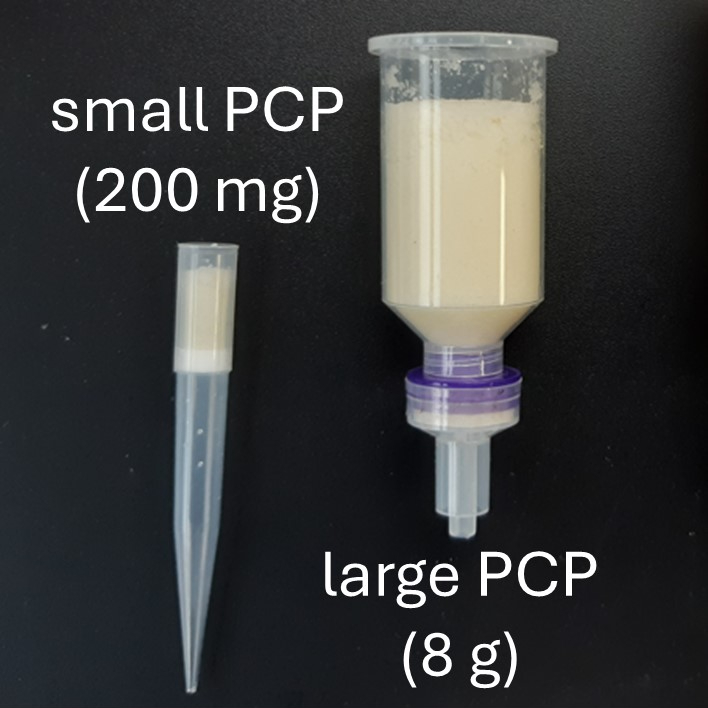
- This protocol consists of two different workflows that provide a high throughput at a scale of 60-200 mg cells per transformed sample (referred to as "small PCPs") or a lower throughput but a large scale of 8 g cells per transformed sample (referred to as "large PCPs").
- Note that this protocol has been optimized for Col-0 and MM1 cell lines (kindly provided by Laszlo Bako, Umeå University, Sweden). While we recommend using these two cell lines for transient and stable transformation, respectively, other cell lines might also work using this protocol. The cell line YG1 has also been successfully tested but is not recommended due to slower growth in our hands. For other cell lines that are routinely cultured under light conditions, we recommend culturing them under darkness for at least one round of propagation before PCP preparation. This modification was crucial for high transformation efficiency for the cell line MM1. The cell lines T87 and PSB-L could not be transformed using this protocol when cultured under a 16-h photoperiod.
- The A. tumefaciens strain GV3101::pMP90 is the only strain that has been tested for both A. thaliana cell lines and is therefore recommended. Note that the strains EHA105 and AGL-1 have also been successfully tested for transient expression of Col-0 cells.
- We recommend including the RUBY reporter (He et al., 2020) as a control to visually assess the success of the transformation protocol.
Materials
Biological material:
- Agrobacterium tumefaciens strain GV3101::pMP90
- Arabidopsis thaliana suspension cell line Col-0 (Alternatively: cell line YG1)
- Arabidopsis thaliana suspension cell line MM1
Media and buffers:
- Col-0 Growth Medium:
Murashige & Skoog medium including vitamins4.4 g/L
Sucrose 30 g/L
2,4-Dichlorophenoxyacetic acid (2,4-D)0.24 µg/mL
Kinetin 0.014 µg/mL
KOH to adjust pH5.7
- for Col-0 Selection Medium, add:
Carbenicillin250 µg/mL
Vancomycin165 µg/mL
Hygromycin20 µg/mL
- MM1 Growth Medium:
Murashige & Skoog medium (basal salts)4.3 g/L
Sucrose 30 g/L
Thiamine HCl0.4 µg/mL
Myo-inositol0.1 mg/mL
1-naphthaleneacetic acid (NAA)0.5 µg/mL
Kinetin0.05 µg/mL
KOH to adjust pH5.7
- for MM1 Selection Medium, add:
Carbenicillin250 µg/mL
Vancomycin165 µg/mL
Hygromycin20 µg/mL
- Paul's Medium (Buschmann 2016):
Murashige & Skoog medium (basal salts)4.3 g/L
Sucrose10 g/L
KOH to adjust pH5.8
- Agrobacterium Infiltration Buffer (adapted from Gengenbach et al., 2020):
Murashige & Skoog medium (basal salts)0.5 g/L
Sucrose50 g/L
Glucose10 millimolar (mM)
2-(N-morpholino)ethanesulfonic acid (MES)15 millimolar (mM)
KOH to adjust pH 5.6
- Lysogeny broth (LB) medium:
Tryptone 10 g/L
Yeast extract 5 g/L
Sodium chloride (NaCl)10 g/L
- Lysis Buffer:
Tris-HCl (pH 8) 100 millimolar (mM)
NaCl 150 millimolar (mM)
MgCl2 10 millimolar (mM)
NP-40 2 % volume
Glycerol 5 % volume
β-mercaptoethanol 5 millimolar (mM)
EDTA 5 millimolar (mM)
Protease inhibitor cocktail (Sigma P9599) 0.5 % volume
Equipment:
- For Col-0 cells: Incubator-shaker set to 25°C
- For MM1 cells: Incubator-shaker set to 22°C with illumination.
- Incubator-shaker set to 28°C
- Laminar flow hood
- Vacuum pump
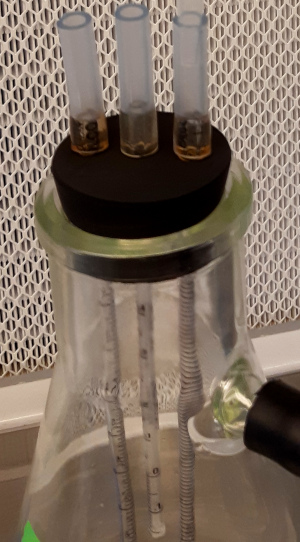
- Vacuum manifold (or DIY version: vacuum flask with perforated rubber stopper equipped with PCV tube sections.
 DIY 3x manifold.jpg93.5KB )
 - Swing-bucket centrifuge equipped for 50-mL Falcon tubes.
Other materials:
- For large-scale PCPs: Zymo-Spin V-PS midiprep column assembly (with the DNA-binding matrix removed) with a 15-ml reservoir-X (Zymo Research)
- Pipette filter tips (standard and wide-bore)
- Serological pipettes (standard and wide-bore)
- Micropore Surgical Tape (3M)
- 250-ml glass shake flasks closed with aluminium foil (2 layers)
Safety warnings
- Plant cell suspensions are prone to microbial contamination. Always use a laminar flow hood for handling and propagating suspension cultures. The use of filter pipette tips is recommended. We further recommend maintaining backup cultures on solid medium (propagation once per month), from which fresh liquid cultures can be prepared in case of contamination.
- Different Arabidopsis cell lines might need further optimization for this protocol to work (see guidelines).
Before start
Maintaining the A. thaliana suspension cultures in a healthy state is a prerequisite for the success of this protocol. Low and high cell densities can both lead to poor culture viability. Healthy cell suspensions sediment within minutes, resulting in a clear upper phase above the sedimented cells. A green or yellowish colour of the cells (depending on the light conditions) indicate good health, as opposed to white cell colour. It is recommended to weekly passage the cultures as follows:
Col-0 cell line:
Inoculate 7 mL dense culture into 40 mL of Col-0 Growth Medium. Propagate weekly and incubate in an incubator-shaker. 100 rpm, 25°C darkness
MM1 cell line:
Inoculate 2 mL dense culture into 48 mL of MM1 Growth Medium. Propagate weekly and incubate in an incubator-shaker. 100 rpm, 22°C , 16h light/ 8h darkness
Plant cell suspension precultures
Col-0 cell line:
Inoculate 7 mL dense culture into 40 mL of Col-0 Growth Medium. Grow for 3-7 days before PCP preparation in an incubator-shaker. 100 rpm, 25°C , darkness
MM1 cell line:
- Inoculate 2 mL dense culture into 48 mL of MM1 Growth Medium. Grow for 1 week in an incubator-shaker. 100 rpm, 25°C darkness
- Inoculate 2 mL dense culture grown in the dark into 48 mL of MM1 Growth Medium. Grow for 4-7 days before PCP preparation in an incubator-shaker. 100 rpm, 25°C , darkness
Note
- Growth of the MM1 preculture under darkness differs from routine propagation for MM1, which is under a 16-h photoperiod. Growing MM1 precultures under light conditions leads to a much lower transformation efficiency.
- Replacing the spent medium with fresh medium the day before PCP preparation can increase transformation efficiency.
Agrobacterium tumefaciens preparation
3d
- Streak A. tumefaciens strain GV3101::pMP90 containing a plant expression vector onto LB agar containing 25 µg/mL rifampicin, 40 µg/mL gentamycin and the appropriate amount of antibiotic to select for your expression vector. Incubate for 2-3 days at 28 °C .
- From the plate prepared in the previous sub-step, inoculate a 10-mL liquid LB culture containing the same antibiotic concentration as above. Scale up culture if more than 150 small PCPs or more than 3 large PCPs are prepared. Incubate for 24:00:00 in an orbital shaker at 28 °C .
- Harvest A. tumefaciens cells by centrifugation. 5000 x g, Room temperature, 00:10:00
- Washing: Resuspend the pellet in 20 mL Agrobacterium Infiltration Buffer and centrifuge again as above.
- Resuspend the pellet in 5 mL Agrobacterium Infiltration Buffer and determine the OD600nm.
- Adjust the OD600nm to 0.4 with Agrobacterium Infiltration Buffer.
Note
- The last sub-step should be carried out immediately before PCP infiltration. Keeping the diluted A. tumefaciens suspension for an extended time can lead to cell aggregation, which results in lower transformation efficiency.
- A final OD600nm of 0.1 has also been successfully tested. However, incubation times for infiltrated PCPs might change.
- Sub-steps 2 and 3 can be omitted, resupending A. tumefaciens cells grown on LB agar directly in Agrobacterium Infiltration Buffer for washing (alternative sub-step 4). However, lower transformation efficiencies are sometimes observed following this short-cut.
3d
Plant cell pack preparation and infiltration
2h 15m
Washing of plant cells (done on the day of PCP infiltration):
- Transfer the plant suspension preculture to a 50-mL Falcon tube.
- Remove the liquid medium by pressing the tip of a serological pipette against the tube bottom followed by slow aspiration, leaving a cell pellet behind. Alternatively, slow centrifugation (200 g) followed by removing the supernatant with a serological pipette may be used.
- Slowly add Paul's Medium to the cell pellet until it is resuspended. Only add as much volume as needed to be able to barely aspirate the suspension with a wide-bore 1000-µL pipette tip. This volume depends on the pellet size and the cell line.
15m
Casting and infiltration of PCPs:
Small PCPs:
Col-0 cell line:
- Load 500 µL washed Col-0 suspension cells onto the top part of a 1000-uL pipette filter tip. The use of wide bore pipette tips is crucial to transfer the dense cell suspension.
- Remove excess liquid using a vacuum manifold for approximately 00:00:10 to generate the PCPs.
- Place the pipette filter tips containing the PCPs in a sterile tip box.
- Add 300 µL A. tumefaciens suspension to each PCP.
- Close the tip box and incubate for 01:00:00 at 25 °C .
- Remove excess liquid using a vacuum manifold for approximately 00:00:10 to dry the infiltrated PCPs and place the pipette filter tips back into the tip box.
- Place wet sterile filter papers into the tip box next to the PCP-containing filter tips to maintain high humidity.
- Incubate the PCPs inside the tip box for 2-3 days at 25 °C .
- To harvest the PCPs, place the filter tip upside-down in a 2-mL Eppendorf tube and tap it on the laminar flow hood working surface.
MM1 cell line:
- Load 150 µL washed suspension cells onto the top part of a 200-uL pipette filter tip. The use of wide bore pipette tips is crucial to transfer the dense cell suspension.
- Remove excess liquid using a vacuum manifold for approximately 00:00:10 to generate the PCPs
- Place the pipette filter tips containing the PCPs in a sterile tip box.
- Add 90 µL A. tumefaciens suspension to each PCP.
- Close the tip box and incubate for 01:00:00 at 25 °C
- Remove excess liquid using a vacuum manifold for approximately 00:00:10 to dry the infiltrated PCPs and place the pipette filter tips back into the tip box.
- Place wet sterile filter papers into the tip box next to the PCP-containing filter tips to maintain high humidity.
- Incubate the PCPs inside the tip box for 2-3 days at 25 °C
- To harvest the PCPs, place the filter tip upside-down in a 2-mL Eppendorf tube and tap it on the laminar flow hood working surface.
Note
- Transient expression levels can be increased by including a constitutively expressed gene encoding the suppressor of silencing p19 on the expression vector. Alternatively, p19 can be employed by co-infiltration of a second A. tumefaciens strain carrying an expression vector with p19. In that case, we recommend mixing the two A. tumefaciens suspensions (OD600nm=0.4) in a 1:1 ratio before PCP infiltration.
- For protein extraction from harvested PCPs, the following protocol is recommended:
- Add a 7-mm steel ball and 2 µL of Lysis Buffer per mg of harvested PCP to the 2-mL tube
- Homogenize for in a Qiagen Retsch MM300 TissueLyser. 00:01:00
- Incubate on a tube rotator. 00:15:00 4 °C
- Optional: To obtain the soluble protein fraction, centrifuge and harvest the supernatant. 20000 x g, 4°C, 00:15:00
Expected result
If a control construct harbouring the RUBY reporter is included, PCPs are expected to appear red after 2-3 days. MM1 generally exhibits less RUBY expression than Col-0.
Large PCPs (same protocol for all cell lines):
- Load 20 mL washed suspension cells onto a Zymo-Spin V-PS midiprep column assembly (with the DNA-binding matrix removed) with a 15-ml reservoir. The column+reservoir may be placed in a 50-µL Falcon tube or in a similar sterile container for this step.
- Remove excess liquid by gravity or by applying a mild vacuum to generate PCPs.
- Add 20 mL A. tumefaciens suspension to each PCP. This is done stepwise; the excess liquid is allowed to drip out of the column.
- Incubate for 01:00:00 , starting from the first addition of the A. tumefaciens suspension at Room temperature . Keeping the infiltrated PCPs in the laminar flow hood is recommended.
- Place the PCP-containing column+reservoir in a 50-mL Falcon tube, if not already done in step 1, and close the tube with a screw lid. It is recommended to seal the lid with Micropore tape to reduce the risk of contamination in the following step.
- Remove excess liquid using a centrifuge with a swing-bucket rotor 200-300 x g, Room temperature, 00:02:00 . The resulting PCP should appear lighter-coloured than before centrifugation, indicating sufficient liquid removal. Repeat this step if the PCP has not been sufficiently dried.
- Transfer the infiltrated and dried PCP to a sterile 50-mL Falcon tube. The transfer is facilitated by placing the column+reservoir upside down on the Falcon tube and gently tapping them on the laminar flow hood working surface.
- Partially close the the Falcon tube with a screw lid and seal it with Micropore tape to allow gas exchange.
- Place in a humid box at 25 °C in the dark for 2-3 days.
Expected result
If a control construct harbouring the RUBY reporter is included, PCPs are expected to appear red after 2-3 days. MM1 cells sometimes exhibit only a slight colour change; however, the generation of stable transformant from such PCPs is still possible following the steps described in the following section.
2h
Generation of stable transformant cell cultures from infiltrated PCPs
1h
Small PCPs:
Col-0 cell line:
- Add 1 ml of Col-0 Selection Medium to the harvested PCPs placed inside a 2-mL Eppendorf tube.
- Gently disrupt the PCP by pressing it against the tube wall and by up-and-down pipetting with a wide-bore 1000-µL pipette tip.
- Transfer the disrupted PCP together with all the liquid into a 25-mL shake flask containing 3 mL of Col-0 Selection Medium. Incubate at in an incubator shaker.100 rpm, 25°C in darkness
- Once the culture reaches a density comparable to a 7-day-old untransformed culture, propagate it as described under Guidelines, but with Col-0 Selection Medium for several passages.
MM1 cell line:
- Add 1 ml of MM1 Selection Medium without hygromycin to the harvested PCPs placed inside a 2-mL Eppendorf tube.
- Gently disrupt the PCP by pressing it against the tube wall and by up-and-down pipetting with a wide-bore 1000-µL pipette tip.
- Transfer the disrupted PCP together with all the liquid into a 25-mL shake flask containing 3 mL of the same medium (described in sub-step 1). Incubate in an incubator-shaker.100 rpm, 22°C 16h light/8h dark
- After 3-5 days of culturing, add hygromycin to a final concentration of 20 µg/mL .
- Once the culture reaches a density comparable to a 7-day-old untransformed culture, propagate it as described under Guidelines, but with in MM1 Selection Medium for several passages.
Large PCPs:
Col-0 cell line:
- Add 10 mL of Col-0 growth medium to the PCP inside the 50-mL Falcon tube.
- Gently disrupt the PCP by pressing it against the tube wall and by up-and-down pipetting with a wide-bore serological pipette.
- Transfer the disrupted PCP together with all the liquid into a 250-mL shake flask containing 40 mL growth medium. Incubate in an incubator-shaker.100 rpm, 25°C, 00:30:00
- Replace the growth medium containing washed-off A. tumefaciens cells with fresh Col-0 Selection Medium. Incubate for 4 days at 100 rpm, 25°C .
- Discard the spent medium and replace it with 40 mL fresh Col-0 Selection Medium. Equally inoculate four 250-mL shake flasks containing 50 mL Col-0 Selection Medium with the transgenic cell suspension. Incubate for 7 days at 100 rpm, 25°C .
MM1 cell line:
- Add 10 mL of MM1 growth medium to the PCP inside the 50-mL Falcon tube.
- Gently disrupt the PCP by pressing it against the tube wall and by up-and-down pipetting with a wide-bore serological pipette.
- Transfer the disrupted PCP together with all the liquid into a 250-mL shake flask containing 40 mL growth medium. Incubate in an incubator-shaker.100 rpm, 25°C, 00:30:00
- Replace the growth medium containing washed-off A. tumefaciens cells with fresh MM1 Selection Medium without hygromycin. Incubate for 4 days at 100 rpm, 22°C 16h light/8h dark .
- Discard the spent medium and replace it with 40 mL MM1 Selection Medium. Equally inoculate four 250-mL shake flasks containing 50 mL MM1 Selection Medium with the transgenic cell suspension. Incubate for 7 days at 100 rpm, 25°C .
Expected result
Starting from one large PCP of approximately 8 g (fresh weight), around 100 g of transgenic cells are expected to be produced in total in the four flasks prepared in sub-step 5.
1h
Protocol references
Buschmann H. 2016. Plant cell division analyzed by transient Agrobacterium-mediated transformation of tobacco BY-2 cells. Methods in molecular biology 1370, 17–25.
Gengenbach BB, Opdensteinen P, Buyel JF. 2020. Robot cookies – plant cell packs as an automated high-throughput screening platform based on transient expression. Frontiers in Bioengineering and Biotechnology 8.
He Y, Zhang T, Sun H, Zhan H, Zhao Y. 2020. A reporter for noninvasively monitoring gene expression and
plant transformation. Horticulture Research 7, 1–6.
Rademacher T, Sack M, Blessing D, Fischer R, Holland T, Buyel J. 2019. Plant cell packs: a scalable platform for
recombinant protein production and metabolic engineering. Plant Biotechnology Journal 17, 1560.
Acknowledgements
We thank Laszlo Bako (Umeå University, Sweden) for providing the Col-0 and MM1 cell lines.