Aug 16, 2025
Aquatic Therapy on Motor and Behavioral Skills in Children with ASD
- Iffat Ara Nasrin Chaity1,
- Dr. Md. Feroz Kabir1
- 1Jashore University of Science & Technology



Protocol Citation: Iffat Ara Nasrin Chaity, Dr. Md. Feroz Kabir 2025. Aquatic Therapy on Motor and Behavioral Skills in Children with ASD. protocols.io https://dx.doi.org/10.17504/protocols.io.6qpvrw34blmk/v1
License: This is an open access protocol distributed under the terms of the Creative Commons Attribution License, which permits unrestricted use, distribution, and reproduction in any medium, provided the original author and source are credited
Protocol status: Working
We use this protocol and it's working
Created: August 15, 2025
Last Modified: August 16, 2025
Protocol Integer ID: 224782
Keywords: Autism Spectrum Disorder, Aquatic Therapy, Motor Coordination, Behavior, Community-Based Rehabilitation, Pediatrics, Randomized Controlled Trial, Pediatrics, week structured aquatic therapy program on motor coordination, aquatic therapy on motor, aquatic therapy, structured aquatic therapy program, evidence gaps in aquatic therapy, based pediatric neurorehabilitation, autism spectrum disorder, pediatric neurorehabilitation, aquatic activity, behavioral skills in children, based aquatic activity, behavioral outcomes in children, behavioral skill, improvements in motor coordination, playful motor, motor coordination, behavioral symptom, reductions in behavioral symptom
Abstract
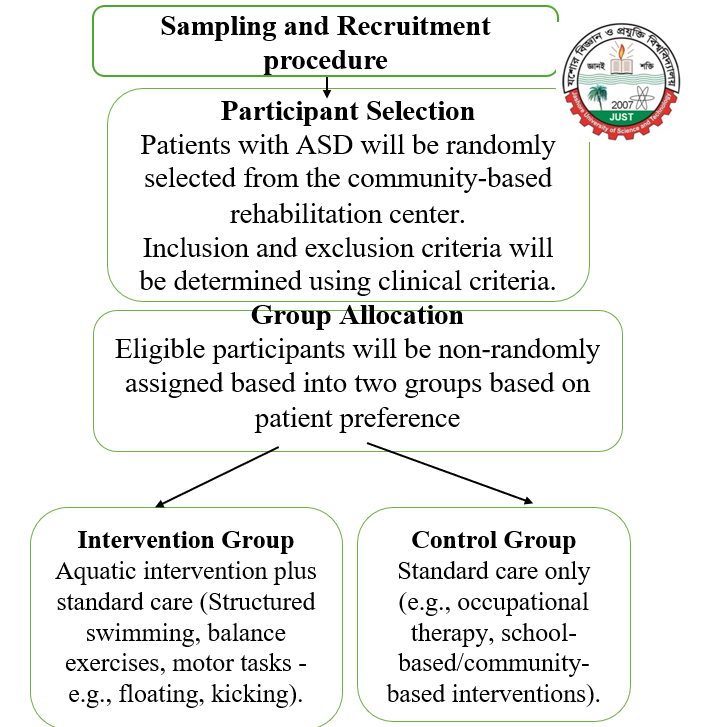
This protocol describes a single-center randomized controlled trial evaluating the effects of a 12-week structured aquatic therapy program on motor coordination and behavioral outcomes in children aged 5–12 years with Autism Spectrum Disorder (ASD). The intervention includes twice-weekly, 45-minute sessions combining warm-up, orientation, playful motor-based aquatic activities, and cool-down, compared to standard care.
The study is expected to demonstrate improvements in motor coordination (BOT-2) and reductions in behavioral symptoms (ABC), alongside positive parental feedback. Results will address evidence gaps in aquatic therapy for ASD and may inform best practices for community-based pediatric neurorehabilitation, particularly in resource-limited settings.

Guidelines
- Informed Consent: Obtain written informed consent from parents or legal guardians before participation.
- Safety Protocols: All sessions will be conducted in a child-safe pool with supervision at all times. Emergency protocols must be in place, including trained lifeguards and access to first aid.
- Ethical Considerations: Adhere to ethical guidelines for research involving children, ensuring their privacy, safety, and well-being. The study must be approved by an Institutional Review Board (IRB) prior to initiation.
- Pre-start Information: Participants must be diagnosed with Level 1 or 2 ASD according to DSM-5 criteria and confirmed by ADOS-2 and CARS-2.
- Pre-screening: Medical screening to assess if participants are physically fit for aquatic therapy. Exclude children with contraindications for water-based activities.
- Intervention Monitoring: Ensure therapist-to-child ratio is maintained as per protocol to monitor progress and adjust the therapy as needed.
Materials
Aquatic Therapy Pool:
- Shallow, child-safe pool with water temperature maintained at 82–86°F (28–30°C).
Therapeutic Equipment:
- Kickboards, pool noodles, balls, hula hoops, floating devices, and water toys.
Safety Gear:
- Life vests or floatation devices, non-slip water shoes, towels, and warm blankets.
Assessment Tools:
- Bruininks-Oseretsky Test of Motor Proficiency (BOT-2), Aberrant Behavior Checklist (ABC), parent feedback forms.
Therapist Materials:
- Whistle, stopwatch, first aid kit, waterproof writing pads.
Health and Comfort:
- Hydration supplies, sunscreen (if outdoor), extra clothing, and dry towels.
Documentation:
- Consent forms, parent/guardian contact forms, emergency contact list, and participant medical history forms.
Emergency Equipment:
- Life-saving devices (e.g., rescue buoy), communication devices, poolside safety signage.
Safety warnings
- Supervision: Ensure constant supervision by trained aquatic therapists and lifeguards during all sessions.
- Contraindications: Exclude children with medical conditions (e.g., severe epilepsy, heart issues) that contraindicate aquatic activities.
- Emergency Protocols: All staff must be trained in CPR and first aid. Emergency contacts should be readily available.
- Water Temperature: Monitor and maintain water temperature within a safe range (82–86°F or 28–30°C).
- Therapist-to-Child Ratio: Maintain at least a 1:3 ratio of therapist to children for safety.
- Participant Behavior: Stop activities if a participant shows distress or discomfort and reassess as needed.
- Hydration: Provide water to participants during sessions to prevent dehydration.
- Adverse Events: Report any incidents or injuries immediately and take necessary actions.
- Parent/Guardian Involvement: Obtain written consent from guardians and encourage their presence during sessions.
- Assessment Tools: Ensure trained personnel administer assessments (BOT-2, ABC) to avoid inaccurate results.
Ethics statement
This study involving children with Autism Spectrum Disorder (ASD) adheres to internationally accepted ethical standards for research involving human participants. Prior approval from an Institutional Review Board (IRB) or equivalent ethics committee must be obtained before starting the trial. Ethical considerations will include ensuring the privacy, safety, and well-being of all participants. Informed consent will be acquired from the parents or legal guardians of each child before participation.
This protocol is conducted with the highest standards of care and respects participants' autonomy. Any adverse events or ethical concerns will be promptly addressed, and the study will be continuously monitored for compliance with ethical guidelines.
If prior approval has been obtained, the name of the reviewing IRB or equivalent ethics committee and any relevant approval or permit numbers will be provided.
Protocol references
- Akhter, S., Hussain, A. H. M. E., Shefa, J., Kundu, G. K., Rahman, F., & Biswas, A. (2018). Prevalence of Autism Spectrum Disorder (ASD) among the children aged 18-36 months in a rural community of Bangladesh: A cross sectional study. F1000Research, 7, 424. https://doi.org/10.12688/f1000research.13563.1
- Allgar, V., Wright, B., Taylor, A., Couter, A. L., & Phillips, H. (2021). Diagnosing Autism Spectrum Disorders in Deaf Children Using Two Standardised Assessment Instruments: The ADIR-Deaf Adaptation and the ADOS-2 Deaf Adaptation. Journal of Clinical Medicine, 10(19), 4374. https://doi.org/10.3390/jcm10194374
- Ansari Kolachahi, S., AdibSaber, F., Zidashti, Z. H., Elmieh, A., Bidabadi, E., & Hosseinkhanzadeh, A. A. (2020). Water-based training in combined with vitamin D supplementation improves lipid profile in children with ASD. Research in Autism Spectrum Disorders, 76, 101603. https://doi.org/10.1016/j.rasd.2020.101603
- ASHA Practice Portal. (n.d.). American Speech-Language-Hearing Association; American Speech-Language-Hearing Association. Retrieved August 15, 2025, from https://www.asha.org/practice-portal/
- Battaglia, G., Agrò, G., Cataldo, P., Palma, A., & Alesi, M. (2019). Influence of a Specific Aquatic Program on Social and Gross Motor Skills in Adolescents with Autism Spectrum Disorders: Three Case Reports. Journal of Functional Morphology and Kinesiology, 4(2), 27. https://doi.org/10.3390/jfmk4020027
- Bondy, A., & Frost, L. (2001). The Picture Exchange Communication System. Behavior Modification, 25(5), 725–744. https://doi.org/10.1177/0145445501255004
- Downs, S. J., Boddy, L. M., McGrane, B., Rudd, J. R., Melville, C. A., & Foweather, L. (2020). Motor competence assessments for children with intellectual disabilities and/or autism: A systematic review. BMJ Open Sport & Exercise Medicine, 6(1), e000902. https://doi.org/10.1136/bmjsem-2020-000902
- Faraji, S., Najafabadi, M. G., Zandi, H. G., & Shaw, I. (2023). Effect of aquatic therapy on motor skill and executive function in children with Autism Spectrum Disorder. South African Journal for Research in Sport, Physical Education and Recreation, 45(2), 17–27. https://doi.org/10.36386/sajrsper.v45i2.101
- Griffiths, A., Toovey, R., Morgan, P. E., & Spittle, A. J. (2018). Psychometric properties of gross motor assessment tools for children: A systematic review. BMJ Open, 8(10), e021734. https://doi.org/10.1136/bmjopen-2018-021734
- Hirota, T., & King, B. H. (2023). Autism Spectrum Disorder: A Review. JAMA, 329(2), 157–168. https://doi.org/10.1001/jama.2022.23661
Acknowledgements
We would like to express our sincere gratitude to all the participants and their families for their invaluable contribution to this study. We also extend our thanks to the staff at the PROYASH Institute of Special Education, Jashore Cantonment, for their continuous support and assistance throughout the trial. Special thanks to the aquatic therapists, assessors, and research team for their dedication and expertise. This study was partially funded by the Department of Physiotherapy and Rehabilitation and was approved by the Institutional Review Board (IRB) of the Department of Physiotherapy & Rehabilitation at Jashore University of Science & Technology, Jashore-7408, Bangladesh.