Jul 04, 2024
Version 1
Antibody and TDP-43 RNA aptamer dual staining to detect patterns of co-pathology in FFPE-preserved human tissue, as described in Rifai et al., 2024 (Brain Pathology): A SOP and tick-sheet. V.1
- Fergal M Waldron1,
- Olivia Rifai2,
- Jenna Gregory1
- 1University of Aberdeen;
- 2Columbia University



Protocol Citation: Fergal M Waldron, Olivia Rifai, Jenna Gregory 2024. Antibody and TDP-43 RNA aptamer dual staining to detect patterns of co-pathology in FFPE-preserved human tissue, as described in Rifai et al., 2024 (Brain Pathology): A SOP and tick-sheet.. protocols.io https://dx.doi.org/10.17504/protocols.io.14egn6wnml5d/v1
Manuscript citation:
Reference for citations of this method
Clinicopathological analysis of NEK1 variants in amyotrophic lateral sclerosis.
Olivia M. Rifai, Fergal M. Waldron, Danah Sleibi, Judi O’Shaughnessy, Danielle J. Leighton*, Jenna M. Gregory*‡ (2024). Brain Pathology DOI: 10.1111/bpa.13287 (in press at the time of publication of this SOP), *equal contributions, ‡corresponding author.
Antibody and TDP-43 RNA aptamer dual staining to detect patterns of co-pathology in FFPE-preserved human tissue, as described in Rifai et al., 2024 (Brain Pathology): An SOP and tick-sheet.
Fergal M. Waldron, Olivia M. Rifai, Jenna M. Gregory‡, (2024). Protocols.io 2024; DOI: dx.doi.org/10.17504/protocols.io.14egn6wnml5d/v1, ‡corresponding author
License: This is an open access protocol distributed under the terms of the Creative Commons Attribution License, which permits unrestricted use, distribution, and reproduction in any medium, provided the original author and source are credited
Protocol status: Working
We use this protocol and it's working
Created: July 04, 2024
Last Modified: July 04, 2024
Protocol Integer ID: 102851
Keywords: Antibody, TDP-43 RNA Aptamer, Immunohistochemistry, primary detection antibody, protein of interest histology, detection antibody, correct procedures to dual stain ffpe, dual stain ffpe, rna aptamer, primary antibody, target of the primary antibody, antibody, ffpe human tissue, dual staining of any rabbit, visualising protein, resulting dual stain, brain pathology dois, dual stain, dual staining, novolink polymer detection system, brown chromogen, amyotrophic lateral sclerosis, interest histology, neuropathologica, brain pathology, rna
Funders Acknowledgements:
Target ALS
Grant ID: BB-2022-C4-L2
NIH
Grant ID: R01NS127186
Royal Society
Grant ID: RGS\R1\221396
Abstract
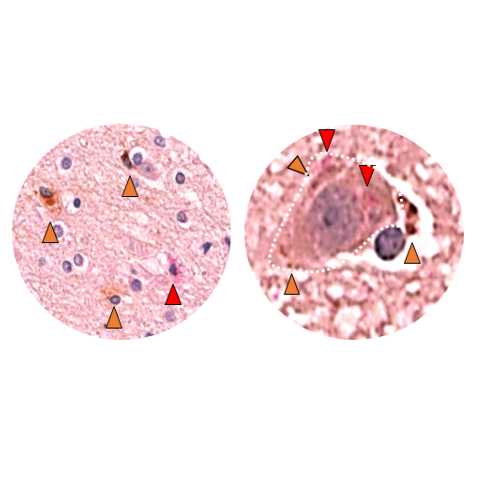
Here we provide a SOP to outline the correct procedures to dual stain FFPE human tissue for, 1) pathological TDP-43 protein, along with 2) any other protein of interest, with the aim of visualising protein of interest histology in the context of TDP-43 pathology.
This protocol can be implemented for dual staining of any rabbit or mouse primary detection antibody (using the Novolink Polymer Detection System), with our TDP-43 RNA aptamer (biotinylated) as published in Acta
Neuropathologica here https://link.springer.com/article/10.1007/s00401-024-02705-1 in Spence and Waldron et al., 2024.
The resulting dual stain will show brown chromogen (detecting the target of the primary antibody) with red chromogen (detecting TDP-43 pathology with our TDP-43 RNA aptamer.
Reference for citations of this method
Clinicopathological analysis of NEK1 variants in amyotrophic lateral sclerosis.
Olivia M. Rifai, Fergal M. Waldron, Danah Sleibi, Judi O’Shaughnessy, Danielle J. Leighton*, Jenna M. Gregory*‡ (2024). Brain Pathology doi: 10.1111/bpa.13287 (in press at the time of publication of this SOP) *equal contributions, ‡corresponding author.
Antibody and TDP-43 RNA aptamer dual staining to detect patterns of co-pathology in FFPE-preserved human tissue, as described in Rifai et al., 2024 (Brain Pathology): An SOP and tick-sheet.
Fergal M. Waldron, Olivia M. Rifai, Jenna M. Gregory‡, (2024). Protocols.io 2024; doi: tbc
‡corresponding author

Image Attribution
Jenna M Gregory
Guidelines
See SOP pdf.
Materials
See SOP pdf Appendix A.
Protocol references
Reference for citations of this method
Clinicopathological analysis of NEK1 variants in amyotrophic lateral sclerosis.
Olivia M. Rifai, Fergal M. Waldron, Danah Sleibi, Judi O’Shaughnessy, Danielle J. Leighton*, Jenna M. Gregory*‡ (2024). Brain Pathology doi: 10.1111/bpa.13287 (in press at the time of publication of this SOP) *equal contributions, ‡corresponding author.
Antibody and TDP-43 RNA aptamer dual staining to detect patterns of co-pathology in FFPE-preserved human tissue, as described in Rifai et al., 2024 (Brain Pathology): An SOP and tick-sheet.
Fergal M. Waldron, Olivia M. Rifai, Jenna M. Gregory‡, (2024). Protocols.io 2024; doi: tbc
‡corresponding author