Dec 11, 2020
Amplification and Pooling
- Franziska Aron1,
- Guido Brandt2
- 1Friedrich-Schiller Universität Jena;
- 2Max Planck Institute for the Science of Human History
- WarinnerGroup
- MPI EVA Archaeogenetics



Protocol Citation: Franziska Aron, Guido Brandt 2020. Amplification and Pooling . protocols.io https://dx.doi.org/10.17504/protocols.io.beqkjduw
License: This is an open access protocol distributed under the terms of the Creative Commons Attribution License, which permits unrestricted use, distribution, and reproduction in any medium, provided the original author and source are credited
Protocol status: Working
We use this protocol and it's working
Created: April 06, 2020
Last Modified: December 11, 2020
Protocol Integer ID: 35308
Keywords: DNA library, NGS, dual-index, ancient DNA, sequencing, nonUDG, double-stranded, DNA, genomic DNA, genomics, palaeogenetics, archaeogenetics, paleogenetics, archeogenetics, aDNA, Illumina, library preparation, nucleic acids, Amplification, PCR, Index Amplification, dna library, stranded dna library, amplification procedure, amplification, stranded dna, dna, following protocol, protocol, procedure
Abstract
This protocol describes the amplification procedure of dual-indexed double-stranded DNA libraries, for shotgun Illumina sequencing. It is typically used for libraries indexed using the following protocol: (https://dx.doi.org/10.17504/protocols.io.bakticwn)
Image Attribution
Franziska Aron
Guidelines
Working in an Molecular Biology Laboratory
This protocol can place in a typical DNA-based molecular biology lab.
Please keep in mind the safety guidelines of your specific country and institution.
Recommendations include wearing of:
- lab coats
- closed shoes and trousers
- safety glasses
- nitril or latex gloves
Materials
MATERIALS
0.2 ml PCR Tube stripsEppendorfCatalog #0030124359
DNA LoBind Tube 1.5ml EppendorfCatalog #022431021
2 ml LoBind TubesEppendorfCatalog #0030108078
Eppendorf Tubes® 5.0 mL with snap capEppendorfCatalog #30119460
dNTP Mix (25 mM each)Thermo Fisher ScientificCatalog #R1121
Sodium Acetate buffer solution 3M pH 52 for molecular biologyMerck MilliporeSigma (Sigma-Aldrich)Catalog #S7899-500ML
Tween 20Merck MilliporeSigma (Sigma-Aldrich)Catalog #P9416-50ML
Water HPLC Plus Merck MilliporeSigma (Sigma-Aldrich)Catalog #34877-2.5L-M
D1000 LadderAgilent TechnologiesCatalog #5067-5586
D1000 ScreenTapeAgilent TechnologiesCatalog #5067-5582
D1000 ReagentsAgilent TechnologiesCatalog #5067-5583
Herculase II Fusion DNA PolymeraseAgilent TechnologiesCatalog #600679
High Sensitivity D1000 LadderAgilent TechnologiesCatalog #5067-5587
High Sensitivity D1000 ReagentsAgilent TechnologiesCatalog #5067-5585
High Sensitivity D1000 ScreenTapeAgilent TechnologiesCatalog #5067-5584
MinElute PCR Purification KitQiagenCatalog #28004
Primers
| Oligo_ID | Sequence (5'-3') | Cocentration | |
| IS5 | AATGATACGGCGACCACCGA | 10 µM | |
| IS6 | CAAGCAGAAGACGGCATACGA | 10 µM |
Lab equipment
PCR Thermocycler (e.g. Eppendorf Thermomaster Nexus)
Centrifuge 1.5/2.0 ml (e.g. Eppendorf 5424)
Rotor 1.5/2.0ml (e.g. Eppendorf F-45-24-11)
Mini table centrifuge
TapeStation (e.g. Agilent Technologies, 4200 Tapestation System, SKU: G2991AA)
Vortex mixer (e.g. Scientific Industries Vortex-Genie® 2)
Safety warnings
Reagents
Sodium Acetate
- H139: Causes serious eye irritation
Ethanol
- H225 Highly flammable liquid and vapour.
- H319 Causes serious eye irritation.
Guanidinium hydrochloride (GuHCl ) (in PB buffer of Qiagen MinElute kit)
- H302 Harmful if swallowed.
- H332 Harmful if inhaled.
- H315 Causes skin irritation.
- H319 Causes serious eye irritation.
Kits
Check manufacturer's safety information for the TapeStation Kits used in this protocol.
Check manufacturer's safety information for the MinElute PCR Purification kit used in this protocol.
- Note that PBI must be stored at room temperature in the dark. PBI is light sensitive.
Before start
Planning
This protocol takes 1 day.
Check all waste disposal guidance for all reagents in this protocol against your corresponding laboratory regulations.
Preparation of buffers (Qiagen MinElute kit):
- Add ethanol to PE wash buffer acccording to manufacturer's instructions.
- Add 200 µL pH-Indicator and 300 µL Sodium Acetate to 48.5 mL of PB binding buffer. This solution is referred to as PBI throughout the protocol. Must be stored at room temperature in the dark. PBI is light sensitive.
- Add Tween-20 to EB elution buffer to a final concentration of 0.05% Tween-20 in EB. This solution is referred to as EBT throughout the protocol.
Equipment
Make sure all necessary equipment is available (see Materials).
Abbreviations
EBT = modified EB-Buffer (MinElute Kit), see Preparation of buffers
HPLC = High Performance Liquid Chromatography (-Grade Water)
PBI = modified PB-Buffer (MinElute Kit), see Preparation of buffers
PE = PE-Buffer from Qiagen MinElute Kit
Samples
This protocol is designed for the amplification of indexed libraries as prepared by the protocol described in (https://dx.doi.org/10.17504/protocols.io.bakticwn). The indexing protocol generates 50 µL of indexed library, of which 20 µL will be used for this protocol. Ensure sufficient indexed library is avaliable before starting this protocol.
Calculations
Prepare amplification assay [100 µL per reaction ]
Based on the quantification results of the indexed libaries (https://dx.doi.org/10.17504/protocols.io.bakticwn) calculate the number of PCR cycles (amplification factor) needed to reach 10^13 copies of DNA per indexed Library.
Note
Formula in Excel to get the Cycles needed
=LOG((1*10^13/Copies per rxn),2)
(log base 2)
Example: The following calculation is for 5 µL per reaction, with two indexed library samples (A and B) having different concentrations of DNA copies.
Optonial Changes: 1.If the Calculation shows up less then 3 Cycles, you also have the Option to add less then 5 µl.
2. Instead of 4 reactions of 5 µl each you can also split in 8 reactions of 2 µl each
Instead of 4 x 5 µl reactions you can also split in 8 x 2 µl reactions
| Sample Name | Copies per µl | µl per rxn | Copies per rxn | Cycles needed | Real Cycles | Amplification Factor | Output per rxn [Copies] | |
| A | 7.32E+10 | 5 | 3.66E+11 | 4.772998 | 5 | 32 | 1.17E+13 | |
| B | 5.79E+06 | 5 | 2.32E+07 | 18.72018251 | 19 | 524288 | 1.21E+13 |
Note
Do not calculate the amount of cycles for a higher amount of copies than 1.4 *10^13 to avoid heteroduplexes.
Preparation
Prepare cleaned workspace with all necessary reagents and equipment.
Note
Label all 0.2 mL PCR strips for the PCR reactions.
PCR
Set up four amplification reactions of 100 µL each per library
| Reagent | Stock concentration | Final concentration | 1x Volume [µl] | |
| Herculase II Reaction buffer | 5x | 1x | 20 | |
| IS5 primer | 10 µM | 0.4 µM | 4 | |
| IS6 primer | 10 µM | 0.4 µM | 4 | |
| dNTP's | 25 mM | 0.25 mM | 1 | |
| Herculase II Fusion | 1 U | 0.01 U | 1 | |
| DNA | 5 | |||
| HPLC-Water | 65 | |||
| Total | 100 |
Vortex master mix before adding the enzyme. After adding the enzyme, mix by pipetting or inverting the tube.
Pipette 95 µL mastermix and 5 µL indexed library into each tube (use 0.2 mL PCR strips).
Safety information
Keep the remaining library at-20 °C until further use.
Amplify in a thermocycler with the following program:
| Tempreature | Time | ||
| 95°C | 2 min | Inital denaturation | |
| 95°C | 30 sec | Cycles (see Step 1) | |
| 60°C | 30 sec | ||
| 72°C | 30 sec | ||
| 72°C | 5 min | Final elongation | |
| Finally hold the reactions at 10 °C. | |||
Note
Adjust the number of cycles according to the amplification factor as calculated in step 1.
During this incubation take MinElute columns out of the fridge so they warm up to room temperature before use in the next step.
This is an ideal point to prepare downstream steps, including labelling of final elution tubes, MinElute Columns etc.
MinElute Purification
Purify with MinElute kit with the following modifications to the manufacturer's protocol:
Use one column for all four reactions [=400 µL PCR product] of a sample.
Add 2400 µL PB or PBI* buffer to a 5 mL tube for each sample (this is 600 µL buffer for each PCR reaction). Add all 4 PCR reactions per sample to the same tube with PB buffer and vortex briefly.
Safety information
After the PCR product is mixed with the PBI, the PBI should keep its yellow colour. If it turns purple the pH is too high and the efficency of the MinElute columns is not guaranteed.
Load 700 µL of the mixture onto one MinElute column, incubate for 00:02:00 , spin 15800 x g, 00:01:00 , and discard flow-through.
Note
Pour off the liquid into a waste tube, and pat the rim of the collection tube dry on a paper tissue or towel. Use just one spot on the paper tissue per sample. Be careful not to touch the rim of the tube on the waste container. After you are finished with all samples, discard the paper and wipe clean the surface underneath with water and soap.
Repeat loading until the complete mixture was run through the column.
Add 700 µL PE (wash) buffer, spin 15800 x g, 00:01:00 , and discard flow-through.
Dry spin 15800 x g, 00:01:00 ,
Put column into new 1.5 mL LoBind tubes.
Add 50 µL EBT buffer to the center of the filter, incubate for 00:02:00 , and spin 15800 x g, 00:01:00 to elute the amplified indexed library.
Note
Carefully pipette EBT directly onto the center of the membrane without touching the membrane.
Measurement and Dilution
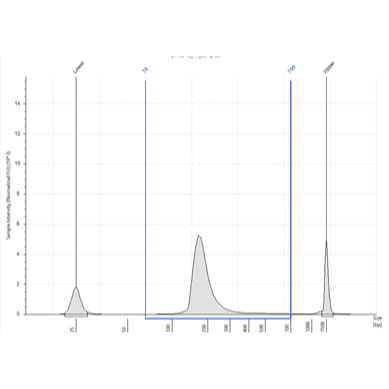
Dilute amplified index library 1:10 with HPLC- water and check for fragment size, concentration, and heteroduplexes. (for example with the D1000 Kit's Tape, Reagent and Buffer - following the manufacturer's protocol on the TapeStation)
Note
if you see heteroduplexes you need to perform a reconditoning PCR.
Reconditoning PCR: one cycle PCR using 100 ng library template in a 100 µl Herculase PCR reaction (same set up as in 3) and amplified with 1 cycles of 95°C for 2 min, 58°C for 2 min, and 72°C for 5 min. Purify with MinElute kit following the instructions from Step 5, but elute in 20µl EBT.
Dilute each amplified indexed library to 10 nM with EBT buffer or HPLC-water for shotgun sequencing. Then pool the 10 nM amplified indexed libraries in equimolar amounts (take the same volume for each sample).
Note
The final concentration of a pool of several amplfied indexed libraries should be 10 nM .
Check the 10 nM library or the 10 nM library pool for the correct concentration, (for example with the HighSensitivity D1000 Kit's Tape, Reagent and Buffer following the manufacturer's protocol on the TapeStation.)