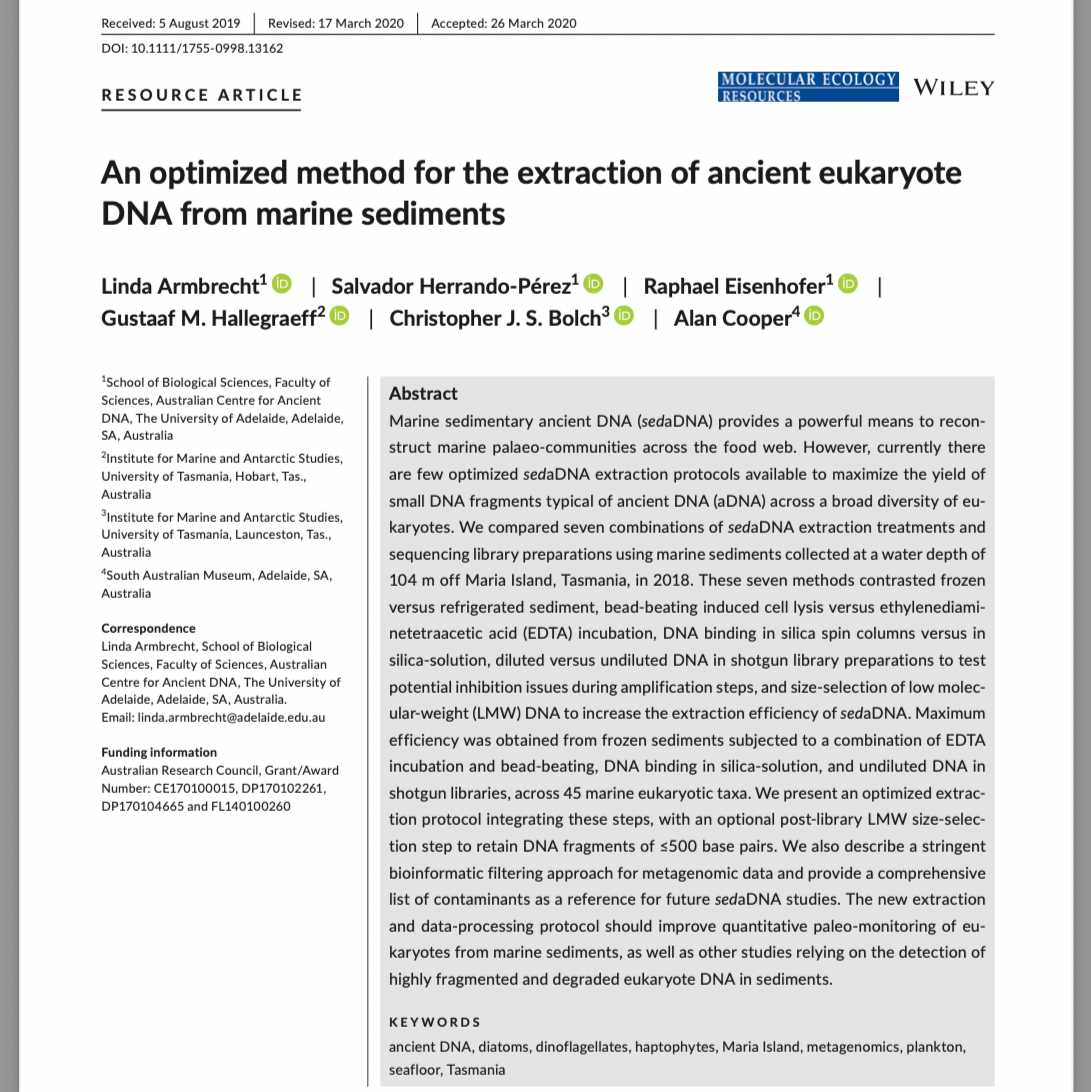
Linda Armbrecht, Salvador Herrando-Pérez, Raphael Eisenhofer, Gustaaf M. Hallegraeff, Christopher J. S. Bolch, Alan Cooper (Invalid date). An optimized method for the extraction of ancient eukaryote DNA from marine sediments. Molecular Ecology Resources.
License: This is an open access protocol distributed under the terms of the Creative Commons Attribution License, which permits unrestricted use, distribution, and reproduction in any medium, provided the original author and source are credited
Protocol status: Working
We use this protocol and it's working
Created: February 13, 2023
Last Modified: April 18, 2023
Protocol Integer ID: 76894
Keywords: ancient DNA, diatoms, dinoflagellates, haptophytes, Maria Island, metagenomics, plankton, seafloor, Tasmania, ancient eukaryote dna from marine sediment, using marine sediment, combinations of sedadna extraction treatment, sedadna extraction treatment, ancient eukaryote dna, marine sediment, dna binding in silica spin column, dna, dna binding, refrigerated sediment, method for the extraction, extraction
Abstract
Four combinations of sedaDNA extraction treatments using marine sediments collected at a water depth of 104 m off Maria Island in Tasmania are compared. These methods contrast frozen versus refrigerated sediment, bead-beating induced cell lysis versus ethylenediaminetetraacetic acid (EDTA) incubation, DNA binding in silica spin columns versus in silica-solution.
All four methods worked to varying degrees; see paper for recommended shotgun library preparation
Bead-beating + liquid silica in QG Buffer (“Si4” and “Si20”)
EDTA + MinElute (“EDTA”)
EDTA + bead-beating + liquid silica in QG Buffer (“Combined”, or “Com”)
Before start
Sediment processing and pretreatment:
Core section processing, sedaDNA extractions and sequencing library preparations took place at ACAD's ultraclean forensic facilities following aDNA decontamination standards (Willerslev & Cooper, 2005). We placed the three sediment core sections into zip-lock bags sterilised with UV light and manually homogenized them for ~5 min. From each section, two 1 cm3 subsamples were transferred into two separate 15 ml centrifuge tubes using a sterile disposable spatula. One subsample was kept at 4°C and the other at –20°C for one month. The samples were prepared for the different extraction methods in a glove box decontaminated (3% bleach) between consecutive subsamples.
This technique was applied to 0.25 g of sediment subsamples stored at 4 °C, following the manufacturer's protocol with the some modifications:
TRANSFER sediment into individual bead-tubes using a disposable, sterile spatula
APPLY bead-beating in three runs of 00:00:20 with 00:00:05 breaks using a Precellys 24 homogenizer
CENTRIFUGE at 10319 rpm for 00:00:30
55s
RETAIN all optional 00:05:00 incubation steps at 4 °C per the kit's protocol
5m
ELUTE DNA in 80 µL of Buffer EB instead of the customary C6 solution and store at -20 °C
Method 2: Bead-beating + liquid silica in QG Buffer (“Si4” and “Si20”)
1h 32m
This lysis process was applied to 0.25 g of the subsamples stored at both 4 °C and -20 °C
FOLLOW the same protocol as described in Section 1 down to step 10 of the manufacturer's instructions (addition of Solution C3 and subsequent centrifugation)
AFTER this step...
TRANSFER the supernatant to 15 mL centrifuge tubes containing a DNA-binding buffer
Note
DNA Binding Buffer
100 µL silica-solution (Sigma Aldrich)
3 mL modified Buffer QG (2.7 mL Buffer QG, 46 µL H2O, 39.08 µL Triton X-100, 24.66 Molarity NaCl, and 164.5 Molarity NaOAc (Brotherton et al., 2013)
STIR on a rotary mixer for 00:00:00 at Room temperature
CENTRIFUGE at 4500 rpm for 00:05:00
DISCARD supernatant
RESUSPEND pellet in 900 µL of DNA-binding buffer
5m
RE-CENTRIFUGE at 14000 rpm for 00:01:00
DISCARD the supernatant
WASH the pellet twice in 80 % ethanol
DRY pellet for 00:15:00 at 37 °C
RESUSPEND pellet in 80 µL Buffer EB
16m
FOLLOWING incubation for 00:10:00 at 50 °C, centrifuge at 14.000 rpm for 00:01:00
STORE the supernatant (free of silica) in a sterile Lo-bind tube (Eppendorf) at -20 °C
11m
Method 3: EDTA + MinElute (“EDTA”)
3m
This technique was applied to 0.25 g sediment subsamples stored at 4 °C following Slon et al. (2017) with minor modifications
ADD1 mL of ethylenediaminetetraacetic acid (EDTA) to the sediment in a 2 mL screw-cap tube
PLACE samples on a rotary mixer and mix at 25 rpm, Overnight at Room temperature
CENTRIFUGE at 13.000 rpm for 00:03:00
PURIFY the DNA using the MinElute Kit (Qiagen) as per the manufacturer's instructions
3m
BIND DNA using the kit's spin column
ELUTE the DNA in 80 µL of Buffer EB
Method 4: EDTA + bead-beating + liquid silica in QG Buffer (“Combined”, or “Com”)
3m
INCUBATE0.25 g of three frozen sediment subsamples in EDTA overnight as in step 3.1 of the above section "EDTA + MinElute (“EDTA”)", EXCEPT use only 0.75 mL to keep volumes consistent with a subsequent step (below)
CENTRIFUGE at 13.000 rpm for 00:03:00
KEEP supernatant at 4 °C
PROCESS pellet separately using bead-beating and DNA purification, as in Method 2 (above)
3m
RECOMBINE the resulting 0.75 mL DNA-solution purified from the pellet (step 10 of DNeasy Kit protocol) with 0.75 mL EDTA supernatant to make 1.5 mL total
ADD6 mL modified QG buffer with 100 µL liquid silica
PROCEED as described in Method 2 (above)
ELUTE the DNA in 100 µL Buffer EB
Citations
Linda Armbrecht, Salvador Herrando-Pérez, Raphael Eisenhofer, Gustaaf M. Hallegraeff, Christopher J. S. Bolch, Alan Cooper. An optimized method for the extraction of ancient eukaryote DNA from marine sediments