Jun 23, 2026
Agrobacterium-mediated duckweed transformation
- Jon Diab1,2,
- Ryan Edwards1,2,
- Matthew Morgan1,2,
- Matthew Gilliham1,2,
- Jenny Mortimer1,2
- 1Australian Research Council Centre of Excellence in Plants for Space;
- 2School of Agriculture, Food and Wine and the Waite Research Institute, University of Adelaide, Urrbrae, South Australia, Australia



Protocol Citation: Jon Diab, Ryan Edwards, Matthew Morgan, Matthew Gilliham, Jenny Mortimer 2026. Agrobacterium-mediated duckweed transformation. protocols.io https://dx.doi.org/10.17504/protocols.io.e6nvwx9wdgmk/v1
License: This is an open access protocol distributed under the terms of the Creative Commons Attribution License, which permits unrestricted use, distribution, and reproduction in any medium, provided the original author and source are credited
Protocol status: Working
We use this protocol and it's working
Created: June 23, 2026
Last Modified: June 23, 2026
Protocol Integer ID: 319638
Keywords: Duckweed, transformation, Agrobacterium, transient, stable, vacuum, surfactant, Silwet L-77, frond, callus, plant, application to aquatic species, infiltration, Lemnaceae, Lemnoideae, transgene, genetic engineering, calli, mediated duckweed transformation, duckweed transformation, dependent on duckweed species, duckweed species, number of duckweed species, agrobacterium culture, agrobacterium, sterile technique, mindful of sterile technique, general transformation protocol, transient transformation efficiency
Funders Acknowledgements:
Australian Research Council Centre of Excellence in Plants for Space
Grant ID: CE230100015
Abstract
This is the general transformation protocol used in the Mortimer Lab at Adelaide University for expression of genetic constructs in a number of duckweed species. This protocol generally takes about a week from start to finish, with about 7 hours total hands-on time.
Critical steps to achieve duckweed transformation:
- Ensure that surfactant is freshly diluted from concentrated stocks.
- Ensure that both duckweed fronds and Agrobacterium cultures are in log phase before use, and have not reached the spatial or nutrient limits of their medium.
- Ensure that pH of CCM is maintained between 5 - 7, especially if adding tyrosine dissolved in acidic solvents.
- As always, be mindful of sterile technique.
Expected transient transformation efficiency is ~40%, dependent on duckweed species.
Safety warnings
Diluted Silwet L-77 surfactant needs to be prepared fresh. If needed, it can be stored at 10% concentration for a maximum of 3 weeks. Note that transformation efficiency drops significantly after this time.,
If possible, refrain from autoclaving media containing supplementary tyrosine. This results in a drastic blackening of the media, the root cause of which is unknown at time of writing. Instead, add filter-sterilised tyrosine to autoclaved media as needed afterwards.
Pre-Culture
2d
Inoculate desired strain(s) of Agrobacterium tumefaciens from glycerol stock or 2xYT agar starter plate into 5 mL of Preculture Medium (PM). Incubate for 2 days at 28°C, on an orbital shaker at 200 rpm. Growth should appear saturated before moving to next step.
Overnight Outgrowth
1d
Transfer 10, 50, and 100 µL of saturated preculture to three different 50 mL conical centrifuge tubes containing 20 mL of stock PM + 150 µM sterile acetosyringone. Incubate for ~20 hours at 28°C, on an orbital shaker at 200 rpm.
Note
The purpose of inoculating with three different volumes is to obtain a culture in log phase the following day, - around 0.7 optical density at 600 nm (OD600) as measured by spectrophotometer. The required inoculation volume will differ depending on the growth kinetics of each particular Agrobacterium strain.
Infiltration
1d
Measure the OD600 of each Agrobacterium overnight culture using a 1:10 dilution.
Note
1:10 dilution = 100 µL overnight culture + 900 µL 2xYT stock. Open tubes only in a laminar flow hood to ensure sterility.
Select the tube with the closest OD600 to 0.7 and centrifuge it at 3260 rpm for 10 minutes.
10m
Discard the supernatant and resuspend the pellet in 2 mL of infection media (IM). Measure the OD600 using a 1:10 dilution.
Note
1:10 dilution = 100 µL IM resuspension + 900 µL IM stock. Open tubes only in a laminar flow hood to ensure sterility.
Calculate the required volume to reach a final OD600 of 0.5, and further dilute the IM-Agrobacterium resuspension using this value.
Add freshly prepared Silwet surfactant to a final concentration of 0.01% and 150 µM acetosyringone to IM-Agrobacterium resuspension.
Mix well and aliquot out IM-Agrobacterium resuspension to desired number of replicates.
Note
Volumes can be as low as 1 mL in 2 mL Eppendorf tubes, or as large as your vacuum chamber allows.
Transfer duckweed into individual tubes using sterile forceps.
Yellow-capped 10 mL tubes containing IM-Agrobacterium resuspension aliquoted from original red-capped 50 mL Falcon tubes. Plates of callus replicates ready for transfer.
Note
Fronds - Add enough fronds such that they are stacked more than 1 layer deep. This is to ensure as much as possible that they are immersed in solution.
Callus - Add as many as have been distributed for each replicate. These do not float, so immersion not a concern as it is for fronds.
Mix vigorously by inversion 10 times. An indication of adequate surfactant will be the formation of small bubbles/foam at the surface of the liquid.
Place the tubes in a vacuum chamber, inside of a laminar flow hood, with the ventilation valve close to the back of the hood.
Crack the lids of the tubes in the vacuum chamber, close the chamber lid and turn on the vacuum.
Foreground: Calli sunk to the bottom of IM-Agrobacterium resuspension.
Background: Fronds floating at the top of IM-Agrobacterium resuspension.
When the vacuum gauge hits -0.1 MPa, start a 10 minute timer and maintain vacuum pressure here.
Note
Note appearance of boiling here. Adequate surfactant will result in many, smaller bubbles as opposed to fewer, larger ones.
After 10 minutes have passed, turn off the vacuum and very slowly vent air into the chamber.
Note
Fronds should sink to the bottom of the tube at this stage. This behavior is highly correlated with transformation success.
Example of sunken fronds. From left to right: 0.1%, 0.01%, and 0.001% Silwet.
Note that 0.1% Silwet can be lethal in duckweed.
If working with calli, decant roughly half the IM+Agrobacterium liquid mixture from the tube into a waste container, reserving the duckweed calli. Transfer calli to fresh Co-Cultivation Medium (CCM) and seal with parafilm or micropore tape.
Note
Decanting too much here results in very little agro growth, decanting too little results in a liquidy mess. I use 5 mL IM and decant ~3 mL of it.
If working with fronds, remove the IM+Agrobacterium liquid mixture and transfer to CCM.
Co-Cultivation
4d
Incubate duckweed on CCM in the light (white light, approx. 100 μmol/m2/s, 16:8 day/night photoperiod) at 25°C for 4 days.
After 4 days, transfer the duckweed to sterile Selection Medium to eliminate the Agrobacterium, re-culturing every two weeks until cleared.
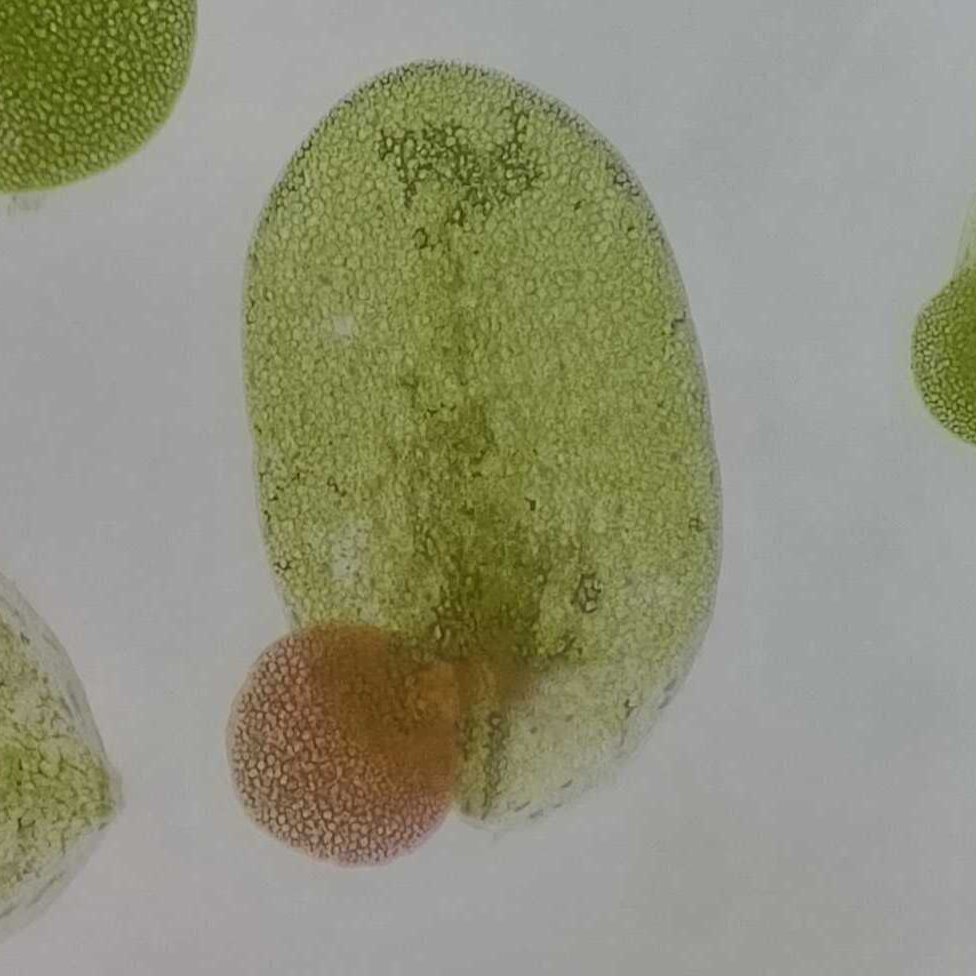
Representative images of L. minuta at 6 days post-infiltration (left) and
W. australiana at 4 dpi (right) transiently expressing the RUBY reporter.
Media Recipes
Preculture Medium (PM)
2xYT medium + 50 mg/L rifampicin + relevant selection antibiotic(s)
(add filter sterilised acetosyringone at 150 µM for final overnight culture medium (OM))
Growth Medium (GM)
0.5x Schenk & Hildebrandt medium (+0.8% (w/v) agar for solid plates)
Callus Induction Medium (CIM)
GM + 5 µM 2,4-Dichlorophenoxyacetic acid (2,4-D), 0.5 µM thidiazuron, 2% (w/v) sucrose, 1% (w/v) mannitol, 1% (w/v) sorbitol, 0.8% (w/v) agar, final pH = 7.0
Nodule Induction Medium (NIM)
GM + 1 µM 2,4-D, 2 µM 6-benzylaminopurine (6-BA), 3% (w/v) sucrose, 0.8% (w/v) agar, final pH = 7.0
Infection Medium (IM)
GM + 0.01% (v/v) freshly prepared Silwet L-77 + 150 µM acetosyringone added before use
Co-cultivation Medium (CCM)
GM + 150 µM acetosyringone added before use + 1% (w/v) sucrose (+ 0.8% (w/v) agar for solid medium, +200 mg/L tyrosine for RUBY construct use)
Nodule Co-cultivation Medium (NCCM)
GM + 150 µM acetosyringone added before use, + 1% sucrose, 0.8% (w/v) agar, 1 µM 2,4-D, 2 µM 6-BA (+200 mg/L tyrosine for RUBY construct use)
Selection Medium (SM)
GM + filter-sterilised 250 mg/L cefotaxime (+ 0.8% (w/v) agar for solid medium, + 200 mg/L tyrosine for RUBY construct use) added before use