Sep 29, 2025
Aeroponic Propagation of Citrus Trees Infected with ‘Candidatus Liberibacter asiaticus’
- Lisa Scanlon1,
- Stacy L. DeBlasio2,
- Samantha R. Sullivan3,
- David O. Igwe1,4,
- Chad Thomas5,
- Michelle Heck1,2,6
- 1Plant Pathology and Plant Microbe Biology Section, School of Integrative Plant Science, Cornell University, Ithaca, NY;
- 2Emerging Pests and Pathogens Research Unit, United States Department of Agriculture, Agricultural Research Service, Ithaca, NY;
- 3United States Department of Agriculture, Agricultural Research Service, Emerging Pests and Pathogens Research Unit, Department of Energy Oak Ridge Institute for Science and Education, Ithaca, NY;
- 4Present Address: Department of Natural Sciences, Bowie State University, Bowie, MD;
- 5Cornell University Agricultural Experiment Station, College of Agriculture and Life Sciences, Cornell University, Ithaca, NY;
- 6* Corresponding author information: Michelle Heck, [email protected]



Protocol Citation: Lisa Scanlon, Stacy L. DeBlasio, Samantha R. Sullivan, David O. Igwe, Chad Thomas, Michelle Heck 2025. Aeroponic Propagation of Citrus Trees Infected with ‘Candidatus Liberibacter asiaticus’. protocols.io https://dx.doi.org/10.17504/protocols.io.36wgqp6pyvk5/v1
License: This is an open access protocol distributed under the terms of the Creative Commons Attribution License, which permits unrestricted use, distribution, and reproduction in any medium, provided the original author and source are credited
Protocol status: Working
We use this protocol and it's working
Created: September 08, 2025
Last Modified: September 29, 2025
Protocol Integer ID: 226766
Keywords: Candidatus Liberibacter asiaticus, citrus greening disease, HLB, CLas, citrus, vegetative propagation , EZ-Clone Pro Low Cloning System, Hydrobuilder.com, aeroponics , plant pathology, woody plant species , causal agent of citrus greening disease, citrus greening disease, cloning versus seed sowing, bacterium candidatus liberibacter asiaticus, aeroponic cloning apparatus, citrus cultivar, candidatus liberibacter asiaticus, mature citrus tree, citrus tree, cloning, clone pro low cloning system, clone viability rate, variable plants from seed, seed germination, infected branch, clone pro low cloner, pro low cloner, number of clone, infected citron cutting, variable plant, seed, seed sowing, clone, flowering tree, keeping algae growth, general protocol for the vegetative propagation, vegetative propagation, plant, citrus material, algae growth
Funders Acknowledgements:
USDA National Institute of Food and Agriculture (NIFA)
Grant ID: 2020-70029-33176
Abstract
This is a general protocol for the vegetative propagation of citrus material infected with the bacterium Candidatus Liberibacter asiaticus (CLas), the presumed causal agent of citrus greening disease (HLB), using an aeroponic cloning apparatus. The following procedure details a workflow using an EZ-Clone Pro Low Cloning System from Hydrobuilder.com. This system comes in varying cell-sizes (number of clones). We have found the most versatile to be the 16- or 32-cell size based on ease of preparation, keeping algae growth to a minimum, and maintenance. Cloning versus seed sowing has been useful in producing infected material for experimental assays requiring cloned, mature citrus trees as opposed to genetically variable plants from seeds. Where seed germination can take up to 12+ months to achieve plants with stem diameters ≥ 10 mm and 5+ years for flowering, infected branches from flowering trees can be directly propagated using this protocol within a few months and retain their maturity. Clone viability rate differs by citrus cultivar and general health of the cutting used, with citron and CLas negative material having the highest success rate. Infected citron cuttings have had a 95% survival rate, regardless of the diameter of the cutting. The cutting diameter ranged from 2mm-12mm and was limited to 12mm maximum, which is the size of the collar on the EZ-Clone Pro Low cloner.
Image Attribution
All images presented in this protocol were taken by Lisa Scanlon.
Guidelines
- The cloning process in a greenhouse is not sterile; for sterile work use a sterile environment and sterile water.
- Use of chlorine bleach (10%) is described to wash cloner units — rinse thoroughly after bleach wash to remove any bleach residue from collars and system before use.
- Do not lift the entire lid off while the pump is operating — the spray is very strong and there is a chance of exposure to your eyes and person.
- If the spray is not sufficient or sprays in the wrong direction, check pump valve orientation (the valve on the front of the pump should be open with slots in the horizontal position). If the valve is open but the pump still is not spraying properly, check for debris blocking the pump and ensure the pump is covered with the correct amount of water.
- Branches as small as 2mm in stem diameter will grow but can break easily when placing them in the cloner. Branches larger than 12mm thick will not fit in the cloner collars.
- Avoid using branches/trees where leaves are nutrient deficient. This compromises rooting/transplanting success.
- Best success for obtaining a CLas infected clone is to cut branches either right below or between a leaf exhibiting unambiguous CLas symptoms or a C(t) titer equal or less than 33.
- Never fill the entire cloner with fertilized water as it fosters algae formation. If the cloner will be used for more than 2 months, the system should be emptied, rinsed, and refilled each month to minimize algae formation.
- Check cuttings regularly for root formation and power outages; lift collars slightly out of each well to inspect root development.
- Leaf loss/drop/yellowing during rooting is normal as long as stem stays green. If main stem becomes chlorotic or brown during rooting or transplanting, the clone will not survive and should be discarded.
- Minimal watering of yellowed transplanted plants is recommended to help recovery; avoid soggy conditions to prevent root rot.
Materials
EZ-Clone Pro Low Cloning System, (Hydrobuilder.com. 32-cell system)
Clonex Rooting Gel (www.growthtechnology.com)
Sharpened pruners (either bypass pruners or 1-3/8” pruners) — sterile when pruning
HLB infected plants that have branches with minimum 2 mm diameter and 6-8” in length
Reverse Osmosis (RO) water
Tap water, no fertilizer
Electrical outlet with GFI
Chlorine bleach
Fertilizer: Jack's 21-5-20 at a rate of 300 ppm with 18 oz of Epsom salts per gallon
Transplant substrate: 2 bales of 3.8 peat moss tumbled, 4 lbs. calcium sulfate, 4 lbs. Jacks professional media mix 111 10-5-10, 5 lbs. lime, 0.5 lbs. wetting agent, 1 bag of perlite, 2 bags of vermiculite.
Additional items mentioned on these pages: Black foam collars (cloner collars), plant tags (purple), petri dish or small separate container to pour rooting gel into (to avoid cross-contamination), clean cloth (for wiping down bottom vessel when refreshing water).
Safety warnings
- As the cloning process executed within a greenhouse is not sterile. As with all things grown in an open area, the plants, water, and roots will be exposed to anything in the air. For a sterile system, the cloner should be placed in a sterile environment and only sterile water used.
- When plugging in the cloner make sure electrical plug, especially metal prongs are 100% dry to prevent electrocution. Always plug cloner into an electrical outlet with GFI.
- When the cloner pump is moving any liquid, especially when using bleach wash or fertilizer, ensure the lid is securely fastened on to the cloner with the foam collars pressed tightly down in place. To test if the pump is sufficiently spraying the underside of the lid where the plants will be, lift a few foam collars out of their wells, one at a time, to ensure the bottom of the foam is getting sufficiently wet. Do not lift the entire lid off while the pump is operating. The spray is very strong and there is a chance of exposure to your eyes. Wear safety googles at all times when lifting the collars when pump is running.
- When cutting branches for rooting wear thick pruning gloves to prevent cutting your hands with shears, razor blades or citrus thorns.
- When handling bleach, Clonex rooting gel or fertilizer make sure proper PPE is worn, i.e. gloves, safety googles and lab coat.
Preparing the Cloner
Fill the cloner with a 10% bleach solution in clear tap water, ensuring the pump is completely covered. With the lid securely closed and all the collars snugly in place, to avoid the strong spray from the misters spraying out into the area, run the cloner for 1 hour with the pump valve wide open, with the bleach water being cycled through the pump.
Rinse the cloner by discarding the bleach water and refilling with tap water to cover the pump. Run the cloner for 1 hour. Be sure to individually rinse the cloner collars with tap water to remove any bleach. Remove the collars to dry and close the cloner lid.
Fill the cloner to above the line of the pump. Cloners can be filled to just below the misting mechanism. Fill with 3/4 RO water, and 1/4 tap water.
Note: This is not a sterile, closed system, especially if grown in a greenhouse. If your project requires a sterile environment, use only RO water and place the cloner in a sterile location.
Pump Mechanism
Setting up the cloner for cuttings: Ensure the lid is securely seated in place on the cloner with the black, foam collars pressed down in place. Then begin the water spray inside the cloner by plugging it in. To test if the pump is sufficiently spraying the underside of the lid where the plants will be, lift a few foam collars out of their wells, one at a time, to ensure the bottom of the foam is getting sufficiently wet. Do not lift the entire lid off while the pump is operating. The spray is very strong and there is a chance of exposure.
Cloner Lid with Collars
If the spray is not sufficient or is spraying in the wrong direction, check to see if the pump is set correctly. The valve on the front of the pump should be open with slots in the horizontal position. If open but still not spraying properly, check if the pump is blocked with debris and that the pump is covered with the right amount of water (see picture below).
Correct Positions for Pump Valve
Cloning Citrus Trees with Cuttings
Choose branches from CLas positive trees with leaves that are showing unambiguous CLas symptoms, i.e. uneven, yellow, blotchy mottling (images below) or test leaves for CLas titer using RT-qPCR (Igwe et al. 2022), selecting branches whose bottom two leaves have a cycle threshold value (Ct) value of 33 or less, regardless of visual symptoms. Do not use trees that are showing signs of nutrient deficiency (symmetric patterns of chlorosis) as it compromises clone viability. Note: we have also tried randomly choosing branches from a positive tree. The percent success of obtaining a CLas positive clone from this approach is listed in Table 1.
Representative Images of Unambiguous CLas Symptoms on Citron Leaves in the Greenhouse
Cutting branches for rooting
Selecting optimal branches: Branches should be rigid, but not completely woody (image below). A slightly hardened, partially green, epidermal layer works well for both healthy and infected citron. Choose a branch that can be 6-8” long when prepped for cloning. The stem diameter that works best is approximately 4-5mm. Successful cloning is possible with nearly any diameter branch you choose. Your limitation is the size of the cloner collars. As the branch gets larger than 12mm, it will not fit in the collar. Branches as small as 2mm will grow but they can break easily when placing them in the cloner.
Optimal CLas Infected Branch
Prune the selected branch from the tree using sterile, sharpened pruners or blades. Prune just below or between the leaves that you either visually or quantitatively confirmed are positive for CLas. An example is marked in the photo above. The purple tag marks where the branch is to be pruned.
Pruned Branch
Remove leaves from the bottom of the stem that will be inserted into the cloner (minimum of 10 mm of naked stem), as well as any top, flushing portion of the branch. Citron cuttings will root with 0-8 remaining leaves, with 3-5 producing the fastest and most robust roots. Dip the cut end of the stem into the Clonex rooting gel. Be sure to pour the rooting gel into a separate container, like a petri dish, to prevent cross-contamination of the stock gel.
Trimmed Branch with 5 Leaves
Placing branch into the cloner
Placing branch into the cloner: Once the branch is trimmed, place the stem into the foam collar using the slit on the side. The branch will successfully root if any part of the stem extends into the cloner from the bottom of the collar (image below). It is not necessary to include a node in this section. Similarly, rooting will happen even if nodes from trimmed leaves and thorns extend into the cloner. Roots will form successfully from the bottom, cut section of the stem (brown area) as well as from nodes (see images at the end of the document).
Cut End of the Stem Protruding into Cloner from Collar
Checking root growth
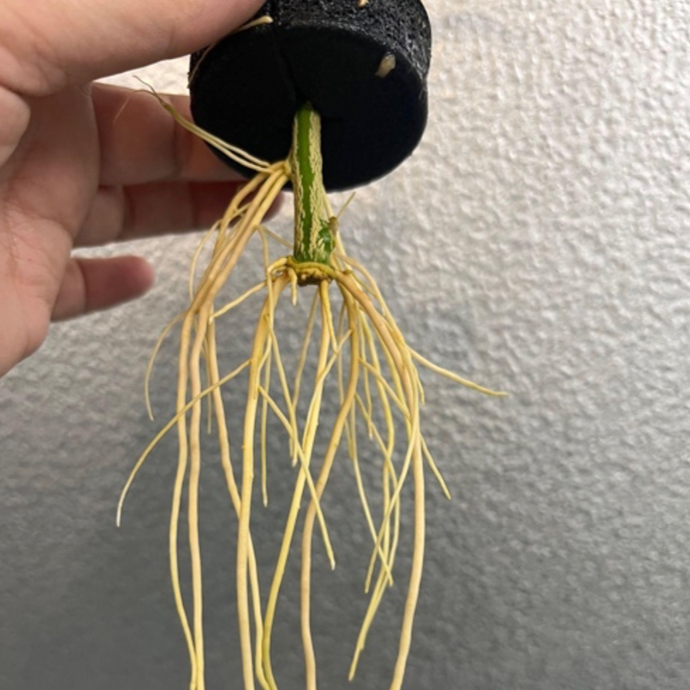
Checking root growth: Check the cuttings regularly for root formation, for proper watering, and to ensure the cloner has not experienced a power outage, by individually lifting the collars slightly out of each well. At this time, there may be leaf loss and/or wilting in the aerial section of the cuttings. If the stem remains green, above and below the collar mark, the plant is still viable, even if every leaf is dropped. If a plant turns brown in the stem, the cutting is not successful and should be removed. See photos at the end of the protocol for weekly stages of root formation.
Cleaning/refreshing water in cloner
Cleaning/refreshing water in cloner: Every 6 weeks, the water in the cloner should be refreshed. Turn off the cloner, empty the bottom vessel and wipe it down with a clean cloth. Refill the vessel with a 3:1 ratio of RO:tap water to just below the top of the pump, and fill to the top of the pump with fertilizer. Do not fill the entire cloner with fertilized water as it fosters algae formation. If the cloner will be used for more than 2 months, the system should be emptied, rinsed, and refilled each month to minimize algae formation.
Root formation in cloner
Root formation in cloner: See Table 1 below for general timelines of root formation for different cultivars of citrus. For CLas infected citron, the cuttings should be transplant-ready within 6 weeks of cutting.
Table 1: Cutting success rate per citrus cultivar
aCitrus cultivar tested. For grapefruit and sweet orange, varieties
tested were Ruby red/Pink Frost and Hamlin/Madam Vinous, respectively.
bTime in days when roots start to form after being placed in
cloner.
cOptimal range of branch diameters (mm) that lead to fastest and
highest rooting success. In parentheses is the minimum and maximum branch
diameter tested that also cloned successfully to some extent.
d Optimal number of expanded leaves that should be retained on the
clone branch, above the cloner collar, for highest rooting success and least
leaf loss. In parentheses is the minimum and maximum number of leaves tested
that also cloned successfully to some extent.
eTime in days from cutting to transplantation of clone into
prepared substrate.
fPercentage of cuttings that successfully rooted and survived from
cutting to after transplantation.
gPercentage of clones that tested positive for CLas after
transplantation following the method where branches were randomly chosen from
an infected mother tree without testing the branch for CLas titer.
Transplanting rooted cuttings into substrate
Transplanting rooted cuttings into substrate: Once the roots have developed to the size of a golf ball (minimal–larger root balls are also successful), transplant them into a 6” pot filled with pre-moistened transplanting substrate. A 6” pot is optimal for transplant success. However, successful transplants can be achieved by going directly into 1 gallon or 4” pots, if the soil is not kept too wet or too dry relative to root size (i.e. small citrus root balls should not be overwatered). Create a small hole in the substrate to fit the root ball and pack the roots with medium pressure into the substrate. Water in the plant thoroughly.
Monitor and test for CLas
Monitor and test for CLas: After the plants have been in pots for a minimum of one month, test again for CLas on mature, hardened leaves that have formed since the cuttings. Avoid flush or juvenile (supple) leaves as they tend to be negative for CLas at this early developmental stage. CLas infection can be validated visually if non-ambiguous leaf symptoms develop or by qPCR analysis. If cloning in cooler climates (~≤ 80°F), testing should start 2 months after transplanting as we have observed slower systemic movement of CLas into the newly formed leaf canopy during colder temperatures and shorter light cycles.
Once cuttings are transplanted, they tend to thrive. Leaves may yellow and fall from the transplant, but new flush will emerge. If the new flush does not emerge, the stem turns brown or if all the leaves remain chlorotic, the transplant may not have been successful, and the plant should be removed. Some yellowing and leaf loss is normal. Minimal watering of yellowed plants—once per day, or only once the pot is dry—may help these plants to recover. Soggy conditions can cause root rot in these plantlets.
Representative images of root formation during aeroponic procedure
Conclusion: Cloning aeroponically creates a situation where roots can be monitored for success more easily than within a soil substrate. In addition, root delivery of disease prevention or mitigation treatments can be administered. The cloning procedure can also be adapted to other woody perennial plants, such as cotton.
Protocol references
Igwe, D. O., Higgins, S. A., Heck, M. 2022. An excised leaf assay to measure acquisition of ‘Candidatus Liberibacter asiaticus’ by psyllids associated with citrus Huanglongbing disease. Phytopathology, 112 (1): 69-75.