Aug 19, 2022
ACE-inhibitory activity assay: IC50
- Ezequiel Coscueta1,
- & Maria Manuela Pintado2
- 1Universidade Catolica Portuguesa;
- 2Centro de Biotecnologia e Química Fina (CBQF)-Laboratório Associado, Escola Superior de Biotecnologia,Universidade Católica Portuguesa, Rua Diogo Botelho 1327, 4169-005 Porto, Portuga



Protocol Citation: Ezequiel Coscueta, & Maria Manuela Pintado 2022. ACE-inhibitory activity assay: IC50. protocols.io https://dx.doi.org/10.17504/protocols.io.q26g74q5kgwz/v1
Manuscript citation:
Coscueta, E. R., Campos, D. A., Osório, H., Nerli, B. B., & Pintado, M. (2019). Enzymatic soy protein hydrolysis: A tool for biofunctional food ingredient production. Food Chemistry: X, 1(100006). https://doi.org/10.1016/j.fochx.2019.100006
License: This is an open access protocol distributed under the terms of the Creative Commons Attribution License, which permits unrestricted use, distribution, and reproduction in any medium, provided the original author and source are credited
Protocol status: Working
We use this protocol and it's working
Created: August 17, 2022
Last Modified: August 19, 2022
Protocol Integer ID: 68779
Keywords: ACE, angiotensin-converting enzyme, antihypertensive, IC50, bioactivity, ngiotensin-I converting enzyme, angiotensin, inhibitory activity assay, ic50 in inhibition, nitrophenylalanylproline, enzyme, terminal dipeptide, peptide substrate, action of ace, converting enzyme, assay, ace
Abstract
This protocol describes the procedure for the determination of the IC50 in inhibition on angiotensin-I converting enzyme (ACE) activity. ACE is also known as peptidyl dipeptidase A because it removes C-terminal dipeptides from a wide variety of peptide substrates. In the assay described here, the chosen substrate is the intramolecularly quenched fluorescent tripeptide o-aminobenzoylglycyl-p-nitrophenylalanylproline (Abz–Gly–Phe(NO2)–Pro). Hydrolysis of this substrate by the action of ACE generates the fluorescent product o-aminobenzoylglycine (Abz–Gly).
Guidelines
ACE-inhibitory activity is measured by fluorescence using the method of Sentandreu & Toldrá (2006) with some modifications (Coscueta, Campos, Osório, Nerli, & Pintado, 2019). A total of 40 µL of ultrapure water or ACE working solution are added to each microtiter-plate well, then adjusted to 80 µL by adding ultrapure water to blank, control or samples. For direct or 1/2 diluted samples a sample blank is also made. The enzyme reaction is started by adding 160 µL of substrate solution and the mixture is incubated at 37 °C. Serial dilutions are made of each sample, usually 1/1 to 1/32. The fluorescence generated is measured at 30 min using a Multidetection plate reader (Synergy H1, Vermont, USA). The assay is performed in a black 96-well microplate (Nunc, Denmark). Excitation and emission wavelengths are 350 and 420 nm, respectively.
Note: In some cases it is necessary to extend the range to 1/5 or 1/10 serial dilutions.
Note: Generally the most concentrated dilutions are the ones that can fluoresce as the sample itself, so in the example sample blanks (SPLB) are used only for the two most concentrated dilutions. In the case of highly fluorescent samples, SPLB should be used for all dilutions.
Citation
LINK
Citation
LINK
Materials
Angiotensin Converting Enzyme from rabbit lungMerck MilliporeSigma (Sigma-Aldrich)Catalog #A6778
Tris BaseFisher ScientificCatalog #BP152-1 or Tris-HClMerck MilliporeSigma (Sigma-Aldrich)
Ultrapure Water
ZnCl2 anhydrousThermo Fisher ScientificCatalog #11497737
Sodium ChlorideFisher ScientificCatalog #S271
Abz-Gly-p-nitro-Phe-Pro-OH TrifluoroacetatebachemCatalog #4003531.0050
Equipment
Synergy H1M
NAME
Multidetection plate reader
TYPE
BioTek
BRAND
679SH1M-SN
SKU
Detection modes: UV-Vis absorbance; fluorescence intensity; luminescence
Read methods: endpoint, kinetic, spectral scanning, well area scanning
Microplate types: 6- to 384-well plates
Temperature control: to 45 °C
Shaking: linear, orbital, double orbital
SPECIFICATIONS
Equipment
96 Well Black Plate
NAME
microplate
TYPE
Nunc
BRAND
237108
SKU
96-Well black polystyrene microplate, flat bottom, 50 to 250 μL, non-sterile, non-treated
SPECIFICATIONS
Before start
Prepare the necessary reagents carefully.
1 U/mL ACE stock solution
- Dissolve the Angiotensin Converting Enzyme from rabbit lungMerck MilliporeSigma (Sigma-Aldrich)Catalog #A6778 (peptidyl-dipeptidase A, EC 3.4.15.1) in a solution of 50% glycerol in ultrapure water, to obtain a final concentration of 1 U/mL.
- Make aliquots of 200 µL of the solution and store at -20 °C .
0.150 Mass Percent Tris buffer 8.3
- Dissolve 1.817 g of Tris base (MW = 121.14) or 2.364 g Tris-HCl (MW = 157.60) in approx. 90 mL ultrapure water .
- Titrate to 8.77 at the lab temperature of Room temperature with monovalent strong base or acid as needed.
- Make up volume to 100 mL with ultrapure water.
Buffer will be8.3 at 37 °C .
42 mU/mL ACE work solution
- Prepare a solution of 1 millimolar (mM) ZnCl2 , dissolving 1.4 mg ZnCl2 (MW = 136.28) in 10 mL ultrapure water . Store at -20 °C .
- Prepare 0.1 millimolar (mM) ZnCl2 0.150 Mass Percent Tris buffer 8.3 (Enzyme buffer). Dilute 1/10 the previous solution (0.1 millimolar (mM) ) and add 25 µL of this solution to 25 mL of 0.150 Mass Percent Tris buffer 8.3 . Store at 4 °C for a maximum of one week, or at -20 °C for a maximum of six months.
- Dilute 1/24 the 1 U/mL ACE stock solution with the Enzyme buffer. Prepare daily.
0.45 millimolar (mM) Substrate solution
- Prepare 1.125 Mass Percent NaCl 0.150 Mass Percent Tris buffer 8.3 (Substrate buffer). Dissolve 3.2872 g NaCl (MW = 58.44) in 50 mL of 0.150 Mass Percent Tris buffer 8.3 . Store at 4 °C for a maximum of one week, or at -20 °C for a maximum of six months.
- Dissolve 3.6 mg of substrate Abz-Gly-p-nitro-Phe-Pro-OH TrifluoroacetatebachemCatalog #4003531.0050 in 16 mL Substrate buffer (for 96 wells). Prepare at the moment.
Analysis
30m
Microplate outline example for IC50 determination.
Add 80 µL ultrapure water to blank (BLK)
Add 40 µL ultrapure water to control (CTL) and sample blank (SPLB)
Add 40 µL sample dilution to sample (SPL) and sample blank (SPLB)
Add 40 µL ACE work solution to control (CTL) and sample (SPL)
Add 160 µL Substrate solution to control all wells
Incubate at 37 °C 00:30:00 and read fluorescence with 350 nm excitation wavelength and 420 nm emission wavelength
30m
Result treatment
Inhibitory activity is expressed as the peptide concentration required to inhibit the original ACE activity by 50% (IC50). The formula applied to calculate de percentage of ACE-inhibitory is:
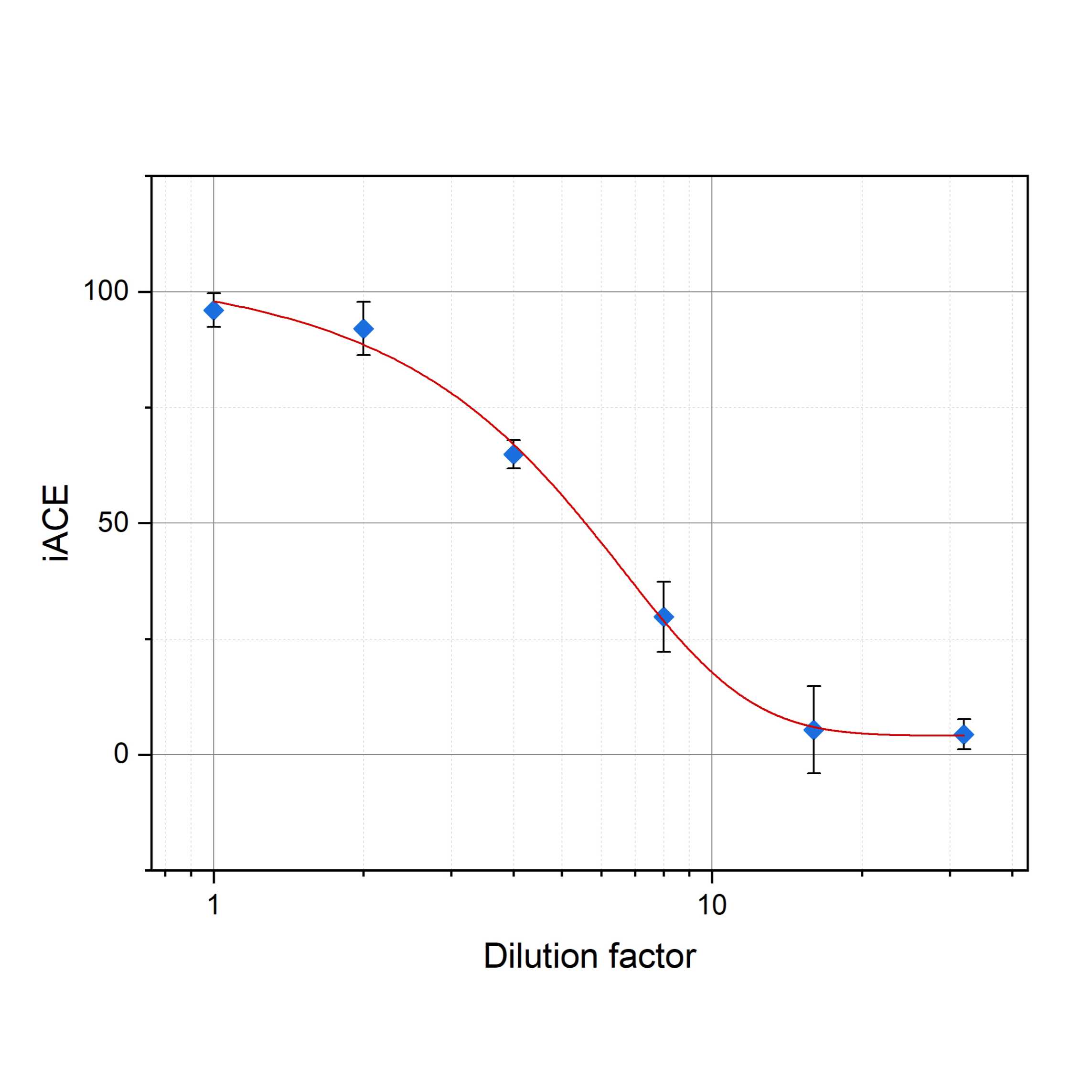
Non-linear fitting to the data is performed to calculate the IC50 values, using the 5 Parameter curve fit method and then Interpolating to 50.
Example of a typical inhibition curve as a function of dilution factor.
Citations
Sentandreu, M. Á., & Toldrá, F.. A rapid, simple and sensitive fluorescence method for the assay of angiotensin-I converting enzyme
https://doi.org/10.1016/j.foodchem.2005.06.006Coscueta, E. R., Campos, D. A., Osório, H., Nerli, B. B., & Pintado, M.. Enzymatic soy protein hydrolysis: A tool for biofunctional food ingredient production
https://doi.org/10.1016/j.fochx.2019.100006