Sep 12, 2025
Version 1
A step-by-step protocol and guide for cavity-nesting Hymenoptera sampling and data collection using trap nests V.1
- Bihaly, Á.D.1,2,
- Stephenson, D.L.1,
- Józan, .3,
- Somay, L.1,
- Báldi, .1,
- Kovács-Hostyánszki, 1,
- Sárospataki, .2,
- Török, 4
- 1Lendület Ecosystem Services Research Group, Institute of Ecology and Botany, HUN-REN Centre for Ecological Research, Vácrátót, Hungary;
- 2Department of Zoology and Ecology, Institute for Wildlife Management and Nature Conservation, Hungarian University of Agriculture and Life Sciences, Gödöllő, Hungary;
- 3Rippl-Rónai Museum, Kaposvár, Hungary;
- 4Lendület Landscape and Conservation Ecology Research Group, Institute of Ecology and Botany, MTA–HUN-REN Centre for Ecological Research, Vácrátót, Hungary



Protocol Citation: Bihaly, Á.D., Stephenson, D.L., Józan, ., Somay, L., Báldi, ., Kovács-Hostyánszki, , Sárospataki, ., Török, 2025. A step-by-step protocol and guide for cavity-nesting Hymenoptera sampling and data collection using trap nests . protocols.io https://dx.doi.org/10.17504/protocols.io.ewov11znovr2/v1Version created by David Stephenson
License: This is an open access protocol distributed under the terms of the Creative Commons Attribution License, which permits unrestricted use, distribution, and reproduction in any medium, provided the original author and source are credited
Protocol status: Working
We use this protocol and it's working
Created: September 12, 2025
Last Modified: September 13, 2025
Protocol Integer ID: 227049
Keywords: data from trap nest, nesting hymenoptera sampling, processing of trap nest, nesting hymenoptera, describing trap nest production, storing of trap nest, using trap nest, trap nest production, trap nest, hymenoptera sampling, hymenoptera research, development of immature brood, abundance data, immature brood, sampling tool for cavity, sampling procedure, sampling tool, reed processing, guide for cavity, obtaining data, practical taxa identification guide, sample, step protocol details the production
Abstract
This step-by-step protocol details the production, deployment, and processing of trap nests, a sampling tool for cavity-nesting Hymenoptera that enables the collection of detailed ecological, life-history, and abundance data. We start by describing trap nest production and the sampling procedure (production, deployment, retrieval and storing of trap nests; see Section A), followed by processing, which begins with pre-sorting (Section B), and continues with reed processing, and data entry (Section C). Finally, the process of putting away samples (Section D), and the development of immature broods (Section E) is described. The flow diagram below shows the nearly two-year process of obtaining data from trap nests. We have included three supplementary resources to complement the protocol: a status datasheet for administrative tracking, a processing datasheet which provides help during data entry, and a practical taxa identification guide. We mention these resources in the protocol where their use is recommended. Useful information regarding the use of these resources can be found under the Guidelines heading. This publication is a full step-by-step version of the protocol outlined in our short communication in the Journal of Hymenoptera Research.


Guidelines
The status datasheet can help with keeping track of processing status and it is especially useful when multiple people are processing trap nests and/or a large number of trap nests are being processed. Additionally, we recommend recording the following information to make data collection more transparent and retraceable: unique identifier of the trap nest, person carrying out pre-sorting and processing, starting and finishing date of pre-sorting and processing, total number of reeds (step 7), total number of occupied reeds (step 10), number of reeds put away for further development, number of vials containing samples (section D).
The variables we included in the main table of the processing datasheet are only recommendations and they should be adjusted for the specific needs of your study. However, we strongly encourage accurate data collection on at least the following properties: number of brood cells and their status (empty, living offspring, etc.), nesting material, provisioned food, and natural enemies. These data will allow you to analyse species interactions and, in cohort with environmental data, allow you to answer ecological questions regarding the habitat preferences and future trajectories of cavity-nesting species.
By examining nest properties, trap nests enable us to approximate the taxonomic identity of nesting species at the Family, Subfamily or Genus level without any specialist knowledge of species morphology. Using 1) nest material, 2) diameter of the reed (see Figure 1.), 3) provisioned food type, 4) specialized natural enemies 5), and cocoons of the offspring as clues, one can determine the identity of the nest-building species to the family, subfamily or genus level (see Table 1.) even if imago cannot be inspected due to their immaturity, or if offspring are absent from the nest. Natural enemy taxons can also be identified (at higher taxonomic level) based on their cocoons, faeces or the clues of activity. The identification guide we have provided and Table 1 allows untrained people to perform this task. During trap nest processing, species identification does not need to be accurate or precise, as samples should later be sent to a professional for more thorough identification, thus identifying the nest-building species at higher taxonomic level is enough.
Materials
● Reeds or other tubular plant stems (see Figure 1 for guidance on tube diameter sizes)
● Binding wire
● Wire mesh: roughly 2x2cm mesh size (optional)
● PVC pipe 18-22 cm long and 10-12 cm in diameter
● Wooden or plastic sheet roughly 50*50cm (optional)
● Wooden poles
● Calliper or pre-calibrated diameter measurer
● Test-tubes
● Vials
● Cotton balls
● Alcohol (70%)
● Tape
● Plastic container for reed stems
● Scalpel
● Cold storage system: Trap nests need to be stored at a stable low temperature, around 4°C and constant humidity, around 70% (Richards & Whitfield, 1988; Bosch & Kemp, 2003; O’Neill et al., 2023; Müller et al., 2025). If a cooling room with stable humidity and temperature control is available, this is the best place to store the samples. However, during processing trap nests can temporarily be stored in a less sophisticated machine (e.g. refrigerator), but should not be kept at room temperature for an extended time.
● Stereo microscope (see photo in step 14)
● Camera (optional)
Troubleshooting
A. Trap nest production and deployment for field sampling
Produce trap nests
Note
Some of the materials and dimensions specified below can be adjusted to accommodate different research objectives and target species or different locally available materials. However, we recommend consulting any relevant literature on the effects of such adjustments before proceeding (MacIvor, 2016; Rauf et al., 2022; Eeraerts et al., 2022; Khan et al., 2024).
Cut reeds into shorter reed pieces, ensuring that each piece contains one node positioned roughly in the centre (or none at all). Based on our experience, 16-18 cm long sections are of ideal size, as this maximises the chance of obtaining reed pieces with two long internodes and one node.
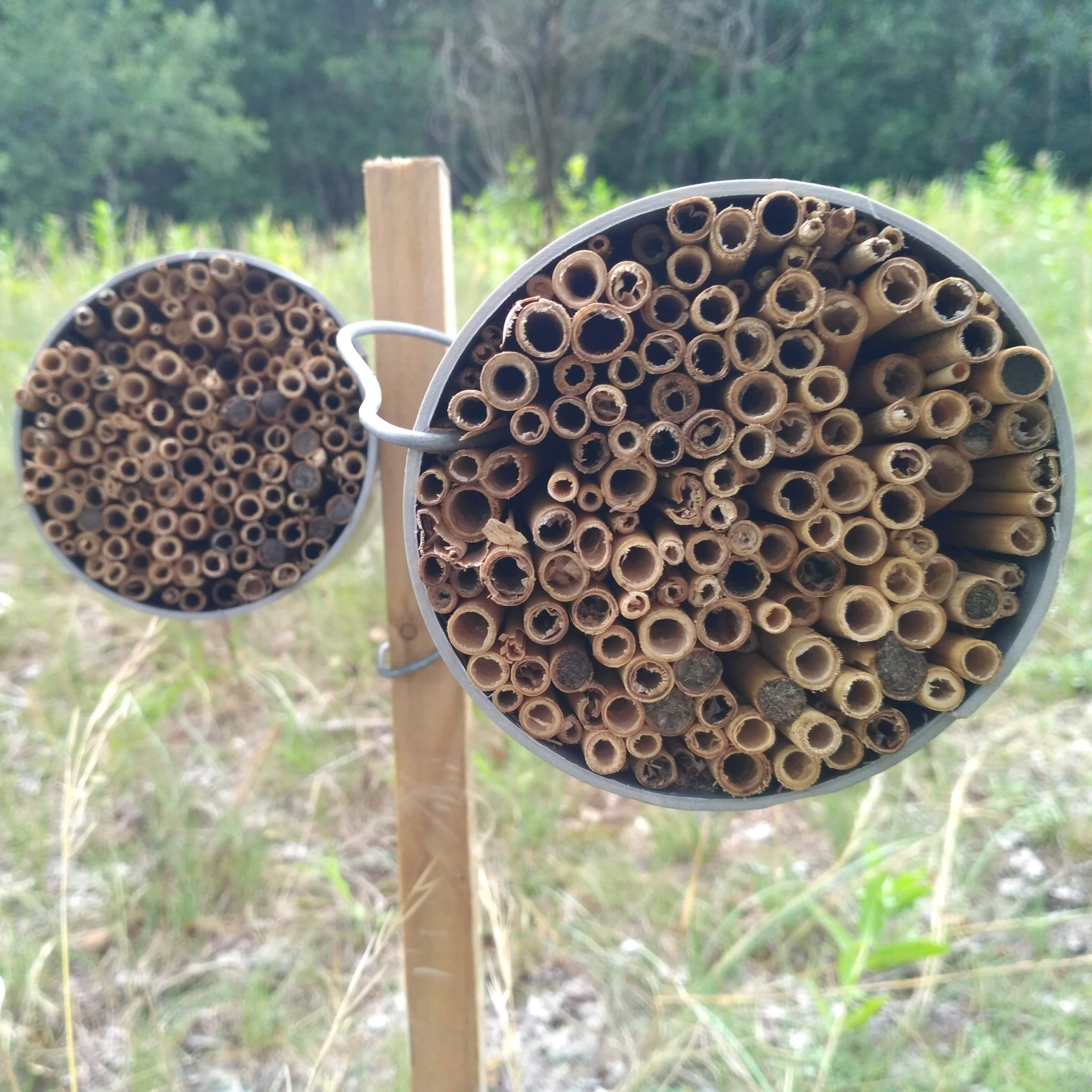
Gather a bundle of reed pieces and wrap them up tightly (e.g. with wire or wire mesh), ensuring that reeds cannot fall out.
Note
The diameter of the reed stems used for a trap nest should be varied, see Figure 1.
The number of reeds you use should depend on whether your sampling design allows for regular replacement of occupied reeds, in which case fewer reeds are enough. If replacing reeds is not possible, we recommend using 100-200 pieces, to avoid the limitation of nesting opportunities.
Figure 1: Cavity size preferences of different Hymenoptera genera. Most cavity-nesting species utilise reed stems with an inner diameter between 3 and 8 mm. However, providing a uniform distribution of diameters ranging from 2 to 12 mm is recommended to avoid excluding smaller or larger-bodied species. Bees are indicated in orange, wasps in dark green, red dots represent the mean, and the violin plot illustrates the distribution. Data are based on surveys conducted by the authors in East-Central Europe.
Place reeds in a protective PVC tube. This is optional; however, it can provide important protection against damage from animals and weather.
Note
Using a tube that is a few centimetres longer than the reeds (18-22 cm long, 10–12 cm in diameter), protects the reeds from environmental damage such as direct sun and heavy rain. We recommend using tubes that are 100-110 mm in diameter to ensure space for about 100-200 reed stems – an appropriate quantity if occupied reeds cannot be replaced regularly.
Deploy trap nests
Note
Different environments will require different deployment procedures, making it hard to generalise. Therefore, the following points are only guidelines. We recommend consulting relevant literature on positioning and orientation before deploying trap nests (e.g., MacIvor, 2016; Yoon et al., 2015; Martins et al., 2012; Khan et al., 2024).
Critical: Deploying your traps at the right time of the year is crucial, as deploying them too late could exclude certain species from your study. Trap nests need to be deployed by the time the first cavity nesting species emerge from their nests. Based on our experience in East-Central Europe, trap nests should be deployed by mid to late February to ensure they are available when the first cavity-nesting species emerge.
Securely attach trap nests to a tree or pole, to keep them off the ground. Poles should be tall enough so that traps are clearly visible and not hidden by ground vegetation, taking into account vegetation growth that may occur in spring and summer after the traps have been deployed. We recommend deploying more trap nests than are going to be retrieved and processed, to account for potential damage to the traps and to ensure that not all members of the local population are harvested.
Ensure that the traps are placed in a location where they will not be damaged by vehicles or agricultural equipment.
Attach a plastic or wooden sheet (roughly 50*50 cm) above the trap nests will provide further protection from heavy rain and direct sun in open habitats.
Applying wire mesh to the two entrances of the trap nest will keep birds away from the reeds yet still allow access for target species.
Retrieve trap nests from the field.
Note
We recommend assigning a unique code to each trap upon retrieval. This code will form part of the codes assigned to samples in later steps.
Critical: Retrieve trap nests as soon as the reproductive season is over. For example, in East-Central Europe nests should be retrieved in September. Collection before September may lead to underrepresentation of the full season, while later collection increases the risk of nest degradation by natural enemies and occupancy by non-target overwintering species (e.g. flies, social wasps).
Store trap nests.
Store trap nests at ambient (outdoor) temperature where further damage can be avoided and broods can finish their natural development.
Note
Collected nests should be stored in a safe place where they are not exposed to any disturbance, such as direct sunlight, extreme warm or cold, excessively low or high humidity, natural enemies, or further occupancy by nesting species or non-nesting species (e.g., flies and ants) looking for overwintering shelter or food resources.
Place trap nests in cold storage (around 4°C and 70% humidity, see Materials for further details).
Note
This step should be carried out once the first frosts occur, as such conditions can pose a risk to the overwintering success of developing offspring. Additionally, holding offspring at a low temperature keeps them from emerging from their cocoons, thus preserving the integrity of the nest and prolonging the optimal processing period.
B. Pre-sorting reeds from retrieved trap nests
Remove a trap nest from cold storage and free the reeds from their casing and any other binding material.
Note
Enter your name or acronym in the appropriate row of the status datasheet to indicate that the trap nest has been removed from cold storage and processing (pre-sorting) has been started.
Record the number of reeds in the trap nest (status datasheet).
Note
Reeds that are so damaged that both internodes are uninhabitable for broods should not be included in the count, as they are unsuitable for occupation.
Identify and set aside occupied reeds for further processing and remove unoccupied reeds.
Remove reeds that are clearly unoccupied. If you can see through the reed lengthwise, the reed is unoccupied.
Set aside reeds that are clearly occupied. If you observe nest material (e.g., mud, leaves, plant hairs) at either end of the reed, it is likely occupied. These occupied reeds will be processed in later steps (see Section C).
In case of unclear occupancy – if you cannot see through the reed, but there are no obvious signs of occupancy (e.g. nest material protruding from either end of the reed) – set it aside.
Cut open reeds with unclear occupancy (see step 7.3).
Cut lengthwise into the upper quarter or third of the reed’s circumference with a sharp scalpel or blade, and carefully pry it open to expose the contents of the internode.
Note
When cutting open reeds, make sure not to run your blade through the centre of the reed, which might house brood. Stop cutting the reed as soon as you find any sign of a nest (e.g. mud or other nest materials) to minimise damage done to the nest. To minimise the chance of injury we recommend cutting into the reed only enough so that the reed can be pried open by twisting the inserted blade.
If the reed is occupied, reseal the reed with tape and place it in a container together with the other occupied reeds identified in step 7.3.
If you have found no nests in either internode, discard the reed stem.
Record the number of occupied reeds found in the trap nest (status datasheet).
Mark the container of occupied reeds with the unique code of the trap nest whence they came from,
close the container and return the reed stems to cold storage (around 4°C and 70% humidity, see Materials for further details) until further processing (see section C).
C. Nest processing and data-recording
Remove a container of the pre-sorted reeds from cold storage.
Record the date of processing of the trap nest you are processing (status datasheet).
Prepare reed for data-recording.
Place one reed on your workstation.
Remove any tape from the reed, or cut it open with a scalpel if the reed was not cut open during pre-sorting, exposing one or both internodes.
If you have found a nest in one of the internodes, assign a unique identifier to the nest, consisting of the trap nest id, the reed id and nest id. Enter the unique identifier into the appropriate row of the processing datasheet.
Note
The number of nests in a reed is usually 1 or 2, as there should be only two internodes in a reed; however, in some cases more than one nesting species can occupy and share a single internode, in which case there may be 3 or more.
Produce a physical copy of the unique identifier and take a photo of the nest with its unique identifier label also visible.
Note
Photographing the nest placed on graph paper, with the unique identifier clearly visible and in focus, is recommended to help resolve potential data inconsistencies. This step may slow down processing; therefore, it can be omitted if the person has experience in trap nest handling and hymenopteran taxonomy. It is worth taking photographs before and after the cocoons have been opened to be able to verify the status of each brood cell.
Record nest properties and species traits (processing datasheet).
Example of a workstation setup at the start of data entry.
Note
Each row should contain data for one nest, thus if one reed contains more than one nest, these are to be processed independently, with their properties entered into separate rows.
Record basic nest properties: nest id, inner diameter of the reed.
Note
The inner diameter can be measured using a calliper or by pre-calibrated diameter measurer (such as a wooden block with various sized holes drilled into it).
Record the material of the closing plug and partition walls.
Note
A list of several possible categories for nest properties can be found in the supplementary excel sheet (processing datasheet/Data_Dictionary).
Identify the nesting species to the closest possible taxon (see the identification guide and Table 1 for guidance on taxa identification).
Table 1. Summary of nesting, developmental traits, and other characteristics of common trap nest inhabitants.
Note
If the nest does not contain brood, or has been occupied or destroyed by a natural enemy, but shows signs of previous occupancy (e.g. partition walls or empty cocoons), the nest should still be treated as a nest belonging to the original nesting species.
Identify any natural enemies to the closest possible taxon (see the identification guide for guidance on taxa identification).
Note
Here, we use the term natural enemy to refer to any organism that harms the offspring of the nesting species (e.g., nest parasites, kleptoparasites, parasitoids, nest destroyers, predators).
Record the total number of brood cells and allocate each cell into one of the following 6 categories: empty cells, cells with living offspring, cells with dead offspring, cells with natural enemies and living offspring, cells with natural enemies and dead offspring, and cells with only natural enemies.
Note
If there are more than one natural enemies in a brood cell, this should not affect how the cell is categorised, as the number of cells affected are still the same regardless of the number of natural enemies per cell. The number of natural enemies present in the cells should be noted separately as a comment.
Record the number of cells containing pollen and the colour of the pollen.
Note
Pollen can only be present in the nests of bees. If necessary, take a sample of the pollen for identification and further analysis.
Record the number of cells containing prey and identify the prey taxon (e.g. spiders, caterpillars, or other insects).
Note
Prey can only be present in wasp nests (see Identification guide). If necessary, take a sample of the prey (residues) for identification and further analysis.
Add any relevant comments related to the nest.
D. Put away samples and developing brood
Remove mature offspring from the nest and store them as samples.
If the offspring are present in their imaginal state (imago), remove them from their cocoons and place all offspring into a vial filled with 70% alcohol for further species level identification by a taxonomist. Place a physical copy (label) of the unique identifier of the nest the individuals came from into the vials.
Place any and all natural enemies into a vial separate from the nesting species, together with a physical copy of the unique identifier.
Note
Separate the samples based on taxonomic group, to make it easy to send them to the professional taxonomist for species level identification.
Store reeds containing immature offspring in test-tubes for further development.
If the offspring or natural enemies are present in their pre-imaginal state (larva or pre-pupa), reseal the reed by taping the two parts back together.
Note
Remove any natural enemies that may spread or multiply within the nest(s), causing damage to the sample (e.g., Trichodes apiarius).
Place the reed, together with a physical copy of its unique identifier, in a test tube and seal the end with a breathable material (e.g., cotton).
Note
- Write the name of the lowest taxonomic group that you could assign to the nesting species onto the test-tube for easier recognition or grouping.
- If the reed contains more than one nest, separate the internodes and put them into different test tubes along with their unique identifiers. If separation is not possible, put the reed in a test tube and write the name of all nesting taxa found in the reed onto the test tube.
- Leave a small gap between the entrance of the nest and the closing cotton ball, to ensure that the offspring can emerge from the nest once they have fully developed.
- If a nest contains a cocoon but you are unsure whether it contains an occupant in its imaginal or pre-imaginal state, it is best to place the reed in a test tube for further development, as rupturing the cocoon of a premature offspring may induce mortality.
Store test tubes containing reeds in cold storage to postpone development (see section E for further steps)
Once you have processed all reeds in the trap nest, record the number of vials and test-tubes containing samples (status datasheet).
E. Brood development
Remove test-tubes from cold storage and keep them at room temperature to speed-up development.
Note
We recommend doing this no later than spring, after all trap nests have been processed, and late-emerging bees and wasps have had time to develop.
Check the test-tubes every week to two weeks for any offspring that have emerged.
Note
Storing nests of similar taxonomic groups in one container will make processing easier, because these offspring will likely emerge from their nests at similar times.
Remove emerged offspring and/or natural enemies from the test-tube and put them in vials with a physical copy of their unique identifiers, according to the instruction of section D 15.
Note
Before removing any offspring, we recommend returning the closed test-tubes to a cooler for a few minutes, making the offspring slower and easier to handle.
Protocol references
Bosch, J., & Kemp, W. P. (2003). Effect of wintering duration and temperature on survival and emergence time in males of the orchard pollinator Osmia lignaria (Hymenoptera: Megachilidae). Environmental Entomology, 32(4), 711–716. https://doi.org/10.1603/0046-225X-32.4.711
Eeraerts, M., Clymans, R., Kerckvoorde, V. V., & Beliën, T. (2022). Nesting material, phenology and landscape complexity influence nesting success and natural enemy infestation of a trap nesting bee. Agriculture, Ecosystems & Environment, 332, 107951. https://doi.org/10.1016/j.agee.2022.107951
Khan, D. H., Ali, M., Khan, F. Z. A., Mehmood, M. A., & Saeed, S. (2024). Effect of landscape complexity, nesting substrate, and nest orientation on cavity-nesting solitary bees in southern Punjab, Pakistan. International Journal of Tropical Insect Science, 44(1), 339–349. https://doi.org/10.1007/s42690-024-01177-w
Lindermann, L., Grabener, S., Fornoff, F., Hopfenmüller, S., Schiele, S., Stahl, J., & Dieker, P. (2023). Wildbienen und Wespen in Nisthilfen bestimmen: Ein Bestimmungsschlüssel für Deutschland: Ratgeber. Braunschweig: Thünen-Institut für Biodiversität. https://doi.org/10.3220/MX1685523077000
MacIvor, J. S. (2016). Cavity-nest boxes for solitary bees: A century of design and research. Apidologie, 48(3), 311–327. https://doi.org/10.1007/s13592-016-0477-z
Martins, C. F., Ferreira, R. P., & Carneiro, L. T. (2012). Influence of the orientation of nest entrance, shading, and substrate on sampling trap-nesting bees and wasps. Neotropical Entomology, 41(2), 105-111. https://doi.org/10.1007/s13744-012-0020-5
Müller, S., Collatz, J., Richter, H., Zboray, R., & Albrecht, M. (2025). Increased overwintering temperature reduces reproductive success of the solitary bee species Osmia bicornis. Scientific Reports, 15(1), 2965. https://doi.org/10.1038/s41598-025-86729-x
O’Neill, K. M., Delphia, C. M., & Spendal, R. C. (2023). Effect of temperature on the post-diapause developmental rate, survival, and body mass of the solitary wasp Isodontia elegans: Implications for rearing of trap-nesting Hymenoptera. Journal of Thermal Biology, 113, 103516. https://doi.org/10.1016/j.jtherbio.2022.103516
Rauf, A., Saeed, S., Ali, M., & Tahir, M. H. N. (2022). Nest preference and ecology of cavity-nesting bees (Hymenoptera: Apoidea) in Punjab, Pakistan. Journal of Asia-Pacific Entomology, 25(2), 101907. https://doi.org/10.1016/j.aspen.2022.101907
Richards, K. W., & Whitfield, G. H. (1988). Emergence and survival of leafcutter bees, Megachile rotundata, held at constant incubation temperatures (Hymenoptera: Megachilidae). Journal of Apicultural Research, 27(3), 197-204. https://doi.org/10.1080/00218839.1988.11100802
Yoon, H. J., Lee, K. Y., Kim, S. Y., Lee, Y. B., Kim, N., & Jin, B. R. (2015). Effects of location, direction, altitude, and placement of trap nests on the rate of trap-nesting of Osmia solitary bees. Journal of Asia-Pacific Entomology, 18(4), 695-700. https://doi.org/10.1016/j.aspen.2015.08.004