Jan 13, 2026
A Simple, Rapid, and Highly Sensitive Magnetic Beads ELISA for Detection of SARS CoV-2 antibodies (IgG) in Plasma Samples as a Point of Care Assay
- Sudhir Bhatia1,
- Gudrun Baersch1
- 1Genekam Biotechnology AG



Protocol Citation: Sudhir Bhatia, Gudrun Baersch 2026. A Simple, Rapid, and Highly Sensitive Magnetic Beads ELISA for Detection of SARS CoV-2 antibodies (IgG) in Plasma Samples as a Point of Care Assay. protocols.io https://dx.doi.org/10.17504/protocols.io.yxmvmbrm6g3p/v1
Manuscript citation:
Bhatia S. A Simple, Rapid and Highly Sensitive Magnetic Beads ELISA for Detection of SARS CoV-2
Anti bodies (IgG) in Human Plasma Samples as Point of the Care Assay. Microbiological journal. 2023 (6). P. 61—65.
License: This is an open access protocol distributed under the terms of the Creative Commons Attribution License, which permits unrestricted use, distribution, and reproduction in any medium, provided the original author and source are credited
Protocol status: Working
We use this protocol and it's working
Created: November 27, 2025
Last Modified: January 13, 2026
Protocol Integer ID: 233660
Keywords: Magentic beads ELISA, SARS CoV-2 antibodies, NP specific antibodies, point of the care assay, Immunology, sensitive magnetic beads elisa for detection, magnetic beads elisa, development of an elisa, conventional elisa, sensitive than conventional elisa, vaccinated person, based vaccine, using magnetic bead, elisa reader, elisa, plasma sample, igg, sar, detection of np, care assay, care assay this work, professional assay, assay
Disclaimer
Genekam Biotechnology AG
Duissernstr. 65a
47058 Duisburg
Germany
Abstract
This work deals with the development of an ELISA using magnetic beads as a point of the care assay that is reproducible, highly sensitive, robust, and easy to perform. It was successfully used for the detection of NP-specific IgG antibodies in plasma samples. This assay can be used as a professional assay, where the results can be verified with an ELISA reader. This assay may also be suitable for small clinics under field conditions. It can be used to detect a SARS CoV-2 infection in vaccinated persons (S protein-based vaccines) as well as in the non-vaccinated population both in the latent and active phases.
This ELISA will be completed within 20 minutes and is more than 100 times more sensitive than conventional ELISA. In addition, this can be used as a rapid test at the point of the care.
Image Attribution
Genekam magnetic ELISA
Guidelines
The user must follow the safety guidelines, as they are working with potentially infectious serum or plasma samples. The user must work in a laminar flow hood or with a mask and gloves.
Materials
Genekam ELISA Kit for detection of NP Antibodies (Genekam Biotechnology AG)
Magnetic rack (Genekam Biotechnology AG)
ELISA Reader (optional)
Pipettes of various sizes
Laminar flow (optional)
Safety warnings
The magnetic rack has magnets, that can damage phones and cameras. Therefore, keep them away from the magnetic rack.
The ELISA analysis must be carried out immediately after the test is completed, and no magnetic beads should present.
Work under laminar flow or with mask with hand gloves.
Used material must be decontaminated with disinfectant or autoclaved before disposal.
Do exercise with some samples before really testing the samples.
Ethics statement
Approveal from the ethics committee is required because the user is working with human samples.
Before start
Please read the protocol carefully before start.
Add 100µl of blocking buffer to 1.5ml microtube.
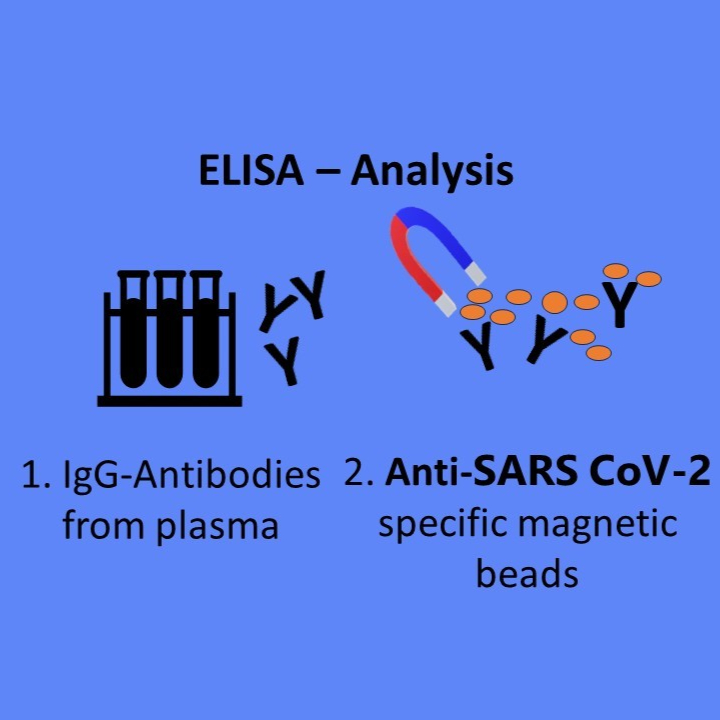
Add 10µl of NP specific magnetic beads to this. Keep this at room temperature for 5 minutes.
Place the tube in the magnetic rack for 2 minutes. Then remove the fluid. While titling the tube to drop the fluid in waste collecting container or remove it with the pipettor, the beads will remain as pellet on the magnetic side of the rack.
Dilute plasma or serum 1:2 or 1:4 in dilution buffer. Add 100µl to the magnetic beads and keep it for 5 minutes at room temperature.
Wash this three times with 1.5 ml of wash buffer. At each of these steps, place the tube in the magnetic rack for 2 minutes. Then remove the liquid. When removing the liquid, the beads remain on the magnetic side of the rack.
Add 100µl of anti-human IgG conjugate to this and keep it for 5 minutes at room temperature.
Wash it 4 times with 1.5ml washing buffer.
Add 100µl of substrate and keep this for 7 minutes in dark.
Carry out the reaction with 4M sulfuric acid. A yellow color develops in a positive sample.
The user can read the reaction with the naked eye, or this can be done in an ELISA reader by adding the same volume to an ELISA plate without magnetic beads. The reading in the ELISA reader must be done immediately.
A negative control should be included, in which only beads are present and no serum is added; instead, the diluting buffer is added. A positive control should be included, in which a known positive serum is used.
Detection of SARS CoV-2 antibodies (IgG) in plasma samples
Magnetic Rack
ELISA with negative control, positive sample and positive control
Protocol references
Bhatia S. A Simple, Rapid and Highly Sensitive Magnetic Beads ELISA for Detection of SARS CoV-2
Anti bodies (IgG) in Human Plasma Samples as Point of the Care Assay. Microbiological journal. 2023 (6). P. 61—65.