Oct 09, 2023
A simple phototaxis assay for aquatic larvae
- 1Stanford University
- O'Connell Lab at Stanford



Protocol Citation: Julie M Butler, Lauren O'Connell 2023. A simple phototaxis assay for aquatic larvae. protocols.io https://dx.doi.org/10.17504/protocols.io.x54v9p294g3e/v1
Manuscript citation:
Butler JM, McKinney J, Ludington SC, Mabogunje M, Baker P, Singh D, Edwards SV, O'Connell LA. Tadpoles rely on different sensory modalities for communication throughout development. bioRxiv preprint: 10.1101/2022.10.18.512729
Adebogun GT, Bachmann AE, Callan AA, Khan U, Lewis AR, Pollock AC, Alfonso SA, Arango Sumano D, Bhatt DA, Cullen AB, Hajian CM, Huang W, Jaeger EL, Li E, Maske AK, Offenberg EG, Ta V, Whiting WW, McKinney JE, Butler J, O'Connell LA. 2023. Albino Xenopus tadpoles prefer dark environments compared to wild type. microPublication Biology. 10.17912/micropub.biology.000750.
License: This is an open access protocol distributed under the terms of the Creative Commons Attribution License, which permits unrestricted use, distribution, and reproduction in any medium, provided the original author and source are credited
Protocol status: Working
We use this protocol and it's working
Created: September 08, 2023
Last Modified: October 09, 2023
Protocol Integer ID: 87546
Keywords: tadpole, phototaxis, larvae, simple phototaxis assay for aquatic larvae phototaxis assay, aquatic larvae phototaxis assay, simple phototaxis assay, aquatic larvae, low cost phototaxi, assays in laboratory setting, assay chamber, assay, neuroscience research, animal, concentric petri dish, teaching laboratory, exploratory behavior, laboratory, useful for behavior, laboratory setting
Funders Acknowledgements:
National Institutes of Health
Grant ID: DP2HD102042
Rita Allen Foundation
Grant ID: Scholar's Award
Abstract
Phototaxis assays are utilized throughout neuroscience research to measure exploratory behaviors and visual capabilities. Here we detail a simple and low cost phototaxis assay for aquatic larvae. The assay chamber is constructed out of concentric petri dishes, where the animal is in the central chamber while the outer chamber can be rotated. The ability rotate the arena allows observers to distinguish between an animal settling on one side of the arena versus a true preference for one environment over the other. This assay is useful for behavior assays in laboratory settings, including undergraduate teaching laboratories. Student can gather data in real time in a relatively-high throughput manner.
Attachments

tadpolephototaxis.mp...
37.6MB
Guidelines
The size of the behavior arena should be adjusted based on the size of the animal. This protocol serves as a starting point, but chamber size may need to be adjusted for larger animals.
Materials
Materials for arena construction
15 cm petri dish
10 cm petri dish
matches/lighter
black paint (or other colors of choice)
clear sealant (Kyrlon Fusion Clear Gloss)
nut and screw/bolt
aquarium sealant
Materials for behavior assay
LED light pad with power cable
USB power adaptor to plug in light pad
Camera holder/mount
Animal transfer utensil
Stopwatch
Timer
Paper towels
Writing utensils
Lab tape
Sharpie
Cellphone camera/video
Bottle of 0.1x MMR (aka: tadpole water; 1 500 ml bottle per pair)
Safety warnings
Open flames are used to burn a hole in a petri dish. Care must be taken when using an open flame to prevent fires. Alternatives include drilling a hole in the petri dishes, although in our experience this resulted in cracking in half the petri dishes.
Ethics statement
The experimental protocol described here was approved by the Stanford University's Institutional Animal Care and Use Committee (protocol 33097).
Before start
Experiments involving animals must have prior approval from an Institutional Animal Care and Use Committee (IACUC) or equivalent ethics committee.
Arena construction
1h 15m
Obtain a large (15 cm diameter) petri dish and burn a hole in the middle of the petri dish just large enough to fit a screw through. This is the chamber base.
1m
Paint half the base black on the inside of the dish. Repeat with two more paint layers until opaque.
1h
Spray the inside of the base with a clear sealant to seal the paint. This also creates a "frost" to diffuse light through the unpainted side.
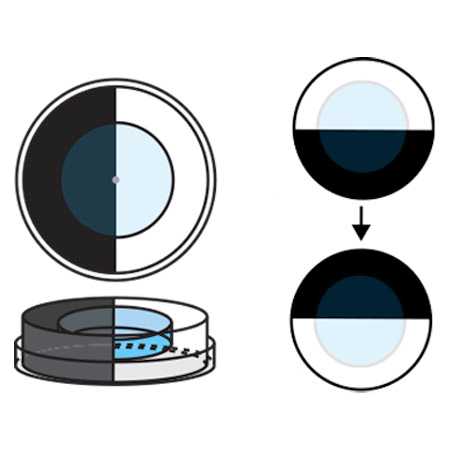
The large petri dish has two light/color conditions on either side. Shown is one side painted black and the other frosted with sealant. Users can choose various color options when constructing the arena. If using in an undergraduate teaching setting, students could pick the color options.
2m
Glue a nut to the middle of the inside of a 15 cm petri dish lid using aquarium sealant.
The lid to a 15 cm petri dish with a nut glued to the inside center.
5m
Obtain a medium (10 cm diameter) petri dish and glue a bolt to the bottom using aquarium sealant.
A 10 cm petri dish has a bolt glued to the bottom. Make sure this bolt is centered and fits the corresponding nut in step 4.
3m
The bolt attached to the 10 cm base goes through the hole in the painted 15 cm petri dish base and screws into the nut attached to the 15 cm petri dish lid. This way, the painted base can be rotated without adjusting the dish (10 cm base) containing the tadpole.
The bolt and nut screw together such that the center aquatic chamber is fixed in place and the large outer petri dish can be easily rotated.
1m
Place the arena in the center of a light pad.
1m
Check to make sure the 10 cm dish is level. If not, adjust the arena or light pad until level by placing a piece of paper towel under one side.
30s
It helps to have the arena positioned such that the border between the light and dark sides is completely vertical or horizontal. This will make flipping it easier.
30s
Set up a camera above the arena.
Final arena set up with the arena on a light pad. Pipette tip boxes hold up an acrylic board with a hole in the middle for a camera.
1m
Set up a stack of two pipette tip boxes on each end of the arena with a camera holder spanning them.
30s
Place your phone a the holder, with your camera pointing through the hole. Any board with a hole in the middle big enough for the camera to film through and strong enough to cold the phone/camera is sufficient.
30s
Running the phototaxis trial
13m
Fill the 10 cm dish with 0.1x MMR (~40 ml). Make sure there’s no debris in the water.
1m
Place a label on the light pad with the trial or animal number so that it is visible in your recording.
1m
Turn on the light pad. Make sure the light is at full strength by holding down the power button.
30s
Start the recording on the camera.
30s
Transfer a single tadpole from its holding container to the arena.
1m
Animal transfer can be done with a transfer pipette with the tip cut off or a spoon, depending on the species and size.
Gently place the tadpole in the center in the 10 cm dish.
Record behavior for 3 m
3m
If recording behavior in real time, use a clicker to record the number of movements the tadpole makes and use the timer to record the time spent on the black side. In a classroom setting, this can be done by a pair of students (one measuring time spent and the other the number of movements).
Alternatively, behavior can be scored later using software.
After 3m, carefully rotate the 15 cm painted base 180 degrees so that the black and clear sides are flipped.
30s
Start the timer for 3 min after completion of the arena flip and record behavior.
3m
After 3 m, stop the video recording.
30s
Take the tadpole out of the arena and return the tadpole to its container.
1m
Remove the water from the 10cm dish. If running another animal, fill with new 0.1x MMR.
1m
Data analysis
Calculate behavior scores and compare across experimental groups. This could include total time spent on the dark side and total number of movements.
Example data collected with phototaxis assay. Students in an undergraduate laboratory course compared phototaxis behavior of albino and wildtype Xenopus tadpoles. Albino tadpoles prefer the dark side more than wildtype while total movements were not different. Data from Adebogun et al., 2023.
Protocol references
Butler JM, McKinney J, Ludington SC, Mabogunje M, Baker P, Singh D, Edwards SV, O'Connell LA. Tadpoles rely on different sensory modalities for communication throughout development. bioRxiv preprint: 10.1101/2022.10.18.512729
Adebogun GT, Bachmann AE, Callan AA, Khan U, Lewis AR, Pollock AC, Alfonso SA, Arango Sumano D, Bhatt DA, Cullen AB, Hajian CM, Huang W, Jaeger EL, Li E, Maske AK, Offenberg EG, Ta V, Whiting WW, McKinney JE, Butler J, O'Connell LA. 2023. Albino Xenopus tadpoles prefer dark environments compared to wild type. microPublication Biology. 10.17912/micropub.biology.000750.