Jul 15, 2025
A Refined Guide for Aging Muskoxen (Ovibos moschatus) Based on Mandibular Examination
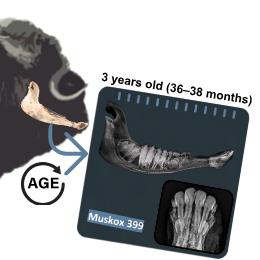
- Erica Suitor1,
- Eleanor Dickinson1,
- John Scheels2,
- Mathieu Pruvot1,
- Fabien Mavrot1,
- Ekaluktutiak Hunters and Trappers Organization3,
- Kugluktuk Angoniatit Association4,
- Olokhaktomiut Hunters and Trappers Organization5,
- Tracy Davison6,
- Lisa-Marie Leclerc7,
- Susan Kutz1
- 1Faculty of Veterinary Medicine, University of Calgary, Calgary, Alberta, Canada;
- 2Milwaukee County Zoo, Milwaukee, Wisconsin, United States of America;
- 3Ekaluktutiak Hunters and Trappers Organization, Cambridge Bay, Nunavut, Canada;
- 4Kugluktuk Angoniatit Association, Kugluktuk, Nunavut, Canada;
- 5Olokhaktomiut Hunters and Trappers Organization, Ulukhaktok, Northwest Territories, Canada;
- 6Department of Environment and Natural Resources, Government of the Northwest Territories, Inuvik, Northwest Territories, Canada;
- 7Department of Environment, Government of Nunavut, Kugluktuk, Nunavut, Canada



Protocol Citation: Erica Suitor, Eleanor Dickinson, John Scheels, Mathieu Pruvot, Fabien Mavrot, Ekaluktutiak Hunters and Trappers Organization, Kugluktuk Angoniatit Association, Olokhaktomiut Hunters and Trappers Organization, Tracy Davison, Lisa-Marie Leclerc, Susan Kutz 2025. A Refined Guide for Aging Muskoxen (Ovibos moschatus) Based on Mandibular Examination. protocols.io https://dx.doi.org/10.17504/protocols.io.j8nlkdb6xg5r/v1
License: This is an open access protocol distributed under the terms of the Creative Commons Attribution License, which permits unrestricted use, distribution, and reproduction in any medium, provided the original author and source are credited
Protocol status: Working
We use this protocol and it's working
Created: March 20, 2025
Last Modified: July 15, 2025
Protocol Integer ID: 124749
Keywords: Muskox aging, tooth eruption pattern, mandible morphometrics, cementum annuli analysis, arctic ungulate, refined guide for aging muskoxen, age of adult muskoxen, aging muskoxen, age in muskoxen, reliability of age determination, age estimation, first continuous eruption timeline by age, age specimen, age determination, tooth eruption, estimating age, related dental change, precise understanding of age, additional metric for age estimation, dental change, adult muskoxen, precision in muskoxen, mandibular examination this protocol, age individual, mandibular examination, age until growth, first continuous eruption timeline, growth period, muskoxen, actual age, first evaluation of caa validity, eruption, caa validity, informative morphometric, age
Funders Acknowledgements:
Polar Knowledge Canada
Grant ID: NST-2122-0049
Natural Sciences and Engineering Research Council Discovery Grant
Grant ID: RGPIN/02796-2021
Natural Sciences and Engineering Research Council Northern Research Supplement
Grant ID: RGPNS/02796-2021
Weston Family Award in Northern Research
Northern Scientific Training Program
Government of the Northwest Territories
Government of Nunavut
Nunavut Harvester Support Program
Nunavut General Monitoring Plan
Canadian North Outfitting
Abstract
This protocol outlines three improved methods for aging muskoxen, along with guidance on selecting the most appropriate approach based on the available sample type. These refinements aim to enhance the accuracy and reliability of age determination.
Tooth Eruption Pattern
Tooth eruption is the most accurate method for estimating age in muskoxen up to 5 years old. Individuals older than this are classified as 5+ years. Previously, muskoxen over 3 years were typically grouped as 4+ years. This protocol introduces the first continuous eruption timeline by age in months, offering a more precise understanding of age-related dental changes.
Mandible Morphometrics
Caudal mandible length is the most informative morphometric for estimating age until growth ceases around 60 months old (5 years). This protocol validates the relationship between mandible growth and age, providing an additional metric for age estimation during the growth period.
Cementum Annuli Analysis (CAA)
CAA is used to estimate the age of adult muskoxen beyond the eruption and growth phases. Using known-age individuals, we found that CAA tends to underestimate actual age due to faint and thin annuli, which require a highly experienced examiner to interpret. This is the first evaluation of CAA validity and precision in muskoxen using known-age specimens.
Image Attribution
All images by the author, Erica Suitor.
Materials
- Large calipers
- Ruler
- Scalpel blade and handle
- Forceps
- Necropsy knife
- Coin envelopes
- Dental elevator
- Extraction forceps
Selecting a Method
The mandible should be stored at -20°C until time of processing if mandibles are fresh. The mandibles should be removed from the freezer and left in a cool room to thaw overnight before examination. If dried then freezer storage is not necessary.
Based on the sample available it is important to know what method is best.
Decision tree for selecting an appropriate aging method for muskoxen based on available sample. *Sex is required to estimate age since caudal mandible length differs by sex for muskoxen 3 years and older.
Aging Muskoxen by Tooth Eruption Pattern
Muskoxen can be aged by tooth eruption up to 5 years old (yo) and can only be aged by month if the month of death and an estimated birth date of May 1st is used. Eruption pattern can be recorded per tooth which can then correspond of their age.
Note
- Tooth eruption can vary and may not correspond exactly to the guidelines presented here.
- Incisor 4 (I4) is sometimes missing or can erupt later than 4 years old; therefore, they are not always reliable for accurate age estimation.
- Primary molars have one (p1), two (p2) and three (p3) cusps (points). Permanent premolars have only one cusp each.
- During their fourth year the premolar precursors may be present or not which can conceal the permanent teeth, it depends on the handling of the sample.
- Molar 3 (M3) erupts for the longest period of time and is very important for determining age. If the M3 cusp 3 is still erupting this animal is around 4 years old. Once all the teeth are erupted it can be classified as 5+ years old.
Tooth eruption pattern can be recorded per tooth to ensure accurate documentation and interpretation.
If date of death is unknown and an age in months is still desired, we have tracked tooth eruption from a calf (1-2 months old) until 4yo (57-60 months old) to use as a reference for consistent aging.
 Muskox- Age in Months with Images.pdf698KB
 Aging Muskoxen by Mandible Morphometrics
To test the utility of mandible morphometrics for aging muskoxen, We examined 178 archived hemimandibles with known sex from Banks Island, NT, Canada. The uniform cleaned and dried state of these mandibles allowed reliable mandible measurements from a single muskox population.
- Each mandible was aged based on tooth eruption patterns as we used this age to compare to the morphometrics.
- The diastema, rostral, and caudal mandible lengths were measured with calipers. Rostral and caudal mandible lengths were summed to calculate the total mandible length.
- A ruler was used to measure height of molar 2 (M2) and M3, from the cervical junction between the root and crown to the crown tip.
Use calipers, when possible, to measure to the nearest millimeter (mm) the following, as illustrated below:
Morphometrics recorded for muskox mandibles. Adapted from CARMA (2008) protocol. I= Incisor, P= Premolar, M= Molar.
| Morphometric | Description | |
| Diastema (cm) | Measurement of the gap caudal point I4 and rostral of P1 | |
| Rostral Mandible Length (cm) | From the most rostral point of the mandible to caudal point of P3 | |
| Caudal Mandible Length (cm) | Most caudal point of P3 to the most caudal part of the mandible | |
| Molar 2 Height (mm) | Measurement from the gumline to the tip of the crown of the 1st cusp | |
| Molar 3 Height (mm) | Measurement from the gumline to the tip of the crown of the 3rd cusp | |
| Total Mandible Length (cm) | Addition of rostral and caudal mandible length |
Statistical Analysis
From these measurements we wanted to see what were the best predictors of age.
- The linearity of relationships between predictors and age was assessed using scatter plots and residual plots. Collinearity among predictors was evaluated using the variance inflation factor (VIF).
When collinearity was detected, independent models were run for each variable. Molar heights (M2 and M3) and other variables unrelated to mandible morphometrics were excluded from analysis due to the lack of available measurements prior to molar eruption and the variability introduced by tooth wear.
Model selection was performed using the Akaike Information Criterion (AIC) to identify the best-fitting models.
- Linear, quadratic, and interaction terms with sex were evaluated for each predictor.
- Quadratic terms were included to address non-linear patterns observed during initial visual assessments.
- Interaction terms with sex were tested to determine whether the relationships between predictors and age differed by sex.
Summary
Caudal mandible length was the best predictor of age but growth was found to slow before complete growth cessation so a quadratic model was necessary. Sex also influenced the models prediction of age indicating sex differences that need to be accounted for. This process was also used for muskoxen from a
single population but does clearly indicate the association between age and mandible growth.
The relationship between age in months and caudal mandible length (cm) for wild muskoxen (88 females and 90 males) harvested on Banks Island, NT. Age in months was determined from tooth eruption patterns, and its relationship with caudal mandible length was modeled using a regression that included linear and quadratic terms for caudal mandible length, sex, and their interactions. Fitted regression lines (black for females and blue for males) and their 95% confidence intervals (shaded regions) are shown, with predictions and intervals truncated to a maximum age of 60 months.
Observed ages from tooth eruption patterns are represented by individual data points.
Aging Muskoxen by Cementum Annuli Analysis
To determine the accuracy of cementum annuli analysis we collected the left central incisor (I1) from known aged, dead muskoxen from captive facilities, as well as wild muskoxen harvested in Nunavut and the Northwest Territories.
Tooth Extraction:
Extract the left I1 from muskoxen aged as 5 yo+ or if examiner has uncertainty of age from tooth eruption pattern. If left I1 is not available extract the right I1 or next available incisor. If possible, extract both left and right I1.
- Make two lateral cuts through the gingiva adjacent to I1, ensuring not to damage the root.
- Use a dental probe to loosen the attachment of the periodontal ligament.
- Carefully use dental pliers and elevator to extract.
- Place the extracted tooth in a paper or coin envelope to dry, and label it with the animal’s ID number and the specific tooth extracted. If available, submit two incisors per individual.
Lab Procedure: Cementum Annuli Analysis
- Incisors were decalcified in hydrochloric acid, fixed in formalin, embedded using the paraffin method, and sectioned at 14μm using a microtome (Model RM 2155; Leica Biosystems, Buffalo Grove, IL, USA).
- Each incisor gets sectioned and mounted on slides, Giemsa stained (RICCA Chemical Co., Arlington, TX, USA), and cover slipped for microscopic examination of cementum annuli.
- Next, Matson’s Laboratory applies their muskox-specific protocol for cementum annuli analysis. Using an I1-based model, the first distinct annulus separated from the dentine is interpreted as corresponding to year 3, with subsequent annuli counted sequentially. A standardized birth date of May 1st is assumed for all individuals. Final age interpretation is adjusted based on the season or documented date of death to account for partial annuli formation.
Summary
Muskoxen exhibit thin cementum annuli with minimal separation between growth and rest lines. Although an experienced examiner evaluated these, the lines are not as distinct as those seen in other species, where cementum annuli age estimates are highly accurate. Consequently, an underestimation of age is expected for muskoxen.
Microscope image of a longitudinal section of an incisor root from a muskox with a known age of 19 years old.
Acknowledgements
We thank the hunters from the communities of Ulukhaktok, Kugluktuk, and Cambridge Bay for
their participation in the Community-based Wildlife Health Surveillance program, as well as the harvesters, wildlife officers, and biologists involved in collecting samples. We thank Arthur Stephens and Stacey Hannebaum from Matson’s Laboratory, along with Brynn Parr with Alaska Department of Fish and Game, for their support in evaluating cementum annuli of muskoxen