Aug 13, 2025
A pot trial comparing sieved and intact soil cores
- Bríd anrahan1,
- Tallula Headington1,
- Jake LeGrice1,
- William Roberts1,
- Martin Blackwell1,
- Alison Carswell1
- 1Rothamsted Research



Protocol Citation: Bríd anrahan, Tallula Headington, Jake LeGrice, William Roberts, Martin Blackwell, Alison Carswell 2025. A pot trial comparing sieved and intact soil cores. protocols.io https://dx.doi.org/10.17504/protocols.io.n92ldmx1nl5b/v1
License: This is an open access protocol distributed under the terms of the Creative Commons Attribution License, which permits unrestricted use, distribution, and reproduction in any medium, provided the original author and source are credited
Protocol status: Working
We use this protocol and it's working
Created: January 29, 2024
Last Modified: August 13, 2025
Protocol Integer ID: 94311
Keywords: controlled environment room, soil, herbage, nitrogen, yield, element concentrations, plant growth pot trial, herbage sample, growth of grassland herbage, herbage yield, grassland herbage, harvesting of the herbage, preparation of soil, herbage, soil chemistry, analysis of the soil, intact soil cores this protocol, plant growth, soil, intact soil core, ryegrass, pot trial, sieved
Funders Acknowledgements:
BBSRC
Grant ID: BB/X010961/1
BBSRC
Grant ID: BBS/E/RH/230004A
Abstract
This protocol covers all steps involved in a plant growth pot trial in a controlled environment room, comparing the growth of grassland herbage (ryegrass and white clover) in sieved (both < 9 mm and < 2 mm) and intact soil cores taken from the same location. It measures herbage yield, and soil chemistry both prior to and after plant growth.
The protocol covers the collection and preparation of soil, the growth and harvesting of the herbage, and the analysis of the soil and herbage samples. There are links to other protocols used during individual steps. Notes relevant to internal facilities are clearly marked and external users using this for the basis of their own work must determine their own local procedures.
Soil collection
Collect soil from 4 separate locations in the “bare” plot of Little Burrows, North Wyke (approximate location: 50.767555, -3.902953), in a square 2 x 2 m sampling strategy. In each of the 4 locations, take one intact soil core (10 cm diameter, 30 cm depth), and an additional 10 kg of loose soil (to 20 cm depth).
Collection of one of the intact soil cores
Transfer intact soil cores to cool room (4°C and dark). Loose soil can be maintained at air temperature prior to sieving.
Preparation of intact soil cores
Outside of columns require cleaning and labelling as Rep 1, 2, 3, or 4
Attach 250 µm nylon mesh to bottom of core with electrical tape
Remove any vegetation from the surface of the soil core and return the core to the cool room until other cores are prepared
Preparation of sieved soil cores and soils for analysis
Samples Take 500 g subsample of each of the 4 loose soil samples, label with a unique ID, and analyse for soil pH, and available P, K and Mg. Internal note: Use sample IDs NW794/204 – NW794/207; analysis by NRM.
For each of the 4 loose soil samples, remove vegetation and the majority of roots. Pass loose soil through 9 mm sieve (this might require repeated passes to break up large soil aggregates).
For each of the 4 loose soil samples, retain at least 5 kg of the <9 mm sieved soil for making soil columns with. Air dry this soil on trays until a consistent weight is reached.
Samples Use approximately 2.5 kg of the remaining < 9 mm soil for sieving to < 2 mm. The soil may require some further air drying before sieving. Once sieved to < 2 mm, air dry the soil in trays.
Weigh 2.03 kg of air-dried soil from each < 2 mm and < 9 mm sample replicate into a large polythene bag and label accordingly (i.e. < 2 mm Rep 1 or < 9 mm Rep 4)
Add fertilizer to the 2.03 kg of soil in accordance with AHDB RB209 recommendations for grass and white clover and thoroughly mix with soil
Apply nylon mesh to bottom of 8 soil columns. Pack soil columns with 2.03 kg of air dried and sieved soil (both < 2 mm and < 9 mm) and label each column as soil Rep 1, 2, 3 or 4.
Seeding the cores
All cores were saturated by standing cores in watering trays of tap water, and also by watering slowly from the top down. After saturation, the cores were left for 24 hrs before seeds were sown.
Weigh clover and grass seeds, per replicate:
Ryegrass (Lolium perenne) – cv. Aber Magic: 0.0234 g per core
White clover (Trifolium repens) – cv. Aberdai: 0.0041 g per core
Scatter seeds on soil surface. Press down to ensure good contact with the soil. Note: In this experiment, there was poor establishment of clover on some of the intact cores. Therefore, replicates 2 and 4 of the intact cores were reseeded after 6 weeks with clover only (maintaining the ryegrass, which had germinated).
Growing conditions
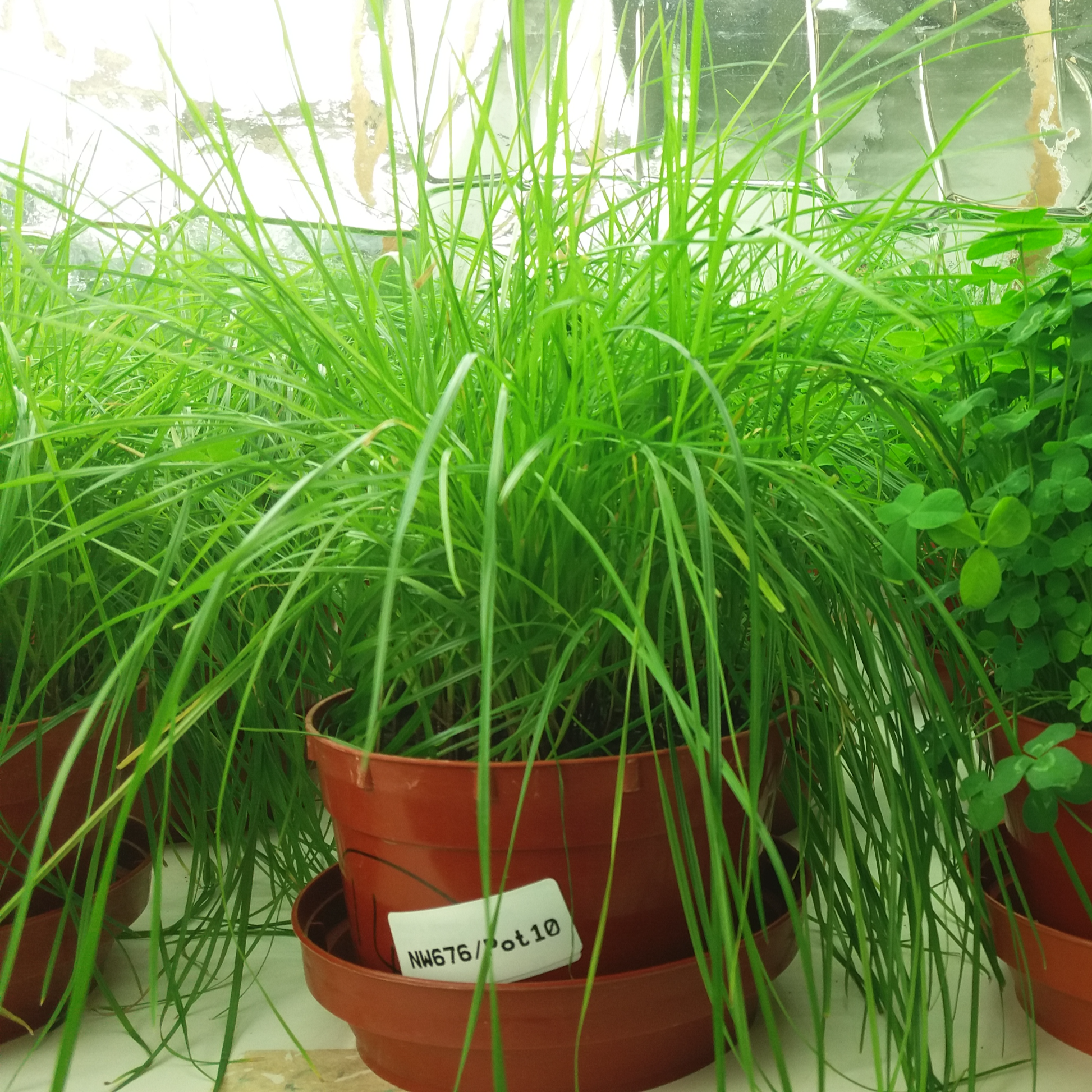
Lay pots out in a randomised block design in the controlled environment (CE) room, to allow for any differences in lighting and airflow. Set the CE room to have a day:night of 16:8 h and temperatures of 20:15 oC respectively.
At sowing, spray the soil surface with 15 sprays of tap water from a spray bottle each day, for approximately 6 weeks. Thereafter, 100 ml tap water to be added to the soil surface daily, or 200 ml to last two days between watering.
Add further fertilizer during the growth period, according to the soil nutrient levels as measured earlier ( ) and AHDB RB209 recommendations.
Harvesting herbage
Herbage to be cut 4 times:
- 1st cut eight weeks after sowing
- 2nd cut seven weeks after cut 1
- 3rd cut six weeks after cut 2
- 4th cut five weeks after cut 3
Harvest herbage according to the grass harvest section of the following protocol:
However, grass was cut at a height of 2 cm from the soil surface, instead of the 5 cm of the original protocol.
Grind dried samples to <0.5 mm
Samples Analyse samples for total nitrogen. Internal note: submit to NW analytical laboratory. Will require weighing on the micro-balance
Samples Submit samples for analysis of major and trace elements via digestion and ICP-OES and ICP-MS. Internal note: requires 2.0 g of sample in a glass vial. Register samples via the batch request system
Processing the soil from the columns
After the final harvest has been made, stop watering soil columns
Put entire soil column in gas permeable bag and transfer to soils fridge (@ 4°C and in the dark) if they are not being processed immediately.
Remove soil core from column (they should slide out after being dried out, but if not apply gentle force to bottom of column to force them out through the top end of column)
Cut soil column into three sections of: 0 – 10 cm, 10 – 20 cm and 20 – 30 cm depth. Record the final depth in case compaction has led to it being < 30 cm
For each individual section crumble the soil and pass it through a 2 mm aperture sieve, removing any stones and vegetation. Place the sieved soil into a clean, sample tray, labelled with its sample ID and air dry in the soil laboratory until a consistent weight is reache
Samples Once soil is air dry, separate it into two. One half will be ground, the other half to remain in the sieved state.
Soil analysis
Samples produced from soil columns
Using the <2mm sieved soils from prior to the experiment, and the <2mm sieved soils produced from dismantling the soil column, analyse for Mehlich III extractable (plant available) elements by ICP-OES and ICP-MS. Internal note: Harpenden analytical labs; weigh 5g of each soil into a 50 mL Greiner vial - sample preparation link here.
Samples produced from soil columns
Grind the air-dried soils to a fine powder and pass through a 500 μm sieve to remove small stones. Analyse for total element concentrations by ICP-OES and ICP-MS. Internal note: Harpenden analytical labs; weigh 2 g of each soil into a 30 mL glass vial - sample preparation link here.
Use remaining soil from this step
Use remaining soil from this step
Analyse the remining <2 mm and finely ground samples to analyse for Total N and C. Internal note: analyses will be conducted at North Wyke labs, and the samples will need to be weighed for the microbalance.
Soil analyses and number of samples. The 36 soils are
from: 3 soil cores (intact, < 2 mm sieved, < 9 mm sieved), 4 replicates, and 3 sections per core (0 – 10 cm, 10 – 20 cm and 20 – 30 cm depth). The final column in the table contains an internal code to specify the desired laboratory analysis.
Acknowledgements
Bríd Hanrahan's student placement was supported by The Stapledon Memorial Trust under their student placement scheme.