Aug 21, 2025
A cost effective protocol for methylome and genome screen using ddRAD and high-throughput sequencing
- 1Department of Animal Biosciences, Swedish University of Agricultural Sciences



Protocol Citation: Christos Palaiokostas 2025. A cost effective protocol for methylome and genome screen using ddRAD and high-throughput sequencing. protocols.io https://dx.doi.org/10.17504/protocols.io.kxygx43bol8j/v1
License: This is an open access protocol distributed under the terms of the Creative Commons Attribution License, which permits unrestricted use, distribution, and reproduction in any medium, provided the original author and source are credited
Protocol status: Working
We use this protocol and it's working
Created: August 20, 2025
Last Modified: August 21, 2025
Protocol Integer ID: 225108
Keywords: genome screen, sequencing library, methylome, genome, using ddrad, targeted organism, cost effective protocol, effective protocol, throughput, large number of animal
Disclaimer
DISCLAIMER – FOR INFORMATIONAL PURPOSES ONLY; USE AT YOUR OWN RISK
The protocol content here is for informational purposes only and does not constitute legal, medical, clinical, or safety advice, or otherwise; content added to protocols.io is not peer reviewed and may not have undergone a formal approval of any kind. Information presented in this protocol should not substitute for independent professional judgment, advice, diagnosis, or treatment. Any action you take or refrain from taking using or relying upon the information presented here is strictly at your own risk. You agree that neither the Company nor any of the authors, contributors, administrators, or anyone else associated with protocols.io, can be held responsible for your use of the information contained in or linked to this protocol or any of our Sites/Apps and Services.
Abstract
The protocol describes the preparation of constructing high-throughput sequencing libraries that would allow scanning both the methylome and the genome of a targeted organism. The protocol is mainly desinged in relation to breeding activities where one needs to screen a large number of animals. The protocol is a compilation of library construction demonstrated in the following:
Guidelines
Step-by-step procedure captured on these pages:
1. Set up DNA digestions (96 well plate format). Prepare the restriction digest master mix and combine with DNA as indicated under Materials.
2. Mix well and incubate @ 37°C for 60 minutes.
3. Cool to room temperature.
4. Add barcodes. Add 3.000 µL barcode mix per sample (see Barcode Calcs and barcode table on next page).
5. Mix well and incubate @ 22°C for 10 minutes.
6. Add ligase mastermix. Use the ligation master mix composition listed under Materials (note: "nb double usual" flagged on sheet).
7. Mix well and incubate @ RT for 2 hours.
8. Add 30 µL PB to inactivate.
9. Combine samples into library pools. Use the plate map noted under Materials. Current pages show: Lib 1 wells 1A–6H and Lib 2 wells 7A–12H on Plate 1; Lib 3 wells 1A–6H on Plate 2; Lib 4 wells 7A–10H on Plate 2.
Materials
Reagents and supplies noted on these pages:
- DNA (30 ng/µL; 30 ng per sample)
- Nuclease‑free water
- 10X CutSmart Buffer
- Restriction enzymes: AciI (10 U/µL) and NlaIII (10 U/µL)
- Barcode mix (see Barcode Calcs; barcode table provided on these pages)
- rATP (100 mM stock; used to 1 mM in ligation mix)
- T4 DNA ligase
- PB (add 30 µL per sample to inactivate after ligation)
- 96‑well plate format for setup
Per‑reaction mixes noted:
- Restriction digest master mix per sample (to 6 µL RE digestion volume): 10X CutSmart Buffer 0.600 µL; AciI 0.030 µL; NlaIII 0.030 µL; water 4.340 µL; plus DNA 1.000 µL.
- Ligation master mix per sample (3.000 µL): water 2.550 µL; 10X CutSmart 0.300 µL; rATP (100 mM) 0.120 µL; T4 DNA ligase 0.030 µL.
Barcode list (expanded with information from these pages):
- A full table of Barcode_Id, P1 Barcode, P2 Barcode, Index_i7, Index_i5 is provided across the barcode pages. The two pages shown here contain Ids 92–176.
- Index scheme across the table (as shown):
- Ids 1–48: Indexi7 = ATTACCTG; Indexi5 = ATAGAGGC.
- Ids 49–93: Indexi7 = TCCGGAGA; Indexi5 = TATAGCCT.
- Ids 94–144: Indexi7 = CGCTCATT; Indexi5 = CCTATCCT.
- Ids 145–176: Indexi7 = GAGATTCC; Indexi5 = GGCTCTGA.
- P2 Barcode by Id range (observed across pages):
- Ids 1–24: P2 = AGTCAT.
- Ids 25–48: P2 = GATCGT.
- Ids 49–72: P2 = GCATTG.
- Ids 73–93: P2 = TTAATG.
- Ids 138–144: P2 = GATCGT. [from this page]
- Ids 145–168: P2 = GCATTG.
- Ids 169–176: P2 = TTAATG.
- Additional column noted: “emseq…” identifiers are listed for Ids 157–176 as follows:
- 157 → emseq378
- 158 → emseq379
- 159 → emseq412
- 160 → emseq414
- 161 → emseq293
- 162 → emseq294
- 163 → emseq300
- 164 → emseq304
- 165 → emseq309
- 166 → emseq313
- 167 → emseq320
- 168 → emseq322
- 169 → emseq326
- 170 → emseq328
- 171 → emseq336
- 172 → emseq337
- 173 → emseq338
- 174 → emseq339
- 175 → emseq346
- 176 → emseq347
- Per‑Id P1 Barcode sequences visible on this page (Ids 138–176):
- 138 → CTAGGAC
- 139 → AGAGT
- 140 → ATGCT
- 141 → GACTA
- 142 → CAGTCAC
- 143 → GCTAACA
- 144 → ACACGAG
- 145 → CCACGCT
- 146 → CGTGCGA
- 147 → GAACAAT
- 148 → TCAGA
- 149 → GATCG
- 150 → CATGA
- 151 → ATCGA
- 152 → TCGAG
- 153 → GTCAC
- 154 → GCATT
- 155 → CGATA
- 156 → CGACAA
- 157 → CGTATCA
- 158 → ACTCGACA
- 159 → TCTTCA
- 160 → GTACACA
- 161 → CTCTTCA
- 162 → CTAGGAC
- 163 → AGAGT
- 164 → ATGCT
- 165 → GACTA
- 166 → CAGTCAC
- 167 → GCTAACA
- 168 → ACACGAG
- 169 → CCACGCT
- 170 → CGTGCGA
- 171 → GAACAAT
- 172 → TCAGA
- 173 → GATCG
- 174 → CATGA
- 175 → ATCGA
- 176 → TCGAG
Plate/well map (from the two images on these pages):
- Columns shown: Lib, Well, Plate.
- First four entries explicitly include P2 barcode text with Plate number:
- Lib 1, Well 1A → Plate "1 AGTCAT"
- Lib 1, Well 1B → Plate "1 GATCGT"
- Lib 1, Well 1C → Plate "1 GCATTG"
- Lib 1, Well 1D → Plate "1 TTAATG"
- Subsequent rows for Lib 1 and Lib 2 list Plate as "1"; beginning with Lib 3 rows the Plate value switches to "2".
- Library-to-well coverage visible (updated with these pages):
- Lib 1: Wells 1E–6H → Plate 1. (This page explicitly shows 6F–6H.)
- Lib 2: Wells 7A–12H → Plate 1. (This page shows 12D–12H, all Plate 1.)
- Lib 3: Wells 1A–6H → Plate 2. (This page shows 1A–6H complete.)
- Lib 4: Wells 7A–10H → Plate 2.
- Plate/well assignments (last page; all entries show Plate 2):
- Lib 3 → Wells 6B, 6C, 6D, 6E, 6F, 6G, 6H → Plate 2.
- Lib 4 → Wells 7A, 7B, 7C, 7D, 7E, 7F, 7G, 7H → Plate 2.
- Lib 4 → Wells 8A, 8B, 8C, 8D, 8E, 8F, 8G, 8H → Plate 2.
- Lib 4 → Wells 9A, 9B, 9C, 9D, 9E, 9F, 9G, 9H → Plate 2.
- Lib 4 → Wells 10A, 10B, 10C, 10D, 10E, 10F, 10G, 10H → Plate 2.
Before start
Setup parameters noted on the sheet:
- Reaction Vol. (All): 12 µL
- Reaction Vol. (RE digestion): 6 µL
- DNA concentration: 30 ng/µL
- DNA per sample: 30 ng
- Restriction enzyme units per µg DNA: 10
- Enzyme 1: AciI (10 U/µL)
- Enzyme 2: NlaIII (10 U/µL)
- Number of samples: 192
- % extra for digest: 5%
Barcode annealing
Resuspend the oligos in 0.25x TE pH 8 to the supplier-defined 100 µM.
The oligos used can be found in the attached spreadsheet. Those oligos are compatible for digestion with the AciI and MseI restriction enzymes (enzymes with compatible recognition sites can be used as well).
 Inner_Barcodes.xlsx11KB
 Prepare the annealing buffer as follows:
| A | B | |
| Stock | mL | |
| 1M Tris pH7.6 | 1,00 | |
| 2M NaCl | 3,75 | |
| H2O | 5,25 | |
| Total | 10,00 |
10X AB buffer.
For each top and bottom barcode, annealing uses the volumes specified below. PCR 200 μl volume tubes are used for each barcode.
| A | B | |
| Reagent | Volume (µL) | |
| 10X AB buffer | 20 | |
| 100 μΜ top oligo | 25 | |
| 100 μM bottom oligo | 25 | |
| MilliQ H2o | 130 | |
| Total | 200 |
Αnnealing reaction for each barcode.
Insert the PCR tubes in a PCR cycle set up at 96oC. The temperature should gradually decline to RT over a time period of 8 hours.
Those should comprise a stock 10μΜ. For library constuction it is advised to prepare 1 μΜ working solutions.
Untitled section
Untitled section
Barcode combinations
The barcode combinations are designed to digest ~ 20ng of template DNA.
| A | B | |
| Reagent | Volume (μl) | |
| 10X NEB Buffer 2 | 0,3 | |
| Barcode P1 AciI (1 uM) | 0.216 | |
| Barcode P2 MseI (1.0 uM) | 0,216 | |
| MilliQ H20 | 2,268 | |
| Total: | 3,0000 |
Barcode combinations for one reaction
The above should be repeated for each unique combination of P1 and P2 adaptors.
The above volumes should be multiplied by the number of reactions needed. It is advised to prepare for more than one reaction.
As those barcodes have to be kept for long storage in the freezer and thawing/freezing cycles can negatively affect them setting up for e.g. 20 reactions is a good compromize. This would allow for 20 batches of libraries.
It is more efficient to set up the P1 and P2 combinations in the form of a PCR 96-well plate.
Template DNA
Dilute the template DNA from each sample to a concentration of 20 ng/μl.
Add 1 μl of the diluted DNA to a separate well of a PCR plate.
Set up master mix for the DNA digestions (96 well plate format)
The protocol has tested with reagents from New Englands Biolabs. been
Prepare the following master mix for 96 samples.
| A | B | |
| Reagent | Volume (μl) | |
| 10X Cutsmart Buffer | 60,5 | |
| AciI (10U/μl) | 2 | |
| MseI (10U/μl) | 2 | |
| MilliQ H20 | 439,5 | |
| Total | 504 |
The protocol has been tested with reagents from New Englands Biolabs (NEB
DNA digestion (96 well plate format)
Add 5 μl of the above mastermix to each well of the PCR plate that contains the template DNA.
Mix well and incubate @ 37°C for 60 minutes.
It is advised to use a PCR cycle for the digestion.
Before proceeding leave the plates to room temperature for 5min.
Barcode ligation
Add 3 μl of a unique barcode mix (check step 3 for preparing the barcode combinations) to each well of previously digested DNA
Mix well and incubate at room temperature for 10 minutes.
Add 3 μl to each well of the following ligation mastermix
| A | B | |
| Reagent | Volume | |
| 10X CutSmart | 30,2 | |
| rATP (100mM) | 12,1 | |
| T4Ligase | 2,0 | |
| MilliQ H20 | 258 | |
| Total | 302,4 |
Mix well and incubate at room temperature for 2 hours.
Template purification
Purify the teplate with a QIAquick PCR Purification Kit for PCR Cleanup
Add 30 μl of the PB buffer to each well to stop the ligation
Combine samples to library pools
Before following the QIAquick PCR Purification Kit protocol add 5 μl 3M NaAce pH5.2 to each library pool
Add 17 μl of EB to each library pool (EB can be preheated to 55 oC before elution.
Centrifuge at 14,000 g for 1min.
Repeat the process by adding another 17μl of EB.
Further purification with AMPure XP beads
Add 1.1X volume of beads (33 ul) to each library
10 min in the bench
2 min in magnet
Remove supernatant
Add 250ul fresh 70% ethanol (2 times )
Elute each library in 20ul EB
It is possible to perform purification only with beads. However, since those are typically more expensive, using the QIAquick PCR Purification Kit for PCR Cleanup is a more economical option.
Gel electrophoresis
Prepare a 1.1% agarose gel using 1X TAE buffer.
It is advised to prepare the gel in advance.
We have best results when gel apparatus and buffer has been kept overnight in the fridge.
Electrophoresis is run with the apparatus fitted in a box containing ice to minimize template loss.
During electrophoresis the following voltages are used:
45V for 3min
60V for 3min
75V for 3min
90V for 3min
100V for 60min
Cut gel slices from each library corresponding to 300 - 600 bp of the template. This size range can be adjusted depending on the used restriction enzymes. It is advised, though, to be within 200-700 bp.
Purify each gel slice with the QIAquick Gel Extraction Kit
Each library is eluted with 40 μl of EB buffer
PCR applification
PCR primers with unique i5 and i7 indexes are used for the amplification.
The indexed primers that have been tested can be seen in the attached spreadsheet
Indexes.xlsx9.5KB Amplification can be tested at various ranges of PCR cycles.
Even though the library construction protocol allows for removing the PCR duplicates bioinformatically it is best to use as few cycles as possible. This highly depends on the amount of templated DNA that was used.
In our case using 48 samples per library (20ng each) we usually conduct 12-13 cycles.
The applification reaction contains:
| A | B | |
| Reagent | Volume | |
| Phusion High-Fidelity Master Mix | 12,5 | |
| Primer mix (10 μM) | 0,5 | |
| MilliQ H20 | 11,0 | |
| Library template | 1,0 | |
| Total | 25 |
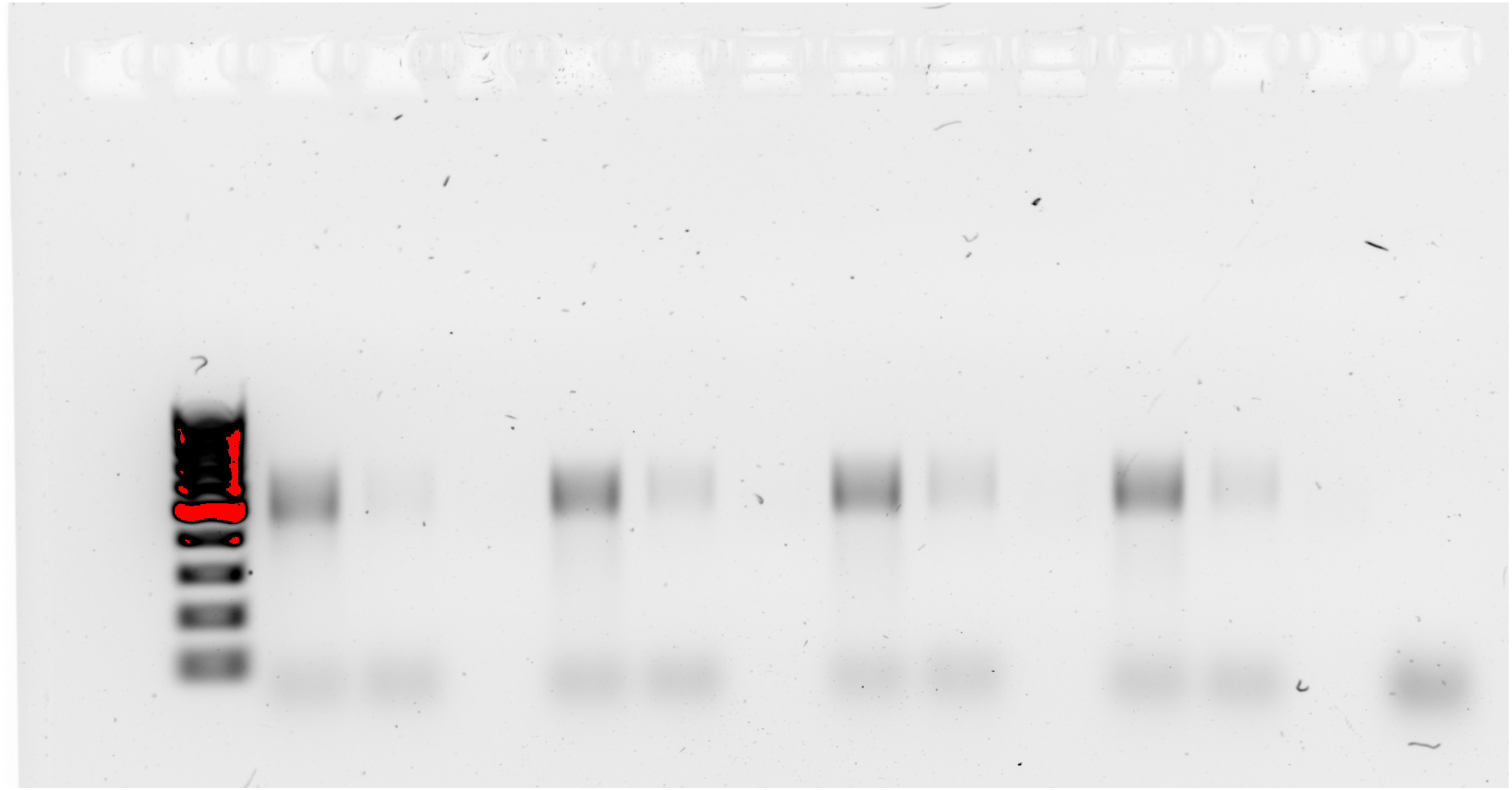
It is important to assess the amplified product in comparison to the template library.
A gel electrophoresis can be used for this.
In a 1.5% agarose gel with 1X TAE, the amplified libraries and the corresponding templates can be run. An amplified product at least twice as bright as the template should be observed.
An example can be seen in the attached image
 Assess PCR amplification.png2.4MB
 Following the determination of the optimal number of PCR cycles a large volume PCR is conducted using the reaction shown under step 17.
The only difference is that multiple reactions per library are prepared. Commonly, 12-24 replicate reactions per library are prepared.
Following PCR amplification, all reactions corresponding to the same library are pooled.
As long as the constructed libraries have unique combinations of inner barcodes and indices can be pooled and sequenced in a single lane. This is a major determinant of the overall cost per sample.
The pool is initially cleaned with the QIAquick PCR Purification Kit for PCR Cleanup as shown in step 12
Typically the pool is eluted to 60 μL with the EB buffer.
Following purification with AMPure XP beads is performed as in step 13.
It is possible to perform purification only with beads. However, since those are typically more expensive, using the QIAquick PCR Purification Kit for PCR Cleanup is a more economical option.
Typically, the final pool is eluted to 30 μL with the EB buffer.
Sequencing library
It is advised to quantify the library with a Qubit fluorometer using HS assay kit.
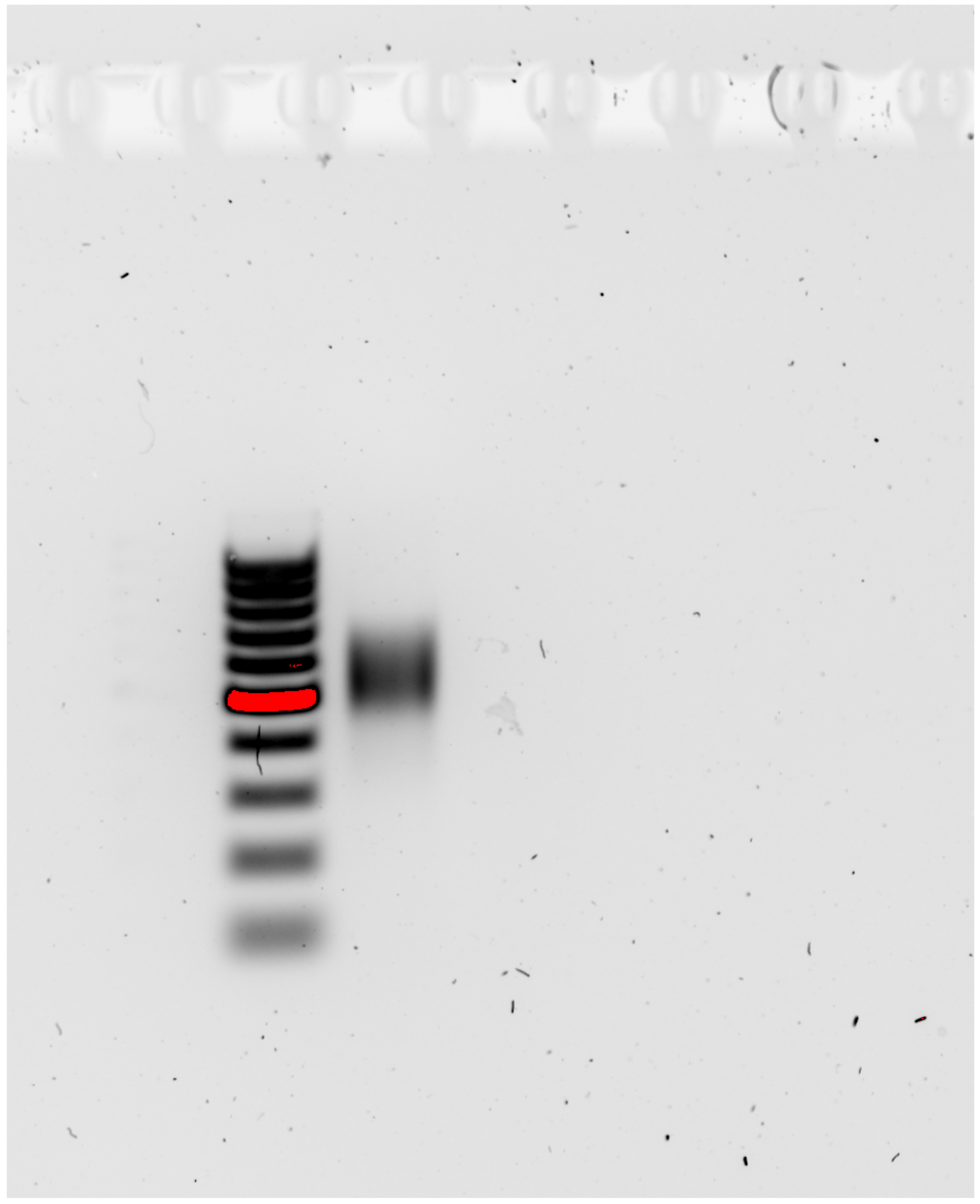
In addition to make sure that the pool doesn't contain primer-dimers the library can be checked through either the Agilent TapeStation or with gel electrophoresis.
An example of a gel image from a successfully sequenced library can be seen in the attached
 Library_for_sequencing.png1MB