Aug 19, 2022
96-well plate R3 desalt and clean up protocol for mass spec analysis
- 1University of Manchester
- BioMS CRF, UoM


Protocol Citation: ronan.ocualain , Staceywarwood , Davidknight , Emmakeevill 2022. 96-well plate R3 desalt and clean up protocol for mass spec analysis. protocols.io https://dx.doi.org/10.17504/protocols.io.dm6gpbnqdlzp/v1
License: This is an open access protocol distributed under the terms of the Creative Commons Attribution License, which permits unrestricted use, distribution, and reproduction in any medium, provided the original author and source are credited
Protocol status: Working
We use this protocol and it's working
Created: July 20, 2022
Last Modified: August 19, 2022
Protocol Integer ID: 67185
Keywords: R3 desalt, 96-well plate, Mass spec analysis, proteomics, plate-based, automation, automatable, beads, peptide desalting, reverse phase, desalting, clean-up, LC-MS, off-line, offline, well plate r3 desalt, protocol for mass spec analysis, mass spec analysis, protocol detail, procedure
Abstract
This protocol details the procedure of 96-well plate R3 desalt and clean up protocol for mass spec analysis.
Attachments

iiaebptmp.docx
173KB
Guidelines
Initial assumptions:
- Allow 60 minutes for R3 desalting, plus 90 minutes time spent drying down time.
- You have digested samples that have no detergents in them (e.g. from S-Trap).
- Samples contain 5 % (v/v) or less organic solvent – dilute samples if necessary.
- 10 µL of the settled R3 slurry approximately corresponds to 10 µg of R3 beads, which should bind and release approximately 100 µL of peptide.
- Sample volume is 50 µL to 200 µL l. If less then dilute with 0.1 % (v/v) formic acid, if more then use multiple loading steps.
Materials
Locate the following consumables:
- 2x Corning FiltrEX desalt filter plates (one to use and one as a balance in the centrifuge)
- 2x ABgene storage/collection plates - one fresh/new, one labelled "wash/waste" should be provided in R3 box in orange workstation tray.
- Mass spec sample vials and caps (blue for samples, red for a pooled sample).
Identify the following equipment that you will use:
- 10 µL or 20 µL pipette
- 1 mL pipette
- Thermo Megafuge 16 with plate rotor fitted
- Eppendorf Thermomixer or Eppendorf plate shaker
Catalogue numbers:
OLIGO™ R3 Reversed - Phase ResinThermo FisherCatalog #1133903
AcetonitrileMerck MilliporeSigma (Sigma-Aldrich)Catalog #34998
Pierce™ 0.1% Formic Acid (v/v) in Water, LC-MS GradeThermo FisherCatalog #85170
Pierce™ 0.1% Formic Acid (v/v) in Acetonitrile, LC-MS GradeThermo FisherCatalog #85174
Methanol Optima™ LC/MS Grade Fisher ChemicalFisher ScientificCatalog #A456-4
Water LC-MS grade B&J BrandVWR International (Avantor)Catalog #BJLC365-2.5
Corning® FiltrEX™ 96-well White Filter Plates with 0.2 µm PVDF Membrane NonsterileCorningCatalog #3504
96-Well Standard MicroplateThermo FisherCatalog #AB0796
Polypropylene plastic screw-top vial 300uL with cap and bonded PTFE/silicone septaWatersCatalog #186002640
Before start
Locate the following buffers and reagents:
| A | B | |
| Location | Buffer/reagent | |
| Bench | 0.1% formic acid in water 50% acetonitrile 0.1% formic acid in 30% acetonitrile Oligo R3 beads in 50% acetonitrile |
Locate the following consumables:
- 2x Corning FiltrEX desalt filter plates (one to use and one as a balance in the centrifuge)
- 2x fresh ABgene storage/collection plates
- Tubes for collecting unbound material (you can reuse sample tubes if desired)
- Mass spec sample vials and caps (blue for samples, red for a pooled sample).
Identify the following equipment that you will use:
- 10 µL or 20 µL pipette
- 1 mL pipette
- Thermo Megafuge 16 with plate rotor fitted
- Eppendorf Thermomixer
- Vacuum centrifuge
Preparing plates
Locate the white Corning FiltrEX 96-well plate you will be using for your peptide desalting.
Locate a new clean ABgene 96 well plate for peptide collection. Label "collection" on it.
There should be a "wash/waste" plate provided in the R3 box in the orange trays.
Note
With a pen, carefully mark on the side of the outside position of the wells, the positions/wells you will be using for desalting. If desalting 8 peptide samples, mark the side of the well for 8 positions. It is recommended you work down the side of the plate, from A to H, on a new row. The purpose of marking the wells that you are using means that it should make it easier for you to track which wells you have used.
Ensure you know which ones you are using (e.g. mark the wells).
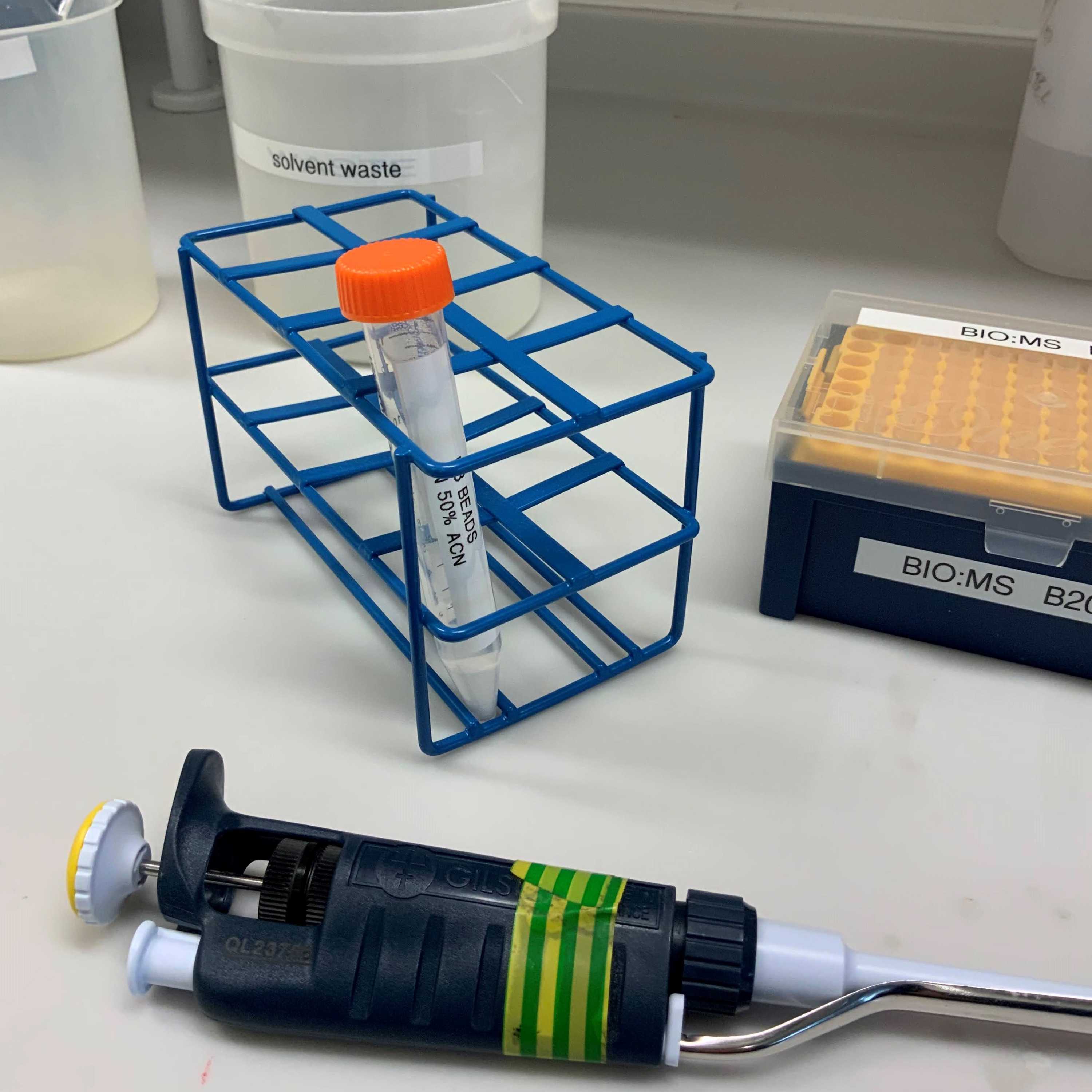
Add 10 µL of the prepared POROS R3 (from the settled beads) to the appropriate number of unused wells the filter plate. If the slurry bed has been disturbed, simply add 20 µL of the bead suspension to each well
Note
Carefully remove 10uL of settled beads from the R3 slurry mix, and add to the plate for each peptide sample to be desalted.
Place the Corning FiltrEX plate with the R3 beads combination on top of the "Wash/waste" plate.
Add 200 µL of 50% acetonitrile to each sample well to be desalted, and centrifuge at 200 x g for 00:01:00 .
Note
Discard the into the temporary "solvent waste" beaker.
1m
Add 200 µL of 0.1% formic acid in water to each sample well to be desalted, and centrifuge at 200 x g for 00:01:00 .
Note
Discard the into the temporary "solvent waste" beaker.
1m
Add 200 µL of 0.1% formic acid in water to each sample well to be desalted, and centrifuge at 200 x g for 00:01:00 .
Note
Discard the into the temporary "solvent waste" beaker.
1m
Load sample and wash beads
Add a maximum of 200 µL of the samples to the plate and beads. Incubate samples on the plate mixer for 00:05:00 at 500 rpm with no heating.
5m
Remove liquid by centrifugation at 200 x g for 00:01:00 .
Note
If you wish, you may save the sample flow through (unbound material) by transferring it to the original sample tube from the wash/waste plate with a pipette.
Alternatively, if you do not wish to keep the unbound material, dispose it in the solvent beaker.
1m
If there is additional sample to be desalted (assuming initial sample volume was > 200 µL ), repeat the previous step.
Wash 1: Add 200 µL of0.1 % (v/v) formic acid, mix for 00:02:00 at 500 rpm ,
and then centrifuge at 200 x g for 00:01:00 . Combine wash with flow through sample if collecting unbound material.
Note
Ensure you are using the correct solution for this step!
3m
Wash 2: Repeat the previous step by adding 200 µL of 0.1 % (v/v) formic acid, mix for 00:02:00 at 500 rpm ,
and then centrifuge at 200 x g for 00:01:00 . Combine wash with flow through sample if collecting unbound material.
3m
Elute peptides
3m
Change the plate below the Corning FiltrEX plate from the "wash/waste plate" to the collection plate.
Elution 1: Add 50 µL of 0.1% formic acid in 30% acetonitrile, mix for 00:02:00 , 500 rpm ,
and then centrifuge at 200 x g for 00:01:00 .
3m
Elution 2: Repeat the previous step.
Add 50 µL of 0.1% formic acid in 30% acetonitrile, mix for 00:02:00 , 500 rpm , centrifuge at 200 x g for 00:01:00 .
3m
The combined elution volumes should be approximately 100 µL . Transfer the combined elution to new sample vials. Label the vials with your initials, and the sample number (it is not essential to record ALL experiment information on the vial, keep this important information elsewhere.
Note
Note
If you wish to prepare a pooled sample, you can do it at this step.
Pooled samples: Only do this if a member of staff has advised you to do so. To prepare the pooled sample(s), -for every 10 samples, remove 9 µL from each into another MS vial labelled “pool”. You will now have 10 samples with 90 µL of sample, and a pooled sample of 90 µL . We will use the pooled sample for QC (quality control). To make it easy to differentiate the “pooled” sample of peptides from the other peptide samples, use a red screw cap instead of a blue cap to close the vial. We will provide you with these caps.
Dry samples to completeness in a vacuum centrifuge.
If you do not have access to a vacuum centrifuge, the peptides will be stable for overnight at 4 °C Any longer than this, and unwanted side chain modifications may occur due to the presence of high acetonitrile.
Note
See facility staff for how to use the vacuum centrifuge to dry peptide samples, or see the section "Using the Thermo SPD1010 speedvac concentrator centrifuge for drying down peptides for LC-MS analysis" that details the procedure). Peptides may be stored in fridge or freezer when dried down.