Apr 18, 2026
3D-printed social place preference assays for aquatic larvae
- Keira Nakamura1,
- Neil Khosla1,
- Max Madrzyk1,
- Lauren O'Connell1
- 1Stanford University
- O'Connell Lab at Stanford



Protocol Citation: Keira Nakamura, Neil Khosla, Max Madrzyk, Lauren O'Connell 2026. 3D-printed social place preference assays for aquatic larvae. protocols.io https://dx.doi.org/10.17504/protocols.io.bp2l6d4y5vqe/v1
License: This is an open access protocol distributed under the terms of the Creative Commons Attribution License, which permits unrestricted use, distribution, and reproduction in any medium, provided the original author and source are credited
Protocol status: Working
We use this protocol and it's working
Created: November 05, 2024
Last Modified: April 18, 2026
Protocol Integer ID: 111548
Keywords: social behavior, tadpole, aquatic larvae, social place preference, aquatic larvae social place preference arena, social place preference arenas appropriate for small animal, behavioral preferences in animal, aquatic larvae, including aquatic larvae, printed social place preference arena, easy animal tracking, easy animal tracking with software, behavioral preference, printed social place preference, animal, small animal, 3d
Funders Acknowledgements:
National Institutes of Health
Grant ID: R56MH133094
National Institutes of Health
Grant ID: DP2HD102042
National Institutes of Health
Grant ID: R01HD110514
Stanford University Undergraduate Major Grant
Grant ID: n/a
Stanford Biology Summer Undergraduate Research Program
Grant ID: n/a
Abstract
Social place preference arenas are commonly used to measure behavioral preferences in animals. Here, we detail 3D-printed social place preference arenas appropriate for small animals, including aquatic larvae. These arenas allow for precise dimensions and easy animal tracking with software.


Materials
3D printerc (e.g., Bambu Lab X1E)
PLA filament
Rhinoceros (design software)
Tadpole water
Tadpoles (e.g., Gosner stages 28-32)
Acrylic, 1/16 inch thickness, to be laser cut
Camera to record assay (e.g., GoProHero7)
DeepLabCut (animal tracking software).
Troubleshooting
Problem
Inconsistent prints
Solution
Ensure filament is consistent in opacity, printers share the same settings if using multiple different models, and printers are regularly inspected.
Problem
Inability to autoclave arenas
Solution
Unfortunately, the low melting point of common 3D printed filaments like PLA prevents arenas from being autoclaved after experience, similar to the pitfalls of working with acrylic arenas. Some filaments have higher melting points, but they are typically more expensive and less commercially available. Ethanol can be used to clean arenas, but if working with PLA, prints should be regularly monitored for damage to the filament to ensure that the print remains watertight and adequate for experiments.
Problem
Acrylic does not fit
Solution
Try designing a few different sizes for the acrylic, as the thickness filament can alter the dimensions. The acrylic walls are easier and faster to design and create than redesigning the whole arena with larger notches. If the thickness of the acrylic is an issue, you will have to make larger notches in the arena and reprint.
Before start
Social place preference assays are ethological tests used to determine the social interactions of animals.
Conducting these behavioral assays with small aquatic animals introduces a few challenges: the space must be able to contain water, be small enough so that the focal animal can interact with its environment but large enough to not be confined to one region, and the assay must be recordable for video behavioral analysis.
3D printing designs can be precisely extruded to create exact replicas of each box, thus controlling the size of space for the stimulus, control, and test subject. This also reduces variability between trials in different boxes compared to models made from acrylic. Additionally, the filament of 3D prints is matte, which eliminates reflections and reduces errors with tracking software. As such, 3D printing serves as an optimal method for creating testing arenas for social place preference assays that are compatible with animal tracking software.
Design of a rectangular arena using precise measurements
31m
Determine the dimensions of the model appropriate for the size of the focal animals. It is useful to sketch the design and record the coordinate points based on the measurements. Ensure there are four notches built into the walls of the model. These will be used to insert a piece of acrylic during the behavioral assay. The notches should be the same depth as the acrylic.
Note
Keep in mind that the walls and base of the box will have depth. Making the depth of the walls equal to that of an acrylic sheet can help make measurements consistent (usually 1.5875 mm ).
Sketch of social place preference arena (by KN). This arena was designed for poison frog tadpoles.
20m
Use a 3D printing software to design the model. In this example, Rhino is used. Open Rhino and select the desired units for the model.
Using the polyline tool, add the coordinates of the outer points of the box determined during step 2. The result should be an outline of a box.
The Rhino interface shows a box drawn by the polyline tool.
1m
Create a wall using ExtrudeCrv to the height determined during step 2. Do not include the height of the base.
The Rhino interface shows walls drawn onto the box using the ExtrudeCrv tool.
1m
Make the walls thick enough for 3D printing and arena stability. Type in OffsetSrf. Flip the arrows so that they are pointing inward by pressing "Flip All," and input the depth of the walls as the "Distance" value.
Make the walls thick enough for 3D printing and arena stability.
1m
Add a base to the box, which is especially important for aquatic animals. The polyline created in step 4 should still exist in the workspace. Select the polyline (step 3) and type PlanarSrf. Then, select the surface and type in ExtrudeSrf. The value should equal the depth of the walls, in the negative direction so it does not overlap with the walls of the box. There should now be a fully enclosed box.
Add a base to the arena.
1m
Add the notches to accommodate barriers halfway into the arena walls. Create a box. Its width should cover the open space of the box, plus the distance required to fix the box halfway into the wall. The barrier box depth should be the same as the depth of the acrylic. The height of the barrier box should be taller than the arena. After finishing one side, repeat on the other arena arm.
Add notches for barriers in the arena.
5m
Subtract the barrier boxes from the arena using BooleanDifference, which creates notches in the arena walls.
Notches are formed by subtracting the barrier boxes.
1m
After completion of the arena design, double check the dimensions and save the file in .stl format. Print on a 3D printer.
The model above was printed on a Bambu Lab X1E 3D Printer.
1m
Design of a circular arena using freehand drawings
15m
An alternative to creating arenas is using a base image in Rhino. Draw any shape that is fully connected and enclosed. This method allows for more freehand shapes, but may be less precise due to lack of measurements. The print itself will still be precise and replicable so long as the file is saved properly.
Base image drawing in Rhino allows freehand design of arenas.
1m
Convert the shape to a surface.
Use merging and smoothing functions to create a surface from the freehand drawing.
1m
Convert the shapes to surfaces using the PlanarSrf function.
1m
Use BooleanMerge to merge all the surfaces into one object.
1m
If surfaces are overlapping, use BooleanSplit to prevent the software from creating empty spaces in areas with overlap.
1m
Run MergeAllFaces for one cohesive surface.
1m
Create the walls of the arena by adding height on the surface.
Create walls on the surface to give the arena height.
1m
Run the ExtrudeSrf function. This will create walls for the arena at the preferred height.
Note
If using ExtrudeSrf with a solid object instead of walls, use Shell to hollow the arena to the preferred depth.
1m
Run OffsetSrf on the walls to the preferred depth, as well as the base of the box.
1m
Go through steps 8 and 9 to create notches in the box before printing.
5m
After completion of the arena design, save the file in .stl format. Print on a 3D printer.
1m
Design of arena barrier walls
10m
Design arena barrier walls to fit inside the notches. Create a polyline in Rhino and ensure that the print width is Hairline for laser cutting.
Design of barrier walls using polyline.
5m
A variety of walls (e.g. solid, perforated) can be designed and laser cut. For example, solid or perforated walls will alter olfactory information while various acrylic types will alter visual information available to the focal animal.
Barriers can be perforated (with holes) or solid to manipulate olfactory information. Acrylic type can manipulate visual information, where animals can see through clear acrylic, but not through black or white acrylic.
Assemble arenas and use them for social place preference assays.
Note
Optional: glue inserts into boxes with rubber cement to ensure everything is water-sealed. Rubber cement is easily removed if different inserts are needed.
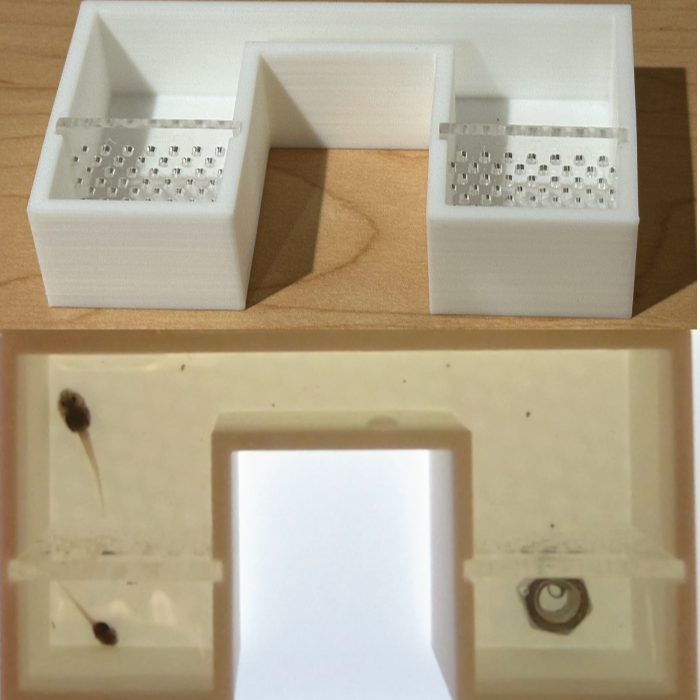
Assembled social place preference arena.
5m
Running a social place preference assay with tadpoles
1h 30m
Set up a camera to record the arena from above. Running multiple assays at a time is possible provided there is enough space or there are multiple cameras.
Assays can be conducted by placing the focal animal to the center of the arena and allowing for 00:30:00 acclimation.
Tadpole acclimating in a social place preference arena.
30m
Add a stimuli to either side of the boxed off areas of the model (bottom of arms). Depending on the experimenter's question, this could be other animals, objects, or odors.
The focal tadpole (top) is interacting more with the stimulus tadpole (bottom left) compared to the asocial control object (bolt, bottom right).
Allow the focal animal to interact with the stimuli for a set amount of time. In our experiments, the assay is 01:00:00
1h
Obtaining behavior counts
Behavior videos can be analyzed in various ways. Common measurements include the time focal animal spends in different regions of the arena, the frequency at which animals switch their regions, and quantification of animal velocity.
Example of how regions in the SPP arena can be split up for analysis.
Different software can be used to analyze behavior videos. Our group commonly uses DeepLabCut machine learning to automate behavior tracking, where Python scripts can be written or modified to determine the number of frames per video that a subject is in different regions of the arena or the velocity of their movement. Alternatively, BORIS can be used to manually annotate instances of a particular behavior and their duration.
Data visualization
An example dataset is shown below. In this experiment, two species of tadpoles were tested in the place preference assay: the brilliant thighed poison frog (Allobates femoralis) and the golden poison frog (Phyllobates terribilis). Tadpole behavior was scored during baseline and then after stimuli presentation, where alarm cue was placed in one arm of the arena while frog water was placed in the other. The time difference score indicates the proportion of time the tadpole spent in the stimulus arm (stim_roi/(stim_roi + cont_roi). Time spent in intermediate zones was excluded.
Data and code are provided as files attached to this protocol.
Example data from a place preference assay where two species of tadpoles were placed in the behavior arena. After baseline (brown), either alarm (yellow) cue or frog water was placed in the arena arms and place preference was scored.
Protocol references
Anneser, L., Gemmer, A., Eilers, T., Alcantara, I. C., Loos, A.-Y., Ryu, S., & Schuman, E. M. (2022). The neuropeptide Pth2 modulates social behavior and anxiety in zebrafish. iScience, 25(3), 103868. https://doi.org/10.1016/j.isci.2022.103868
Dreosti, E., Lopes, G., Kampff, A. R., & Wilson, S. W. (2015). Development of social behavior in young zebrafish. Frontiers in Neural Circuits, 9. https://doi.org/10.3389/fncir.2015.00039
Dulcis, D., Lippi, G., Stark, C. J., Do, L. H., Berg, D. K., & Spitzer, N. C. (2017). Neurotransmitter Switching Regulated by miRNAs Controls Changes in Social Preference. Neuron, 95(6), 1319-1333.e5. https://doi.org/10.1016/j.neuron.2017.08.023
Friard, O., & Gamba, M. (2016). BORIS: A free, versatile open‐source event‐logging software for video/audio coding and live observations. Methods in Ecology and Evolution, 7(11), 1325–1330. https://doi.org/10.1111/2041-210X.12584
Gemmer, A., Mirkes, K., Anneser, L., Eilers, T., Kibat, C., Mathuru, A., Ryu, S., & Schuman, E. (2022). Oxytocin receptors influence the development and maintenance of social behavior in zebrafish (Danio rerio). Scientific Reports, 12(1), 4322. https://doi.org/10.1038/s41598-022-07990-y
Mathis, A., Mamidanna, P., Cury, K. M., Abe, T., Murthy, V. N., Mathis, M. W., & Bethge, M. (2018). DeepLabCut: Markerless pose estimation of user-defined body parts with deep learning. Nature Neuroscience, 21(9), 1281–1289. https://doi.org/10.1038/s41593-018-0209-y
Ogi, A., Licitra, R., Naef, V., Marchese, M., Fronte, B., Gazzano, A., & Santorelli, F. M. (2021). Social Preference Tests in Zebrafish: A Systematic Review. Frontiers in Veterinary Science, 7, 590057. https://doi.org/10.3389/fvets.2020.590057
Acknowledgements
We thank Madison Lacey for animal care.